
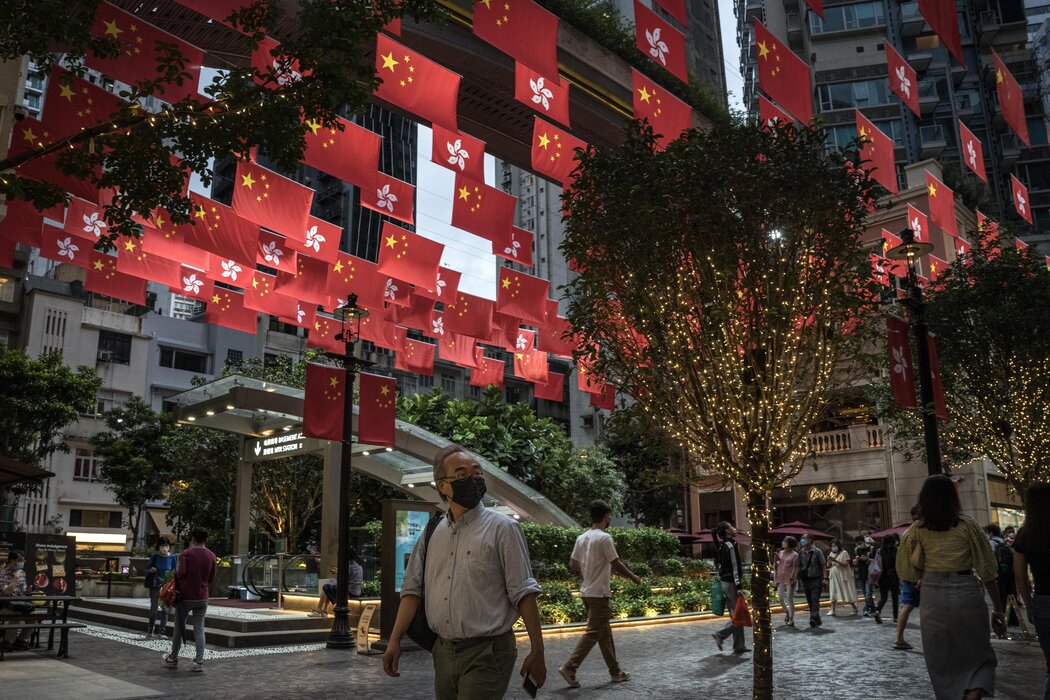
At a moment when political control over Hong Kong keeps tightening, government deficits keep piling up year after year, and an economic winter looms, word has come of a speech by Xia Baolong, director of the Hong Kong and Macau Affairs Office, instructing Hong Kong on how to walk the path of "one country, two systems." Yet Beijing's version of the Hong Kong story, however beautifully worded, not only fails to accomplish anything—at times it actively makes things worse, pushing Hong Kong down a road of no return toward utter ruin.
Xia Baolong's speech is itself a demonstration of "telling Hong Kong's story well"—and, in the process, a demonstration of exactly why that story cannot be told well. He called for institutional innovation under "one country, two systems," for making the most of the advantages of the two systems, and for embodying peace, inclusiveness, openness, and shared prosperity. Every phrase sounds like a benediction, as if urging the governing authorities not to forget their original intent, and reminding them that Hong Kong's version of "one country, two systems" must remain distinct from the mainland's institutions and values.
If that were truly the intent, then why did Beijing go to such lengths in the first place to use the National Security Law to arm the authorities with political violence, sweep away the political opposition, suppress civil society, and choke off freedom of speech? If it genuinely regrets those actions, why doesn't Beijing simply declare that times have changed and immediately restore normalcy on three fronts: first, replacing security-background officials with civilian officials at the head of the SAR leadership; second, restoring genuine representative government; third, repealing the two national-security laws that violate the Basic Law, while guaranteeing freedom of speech, assembly, and association?
A “Patriots-Only” Legislature Has Lost Its Oversight Function—Inclusiveness and Openness Remain Out of Reach
In reality, quite apart from Beijing's exercise of comprehensive jurisdiction, Hong Kong's Legislative Council and even its District Councils have become politically uniform, with every seat filled by government-anointed "patriots." Three years on, the result is that legislators have lost all capacity for oversight, instead lending the government their support in the name of representing public opinion. Some legislators have even said it is difficult even to put political reform on the Legislative Council's agenda—meaning everything will simply stay as it is. How, then, can this achieve the peace, inclusiveness, openness, and shared prosperity that Director Xia is championing?
If Xia Baolong's version of "one country, two systems" does not include institutional guarantees allowing Hong Kongers of differing political views to participate in politics and express their opinions, then this talk of "peace, inclusiveness, openness, and shared prosperity" is really just a synonym for the CCP's standard united-front game: rallying around a pro-Beijing core, co-opting and courting the middle ground, uniting the majority to isolate a small handful of "enemies." Yet the pro-democracy and localist camps that Beijing has singled out for attention have consistently represented close to sixty percent of the public. If the government continues to show its hostility through political prosecutions, harassment of shops, and obstruction of public events, it will only alienate the majority of citizens, ultimately isolating itself and further cementing its image as a minority government.
What Clever Plan Does Beijing Have for Hong Kong’s Economy, Beset on All Sides?
In truth, "peace, inclusiveness, openness, and shared prosperity" is hardly the only one of Xia Baolong's instructions that sets a goal without offering any method. Take institutional innovation: he demands that Hong Kong and Macau actively drive forward construction of the Guangdong-Hong Kong-Macau Greater Bay Area, but which institutions are to be innovated, and how? On "one country, two systems," he holds that the interests of Hong Kong people, the nation, and international investors must all be balanced—but with Hong Kong talent emigrating in droves and foreign capital pulling out in recent years, what contingency plan does Beijing actually have?
Or take his call for Hong Kong to leverage its strengths and reinforce its role of "linking with the mainland while connecting to the world." The trouble is that U.S.-China relations remain tense, with mutual sanctions constantly threatened. What's more, since the National Security Law took effect, Washington has come to view Hong Kong as fully integrated with the mainland and has begun imposing technology and trade embargoes accordingly. With Hong Kong having lost its special status and every one of its advantages, one wonders what clever plan Xia Baolong actually has for keeping Hong Kong connected to the United States.
It would be one thing if Director Xia merely set goals without offering methods—but if Hong Kong is forced to follow national policy to the letter, it needs to guard against efforts that backfire. For instance, should Hong Kong transform into a different kind of international financial center—shifting from helping the mainland connect with Western capital markets to instead specifically serving countries friendly to Beijing, such as Russia, North Korea, and Iran, engaging in financial activities the Western bloc bans (such as financial information services and asset transfers) and commercial dealings (Iranian oil, dual-use military-civilian technology for Russia)—the consequences could be severe. Institutions implicated in such activities have in the past been hit with fines exceeding a billion US dollars from Washington; now, with China and the United States heading toward direct confrontation, the retaliatory measures that could follow are almost unimaginable.
Shenzhen-Hong Kong Research Cooperation May Trigger U.S. Restrictions on High Technology to Hong Kong
Setting aside the strings of empty rhetoric, two of Xia Baolong's ideas are somewhat more concrete—though they would require Hong Kong to shoulder considerable risk. The first is that Hong Kong take full responsibility for building the innovation and technology park in the Loop Area straddling the Shenzhen-Hong Kong border, continuing to play its role as a gateway to the outside world—that is, bringing in foreign technology and capital to advance key mainland research projects. But such a task naturally adds to the SAR government's fiscal burden (more than 30 billion Hong Kong dollars have already been allocated), while it remains unclear how the resulting Hong Kong-mainland research outcomes would actually benefit Hong Kong's economy. What's more, since both mainlanders and foreigners will eventually be able to enter the Loop Area from Shenzhen visa-free—making it effectively indistinguishable from mainland territory—this is bound to arouse American suspicion, giving Washington grounds to cite this integration and further tighten technology-transfer restrictions on Hong Kong. At the same time, one cannot dismiss the risk that scholars taking part in research at the park, if their work involves sensitive American technology, could face countermeasures that further restrict future U.S.-Hong Kong academic exchange.
Finally, Xia Baolong regards the Northern Metropolis project as part of the Greater Bay Area development—another grand offering following Hengqin, the Loop Area, Qianhai, and Nansha—and thus reminds the SAR authorities that the project must be built to a high standard and cannot be handled carelessly. With a single word from a Beijing official, and without spending a single cent themselves, the Northern Metropolis plan was locked into place—remarkably efficient, and a fine demonstration of the superiority of socialism. The trouble, as this column has argued before, is that the whole project delivers poor cost-effectiveness, drains the treasury, and leaves businesses to lose everything they invested. But with the nation's interests placed above all else, who would dare insist that Hong Kong is still operating under the capitalist system explicitly written into the Sino-British Joint Declaration and the Basic Law?