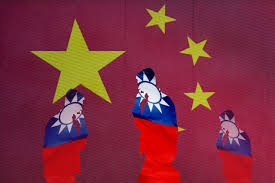
The documentary on CCP united front work by Pa Chiung and Chen Po-yuan jolted the Taiwanese public awake, sparking a wave of anti-communist sentiment across Taiwan and, in the process, thrusting the CCP's United Front Work Department into the spotlight.
When people hear of the CCP's United Front Work Department, many have only a vague notion of it as some department set up specifically to unify Hong Kong, Macau, and Taiwan with the mainland. In fact, that is not what it is. "United front" is short for "united front strategy," a deceptive tactic of struggle. Nor was this tactic invented by the CCP—it was Lenin who first put it forward. At the Fourth Congress of the Communist International in 1922, held under Lenin's direction, the "united front" was formally established as a basic component of international communist policy. In other words, the united front is an essential part of Marxism-Leninism's genetic code.
The precise definition of the "united front" is "an alliance formed, under given historical conditions, in order to oppose the primary enemy, with other revolutionary classes, revolutionary parties and groups, and every force that can possibly be united."
In short, it means dividing your enemies and defeating them one by one. The "united front" is a temporary alliance the Communist Party forms with secondary enemies in order to strike down its primary enemy. Once that primary enemy has been eliminated, one or more of the "allies" within the alliance are then promoted to the status of primary enemy. This cycle repeats itself again and again, until every single "ally" has either been eliminated or reduced entirely to a puppet and plaything of the Communist Party.
For example, the moment Nazi Germany—the common enemy of the United States and the Soviet Union—was defeated, Soviet domestic propaganda made a complete about-face: America, the ally that had helped the USSR defeat the Nazis, overnight became its mortal enemy. Newspapers filled with portrayals of "warmongering, highly aggressive American imperialism." The Soviet Communist Party told its people, falsely, that the United States was about to invade the Soviet Union.
Now consider the Chinese Communist Party. Between 1943 and 1945, its party newspaper, Xinhua Daily, repeatedly ran articles praising American democracy and freedom, declaring its intent to "overthrow the dictatorial Kuomintang reactionaries and establish an American-style democratic system"—thereby winning over American goodwill through deception. In the early stages of the Chinese Civil War, the United States joined the Soviet Union in pressuring the Nationalist government to halt its campaign against the CCP, even suspending military aid to the Nationalist government entirely for a full year. Deprived of ammunition, Nationalist forces saw their combat effectiveness drop by 80%, and morale collapsed along with it. At the very same time, the Soviet Union handed over to the CCP all the weapons and ammunition it had seized from Japan's Kwantung Army and stockpiled in the northeast—enough to equip a million-man army—then gave the CCP all the Japanese weaponry left behind in Korea, and on top of that handed over four billion dollars' worth of American heavy equipment that the U.S. had supplied to the Soviet Union during World War II. By comparison, total American aid to the Nationalist government from 1937 to 1949 amounted to only 3.5 billion dollars, much of which consisted of civilian supplies rather than munitions. So even counting American-made equipment alone, the Nationalist army had less than the Communist forces did—to say nothing of Japanese and Soviet equipment.
Deceived by the CCP, the American government naively believed that cutting off military aid to the Nationalist government would bring the civil war to an end. The opposite happened: that year-long embargo only fueled a continuous escalation of the war—the only difference being that it was now the Nationalist army suffering the crushing defeats. By the time the embargo ended and American representatives went to inspect the state of the Nationalist forces, they found an army whose combat power had collapsed for lack of ammunition, whose morale was at rock bottom, and which had suffered severe personnel losses through one defeat after another; vast quantities of equipment, kept running for years without spare parts, were now beyond repair and fit only to be scrapped. In other words, even if the United States had resumed military aid, it could no longer have reversed the Nationalist army's disadvantage—defeat was already a foregone conclusion. And that says nothing of how the Nationalist government had already been infiltrated internally by Communist spies and fellow travelers (the so-called "democratic parties"), while the CCP kept fomenting protests and strikes in major cities, sabotaging the economy and sowing chaos...
It was precisely because of the enormous role the "united front" played in the CCP's seizure of power that Mao Zedong ranked it first among the Party's "three magic weapons."
But the moment the Kuomintang, the primary enemy, was doomed to defeat, the United States immediately went from being the CCP's admired model to its mortal enemy—so much so that, barely a year after seizing power, the CCP went to war against the United States in Korea.
Consider next the "democratic parties" that helped the CCP undermine the Nationalist government during the civil war. Once the CCP's greatest enemy, the Kuomintang, had been defeated, these democratic parties were automatically promoted to targets of Communist attack. Through the "let a hundred flowers bloom" trap and the Anti-Rightist Campaign, the core leaders and elites of these parties were toppled or driven to their deaths, one after another, until these united-front "allies," who had once aspired to a genuine role in politics, were reduced to mere political ornaments, left entirely at the Communist Party's mercy.
For these united-front "allies," the Communist Party has always had an internal term: "useful idiots." The KGB's internal term was even blunter and uglier: "political prostitutes." That is why the Communist Party has never felt the slightest moral burden—let alone pity—when disposing of these allies.
Today the CCP is directing pro-communist factions in Taiwan to work together against the Democratic Progressive Party. Once the DPP has collapsed, the CCP can seize Taiwan without firing a shot—and then dispose of these "useful idiots" one by one, just as it once disposed of the democratic parties after seizing the mainland.
After Stalin's death, Khrushchev began gradually loosening control over the Soviet people and signaled goodwill toward the West in favor of peaceful competition and avoiding nuclear war, also scaling back the emphasis placed on the united front. The CCP, however, kept insisting on class struggle as its central line, breaking with the Soviet Union and branding it "Soviet revisionist." The implication was that the CCP alone was the true fundamentalist heir to Marxism-Leninism, and it treated the "united front"—this piece of Marxist-Leninist genetic code—as an ancestral secret to be passed down and preserved. This symbolized the CCP's claim to be the sole legitimate successor of the Marxist-Leninist cult. And so, throughout its rise from birth to power, the CCP not only relied heavily on the Soviet Union for funding, equipment, technology, and personnel, but also absorbed the essence of the Marxist-Leninist cult at the spiritual and cultural level. In this sense, the CCP is a purely foreign cult organization—one that has destroyed Chinese culture, massacred and enslaved the Chinese people, and stands as the greatest anti-China force of all. It has turned mainland China into an evil empire, wringing the people's blood and sweat, and exports funding, equipment, technology, and personnel to terrorist organizations and evil regimes around the world, working to build what amounts to a "community of shared destruction for mankind."
The CCP, which once styled itself the orthodox heir of Marxism-Leninism, now dares to fly the banner of "leading the great rejuvenation of the Chinese nation," attempting once again to deceive the people of Taiwan and Chinese communities overseas. What right does it have to represent the Chinese nation?
The Chinese nation has always valued benevolence, righteousness, propriety, wisdom, and trustworthiness. When distant peoples do not submit, one cultivates virtue and culture to draw them near.
The CCP, by contrast, rose to power through deception, struggle, and the slaughter of its own people. It believes the ends justify any means—which is precisely why we hear such ignorant and insane talk as "sacrificing the 200 cities east of Xi'an to fight a nuclear war with the United States."
The Chinese nation has always held reverence for heaven and love for the people, believing in the resonance between heaven and man. Whenever natural disaster struck, an emperor was expected to issue an edict of self-blame, engage in introspection, clear away wrongful convictions, or grant a general amnesty while examining his own failures of governance.
The CCP, in contrast, is arrogant and shamelessly greedy. Whenever disaster strikes, it turns tragedy into celebration, boasting of its triumphant "battle against nature," while officials at every level seize the opportunity to embezzle disaster-relief supplies and funds, profiteering from the nation's misfortune.
The ancient Chinese taught their children to "cultivate the self, order the family, govern the state, and bring peace to all under heaven."
Under CCP rule, elementary school children instead cite "growing up to become a corrupt official" as their life ambition.
The Chinese nation teaches: "Treat the elders in your own family with the respect due to elders, and extend that respect to the elders of others; care for your own children, and extend that care to the children of others."
In the CCP's China, when an elderly person falls in the street, no one dares help them up; when a child goes missing, the police do not even search for them—instead, the moment a body is found, it is seized and cremated immediately to destroy evidence of organ harvesting, with the family forbidden from claiming the body or requesting an autopsy.
…
The CCP's regressive, perverse conduct not only runs directly counter to the cultural traditions of the Chinese nation, but is fundamentally anti-human, and will ultimately destroy all of humanity. At its core, the CCP is the earthly incarnation of the communist evil spirit, the foremost representative of Satan, and the common enemy of the Chinese nation and of all mankind.