
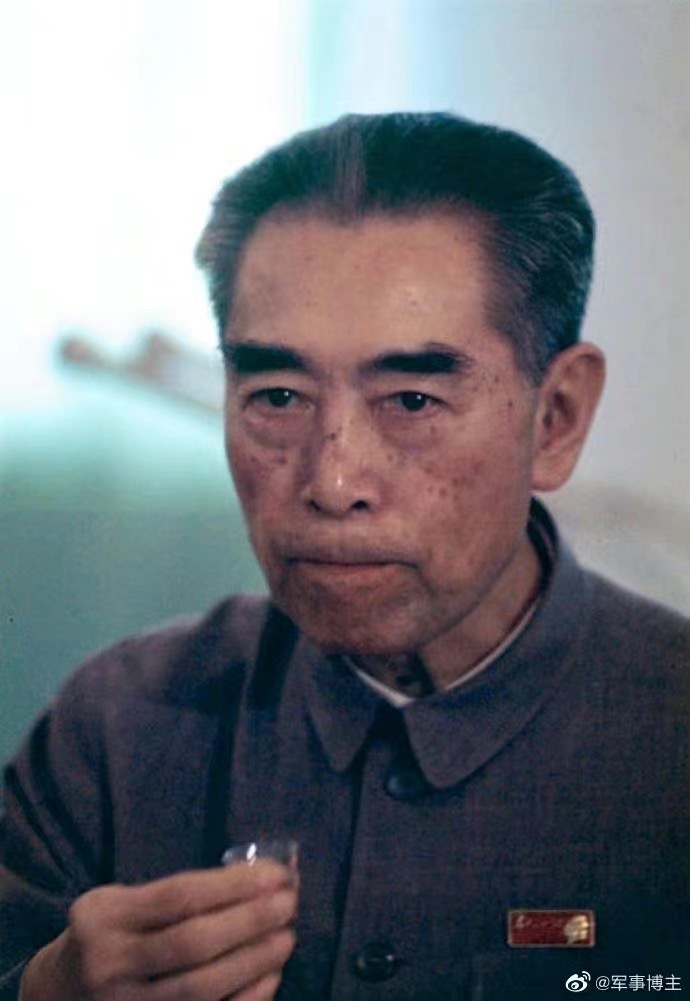
The true, devilish face behind Zhou Enlai — the man the CCP calls ‘the people's good premier’ — keeps being exposed. Zhou once pinned ‘five hats’ on Liu Shaoqi, the CCP's head of state, and also branded Zhu De, former chairman of the National People's Congress, an untrustworthy ‘time bomb.’ Zhou Enlai Pins ‘Five Hats’ on Liu Shaoqi
According to Voice of America, on November 12, 1969, Liu Shaoqi — vice chairman of the Chinese Communist Party and head of state of China — died alone and in misery in a squalid room in Kaifeng, Henan. His body was secretly cremated; the cremation certificate listed him under the name ‘Liu Weihuang,’ with his occupation given as ‘unemployed.’
A year earlier, in October 1968, the Twelfth Plenary Session of the Eighth CCP Central Committee had approved the ‘Review Report on the Crimes of the Traitor, Renegade, and Scab Liu Shaoqi,’ which ‘permanently expelled’ the Party's number-two leader — Mao Zedong's own hand-picked first successor — ‘from the Party, and stripped him of all posts inside and outside the Party.’
Gao Wenqian, a noted scholar of Zhou Enlai, states that the report was read out at that meeting by its very drafter — CCP vice chairman and Premier Zhou Enlai. In the report, Zhou personally wrote the words ‘thief Liu,’ pinning five separate labels on Liu Shaoqi. Zhou also wrote a lengthy endorsement on the file of ‘evidence of Liu's crimes,’ stating: ‘The thief Liu is a great traitor, a great scab, a great renegade, a great spy, and a great collaborator with the enemy — truly a counter-revolutionary guilty of every vice, whose crimes are unforgivable!’
Zhou Enlai Calls Zhu De a ‘Time Bomb’
Zhu De, former chairman of the National People's Congress, had once been hailed by the Chinese people with cries of ‘Long live!’ alongside Mao Zedong himself. In the early stages of the Cultural Revolution, Zhu De came under a barrage of criticism within the Party, accused of harboring ambitions to seize the throne. According to a meeting record in the CCP archives numbered ‘19660523,’ an enlarged session of the Politburo was convened on May 23, 1966, at which Zhu De was subjected to severe criticism.
Zhu De was first ordered to make a self-criticism for his passive attitude toward the denunciation of Peng Zhen, Luo Ruiqing, Lu Dingyi, and Yang Shangkun: ‘I have already made two self-criticisms for my past mistakes. The first was after the Gao Gang–Rao Shushi affair, when I made a self-criticism at a meeting. The second was after the Peng Dehuai affair, when I made a somewhat longer self-criticism at an enlarged session of the Military Commission.’ Zhu De then went on to criticize his own errors concerning the Jinggangshan period in the 1920s and the issues raised at the ‘Seventh Congress’ of the Fourth Red Army.
At the meeting, Zhou Enlai declared: ‘Over these several decades, in Comrade Zhu De's struggle against Zhang Guotao, credit for the first half should go to Comrade Liu Bocheng's efforts in pushing things along. If Liu Bocheng hadn't been there, and you'd had the imperial robe draped over your shoulders, could you have resisted it? Credit for the second half goes to the joint efforts of He Long, Ren Bishi, and Guan Xiangying, which is the only reason the march north happened at all. Without them, you might well have slid off to the west of the river. And since Liberation, there's been plenty more. Chairman Mao has often said you've had a hand in the Gao Gang–Rao Shushi and Peng Dehuai–Huang Kecheng affairs too. Your habit of voicing your opinions everywhere is a dangerous thing, and it makes us uneasy. Having a time bomb like this on the Standing Committee worries Chairman Mao too. You talk carelessly wherever you go. If you want to speak publicly, you need to write out a draft first and discuss it with us. That is why you are unreliable, and why you cannot be trusted.’
Gao Wenqian notes that Zhou Enlai and Zhu De had actually been on fairly good personal terms. But at that meeting, Zhou denounced Zhu De to his face, pointing his finger at him and saying: ‘You are a time bomb planted on the Central Committee's Standing Committee.’