
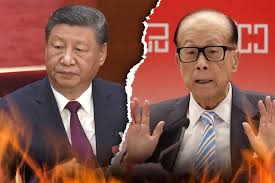
Hong Kong's richest man, Li Ka-shing, through his conglomerate CK Hutchison Holdings, sold 80% of the shares in its subsidiary Hutchison Ports (including a 90% stake in its Panama port operations) to a consortium led by the American firm BlackRock. This move has clearly infuriated Xi Jinping. Official Chinese media in Hong Kong, such as Ta Kung Pao, have run a relentless barrage of attacks on Li Ka-shing — a development that is both startling and, at the same time, entirely logical, and one well worth watching closely.
Over the past several decades, Li Ka-shing has always been one of the iconic figures of China's reform and opening-up. Whether under Deng Xiaoping, Jiang Zemin, or Hu Jintao, none of them ever openly broke with Li Ka-shing — on the contrary, all of them, whether explicitly or implicitly, maintained a kind of “political understanding” with him. This time, however, Xi Jinping has completely broken with him, unhesitatingly unleashing the CCP's mouthpiece media to besiege Li Ka-shing. Why? This is not simply about Li selling off a few ports — it reflects a profound shift in the relationship between the CCP and business, as well as a change in the logic of power under Xi Jinping's rule.
Xi Jinping No Longer Feels the Need to Handle Li Ka-shing with Care
Li Ka-shing is not only one of Hong Kong's most successful entrepreneurs, but also a major investor from the early days of China's reform and opening-up. After Deng Xiaoping launched reform and opening-up, Li quickly moved into the mainland market, investing heavily in China's infrastructure, real estate, ports, and telecommunications — his presence could be found in nearly every major key industry. Deng Xiaoping, Jiang Zemin, and Hu Jintao all understood that Li Ka-shing brought not only money, but, more importantly, the trust of international capital. Even after Hong Kong's 1997 handover, the CCP and Hong Kong's capitalists maintained a tacit understanding of mutual use — you support us economically, and we won't make political trouble for you.
However, this tacit understanding was completely shattered in the Xi Jinping era. After the 2014 Occupy Central movement, Beijing clearly began to doubt the loyalty of Hong Kong's capitalist class, believing their support for the central government was not sufficiently firm. By the time of the 2019 anti-extradition movement, the CCP had become convinced that some segments of Hong Kong's capital were secretly supporting the opposition, and Li Ka-shing himself was harshly criticized by state media over an advertisement featuring the phrase “the melon on a yellowing vine can withstand no more picking.” Even so, over the past several years, Beijing had still not gone so far as to completely turn on Li Ka-shing — after all, his investment empire still spans across China, and a complete break would undermine outside confidence in China's business environment. So why, this time, has Xi Jinping dared to be so tough, directly instructing state media such as Ta Kung Pao to attack Li Ka-shing for “abandoning righteousness for profit” and “selling out the nation's interests”?
The answer is simple: Xi Jinping believes he is now strong enough that he no longer needs to handle Li Ka-shing with any care. In his logic, Hong Kong's capitalist class has already lost its former influence, and the central government is now the true master of Hong Kong. Given this, the old tacit understanding of “political-business compromise” no longer needs to be maintained — Li Ka-shing's “value” is no longer irreplaceable. In other words, this campaign against Li Ka-shing is not aimed at him alone — it is a signal sent to every capitalist in Hong Kong: it is now we who call the shots, and you have no choice but to obediently comply.
Just a few weeks earlier, Xi Jinping had convened a symposium with private entrepreneurs, attempting to reassure China's business community and urge them to invest in order to rescue the economy. This scene actually feels quite familiar. In 2018 and again in 2020, whenever the economy took a downturn, the CCP would come forward and declare that “the private economy is an important component of China's economy,” hoping that entrepreneurs would keep investing, keep paying taxes, and keep creating jobs. But the problem this time is that, even as Xi extends an olive branch to entrepreneurs at the symposium, he simultaneously turns around and has state media besiege Li Ka-shing — isn't that a glaring contradiction? Just imagine: if Li Ka-shing can be attacked today as someone who “abandons righteousness for profit,” what will other Chinese entrepreneurs think? They will surely conclude: “If even Li Ka-shing can be denounced at will, then what about us? If, someday, one of our investment decisions fails to align with Beijing's political needs, will we too be branded traitors to the nation?”
Suppressing Li Ka-shing Is Just the Beginning
More importantly, Li Ka-shing's business empire is, by its very nature, globalized — very little of it truly depends on the Chinese market. But domestic private entrepreneurs cannot simply “pull out” the way he can, whenever they choose. If they invest too heavily, what happens if policy later changes and Beijing decides to squeeze them dry? Under these circumstances, how can Xi Jinping possibly convince entrepreneurs that Beijing genuinely intends to protect the private economy, rather than treating them as a mere cash machine? From Evergrande, to Ant Group, to Li Ka-shing, to the fates suffered by countless private enterprises, the CCP has, time and again over the past several years, shown entrepreneurs that its policies are never consistent — it can turn on anyone at any moment without a second thought. This attack on Li Ka-shing is, once again, a message to every Chinese entrepreneur: do not fantasize that you can buy safety through compromise. There is only one road to real safety — total submission to the Party.
From this episode of Xi Jinping turning on Li Ka-shing, we can draw two conclusions:
First, Xi Jinping no longer feels any need to handle the influence of Hong Kong capitalists like Li Ka-shing with care, and has completely torn away the mask of “political-business coexistence” that persisted for decades. This shows that the CCP's control over capital has entered a far more forceful, far more ruthless phase.
Second, Xi Jinping's policies are wildly inconsistent: on one hand he appeals to private enterprises for investment, and on the other he attacks Li Ka-shing — effectively slapping himself in the face. Going forward, the CCP's crackdowns on capital are likely to become more frequent and more arbitrary, and Li Ka-shing is only the beginning.