
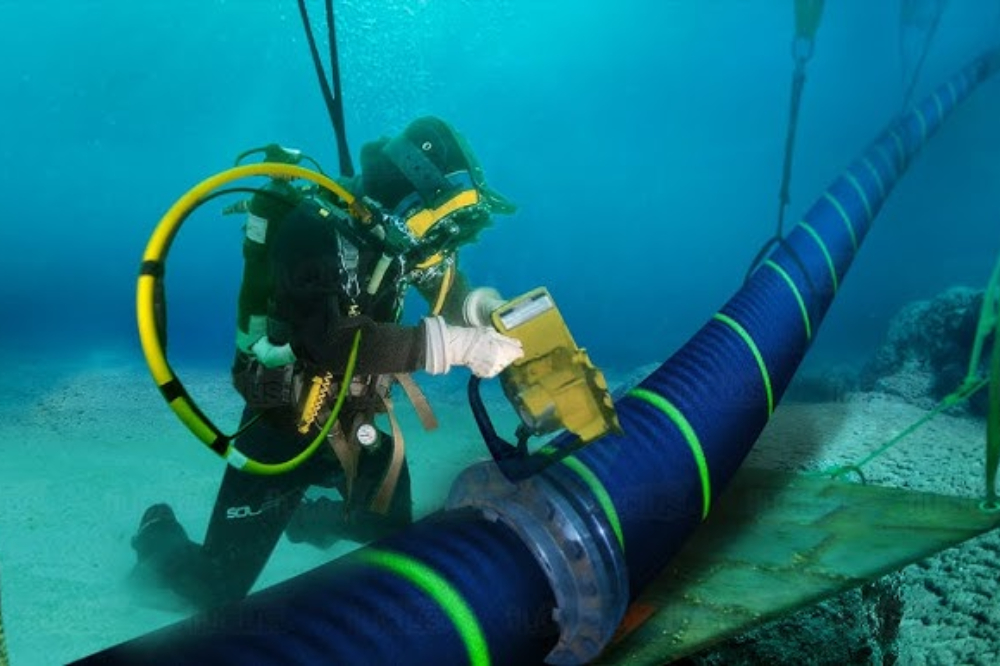
Hong Kong's South China Morning Post reported on March 22, citing a research paper published February 24 in the Chinese-language journal Mechanical Engineering, that China's Ship Scientific Research Center (CSSRC) and its affiliated State Key Laboratory of Deep-Sea Manned Vehicles have developed a powerful deep-sea cable-cutting device capable of severing cables at depths of up to 4,000 meters -- twice the maximum operating range of existing undersea communications infrastructure -- and plan to integrate it with China's manned and unmanned submersibles, including the Fendouzhe (Striver) and the Haidou series.
Boasting of a deep-sea technological breakthrough, revealing a "hidden hand" capable of severing global communications at will
Since 2020, China has repeatedly had undersea cable projects cancelled or rerouted by the United States and its allies on "national security" grounds. These include the U.S. rejecting, in April 2020, the inclusion of Hong Kong in the Pacific Light Cable Network (PLCN); Chile abandoning a Chinese undersea cable proposal in July 2020 in favor of one from Japan's NEC; China's HMN Tech submitting a bid more than 20 percent lower than competitors in 2021 for the East Micronesia Cable project (connecting the Pacific island nations of Nauru, the Federated States of Micronesia, and Kiribati), only for the contract to ultimately go to a U.S.-Australia-Japan consortium; and the 19,000-kilometer SEA-ME-WE 6 cable project running from Southeast Asia to Europe, whose contractor was switched at the last minute in 2022 from HMN Tech to the U.S. supplier SubCom. These outcomes clearly reflect a formidable "undersea cable team" the U.S. has assembled with its allies, repeatedly derailing China's series of undersea cable projects.
Against this backdrop, China's disclosure of equipment capable of destroying critical deep-sea infrastructure carries a strong flavor of retaliation. Although it clings to the tired claim that the device is primarily intended for civilian uses such as cutting abandoned cables and clearing obstacles for mining, the disclosure is more clearly meant to showcase China's advanced deep-sea operational capabilities and engineering breakthroughs -- including its ability to "operate at a depth of 4,000 meters under extreme conditions of 400 atmospheres of pressure," its use of a "150-millimeter diameter diamond-coated grinding wheel spinning at up to 1,600 revolutions per minute, powerful enough to shatter steel while minimizing interference from seabed sediment," and its capacity to "perform precise cutting using a robotic arm with advanced positioning technology even in near-zero visibility" -- all boasting that China's deep-sea equipment has redefined the rules of the deep sea. The report also emphasizes that the device will work in tandem with manned and unmanned submersibles, leaving little doubt about its military deterrence purpose -- aimed at everything from Japan's Okinawa to the Guam base, from the Hawaii command center to Australian military installations, with the ultimate goal of demonstrating that China can, at any moment, sever the undersea-cable-dependent strategic communications network of the U.S. military, intimidating the island-chain defense line and overseas military bases the U.S. takes such pride in, and turning them into isolated information islands because of this device.
Publicizing the device undoubtedly hands adversaries ammunition, intensifying international friction with China
Given that more than 95 percent of the world's cross-border data relies on undersea cables for transmission, these cables function as the information lifeline of every nation. Damaging them could trigger a fatal chain reaction of regional communications paralysis, disrupted economic activity, and even international disputes. Consider the incidents in the Baltic Sea in October 2023 and November and December 2024, when China's Newnew Polar Bear and Yi Peng 3 cargo vessels, as well as the tanker Eagle S belonging to Russia's "shadow fleet," dragged their anchors along the seabed and severed natural gas pipelines and undersea cables -- setting off alarm bells among the surrounding coastal nations of Germany, Finland, and the Baltic states. According to a special report by our National Security Bureau to the Legislative Yuan, an average of seven to eight undersea cable break incidents occur each year over the past three years, many linked to damage caused by Chinese-flagged vessels; in February 2025, the Taiwan-Penghu No. 3 submarine cable was maliciously severed by a Chinese-owned vessel dragging its anchor. These incidents of damage to undersea infrastructure have already raised alarm among multiple countries over "gray zone" operations.
Traditional undersea cable cutting methods require first locating the cable, then dredging it up and cutting it out of the water. As far back as May 2020, China's National Intellectual Property Administration published a patent (CN111203499A) filed by Zhejiang Lishui University for a "towed undersea cable cutting device and cable cutting method." The device resembles an anchor fitted with a cutting blade, capable of directly hooking and quickly severing cables on the seabed without needing an external power supply -- making it low-cost, lightweight, and convenient to use. By 2025, an even more powerful undersea cable cutter had emerged, brazenly labeled for civilian use. Given the CCP's long and disreputable record of deliberately damaging undersea cables belonging to Taiwan and other countries, its publicizing of this kind of "cable cutter" device is striking. At a time when global concern over undersea cable security continues to rise, the emergence of such devices is likely to encourage illegal cable-cutting activity, threaten the stability of global undersea infrastructure, and clearly provoke public safety concerns and challenge the bottom line of international order. If similar gray-zone incidents of cable damage occur in international waters going forward, they will inevitably inflame conflict between the CCP and the international community -- stoking anti-China sentiment worldwide that the CCP will have brought entirely upon itself.