A Brief History of the Chinese Communist Party refers to the bloody crackdown of June 4, 1989, and the fifty days of student protests that preceded it, merely as a ‘political disturbance.’ The Brief History characterizes what eventually became a democracy movement joined by nearly the entire nation as activity ‘instigated by an extremely small number of people’ who opposed Communist Party leadership and the socialist system. As for the massacre on June 4 itself, the Brief History states that ‘the Politburo, with the support of Deng Xiaoping and other veteran revolutionaries, relied on the people’ and ‘took decisive measures on June 4 to swiftly put down the counter-revolutionary riot in the Beijing area.’
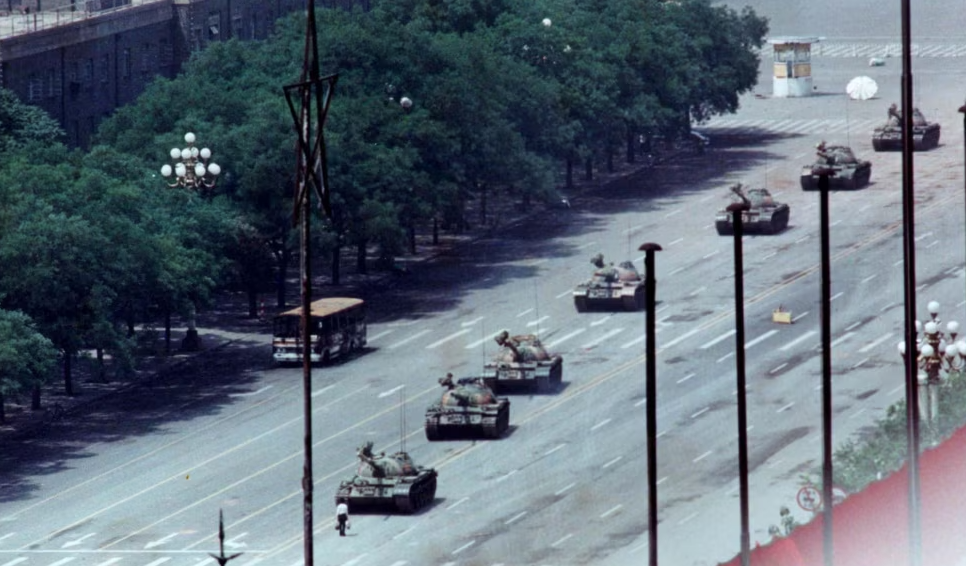
What the Brief History carefully avoids mentioning is that these ‘decisive measures’ consisted of ordering the ‘people's army’ to deploy tanks and machine guns directly against unarmed students and civilians, inflicting massive casualties on innocent people and devastating hundreds, even thousands, of Chinese families. For what is known outside China as the ‘Tiananmen Massacre,’ the Chinese government has never once acknowledged responsibility for its crimes or offered compensation. Instead, it has continually employed every means available to cover up the truth and force victims and eyewitnesses to forget this chapter of history.
Thirty-two years ago tonight, the CCP turned the ‘people's army’ against the people themselves. Thirty-two years later, everyone and everything connected to ‘June Fourth’ still faces suppression. On the Chinese mainland, collective commemorations of June Fourth have all but disappeared, and even private memorial gatherings held by victims' family members are monitored and interfered with by the authorities. In Hong Kong — for thirty years the only place in China where a public vigil for the victims of June Fourth could be held — the annual commemoration has now been banned for two years running. Most recently, Hong Kong authorities forced the closure of the June Fourth Museum on the grounds that it lacked a business license.
That Night, the CCP Used Machine Guns and Tanks to Slaughter Its People
Since its founding, the Chinese Communist Party has always proclaimed that it ‘has always kept the people written on its banner,’ that the bond between Communists and the Chinese people is like ‘fish and water,’ ‘flesh and blood,’ and that its army is the ‘people's army.’ Yet in the early hours of June 4, 1989 — or more precisely, from late on the night of June 3 — the CCP ordered its troops to turn their guns directly on unarmed, defenseless ordinary citizens and students. Hundreds, even thousands, of students and civilians fell under the guns of the ‘people's army.’
At around 10 p.m. on June 3, the authorities issued an emergency notice announcing that martial law troops would forcibly clear the square, warning that ‘if obstructed, the martial law troops may use any and all self-defense measures to remove the obstruction.’ From 10 p.m. on June 3 into the early hours of June 4, troops armed with live ammunition, backed by tanks and armored vehicles, clashed violently with unarmed students and civilians at more than 190 locations across Beijing.
According to research by Wu Renhua, a historian, participant in, and eyewitness to the 1989 democracy movement, the CCP mobilized 19 units — nearly 200,000 troops in all — to enter Beijing and enforce martial law. These included 14 army group armies such as the 38th Army, the 15th Airborne Corps, and an armored division from the Tianjin Garrison.
Wu Renhua personally witnessed the entire process of the military's forcible ‘clearing’ of Tiananmen Square. He saw with his own eyes Chinese soldiers driving tanks that killed people in the street.
In an interview with Voice of America in 2019, he said: ‘A little after 6 a.m. on June 4, I retreated along with about 3,000 fellow students to Liubukou on West Chang'an Avenue. We were walking along the roadside when three tanks from the 1st Division of the Tianjin Garrison fired military tear-gas shells. A 19-year-old female student from the Beijing Institute of Commerce, Gong Jifang, inhaled too much of the gas, which corroded her respiratory system, and she later died. At that same spot, a tank numbered 106 plowed into the rear of the student column, killing 11 students on the spot and injuring many more.’
Wu Renhua says it was this experience that led him to become a historian dedicated to researching June Fourth, vowing to tell the world the truth. He has so far completed three books on the truth of the June Fourth massacre: The Bloody Clearing of Tiananmen Square: Behind the Scenes, The Martial Law Troops of the June Fourth Incident, and A Full Record of the June Fourth Incident.
In 1989, Fang Zheng was a senior at the Beijing Institute of Physical Education, and one of those injured in the ‘Liubukou Massacre’ that Wu Renhua described. That day, both of his legs were crushed by a tank. Fang Zheng told Voice of America that he was walking along West Chang'an Avenue with students retreating from Tiananmen Square when a tank emerged from the smoke of an explosion. He quickly pushed a female classmate who had fainted toward the guardrail at the side of the road, but had no time left to get out of the way himself.
Fang Zheng recalled: ‘I pushed her forward, and then, under the pressure of the tank bearing down on me, in almost no time at all, I was knocked to the ground. I felt as if I were being crushed — I was still conscious enough to feel it happening. I was dragged along the ground, my whole body bouncing and jolting, and then, with a thud, I fell away.’
The CCP has consistently downplayed the massacre by insisting that no one died within Tiananmen Square itself. In fact, a considerable number of people did die in the square. Even more died outside it — with Muxidi and the Xidan intersection on West Chang'an Avenue, the pedestrian overpass south of Tiananmen Square, the Zhushikou and Qianmen areas, and Nanchizi on East Chang'an Avenue believed to be the sites of the heaviest bloodshed and the highest death tolls.
At 6:25 a.m. on June 4, 1989, Radio Beijing International broadcast the following report: ‘Please remember June 3, 1989 — the day the most horrifying tragedy occurred in China's capital, Beijing. Thousands upon thousands of people, most of them innocent civilians, were killed by fully armed soldiers who forced their way into the city. Our compatriots who died include staff members of our own international radio station. Soldiers driving tanks fired machine guns indiscriminately at the countless civilians and students who tried to block their advance. Even after the tanks had cleared a path, the soldiers continued firing indiscriminately into the crowds on the streets. Witnesses say some armored vehicles even ran over infantrymen who hesitated in the face of resisting crowds.’
At the end of the broadcast, the reporter added: ‘The English Department of China Radio International deeply mourns those who died in this tragedy, and appeals to all our listeners: join us in condemning this shameless trampling of human rights and this most barbaric suppression of the people.’
This 80-second broadcast is believed to be the only official news report ever to expose the June Fourth massacre and denounce the actions of the CCP authorities. Its author was later sentenced to four years in prison.
The Tiananmen Mothers, a group formed by mothers of those killed on June Fourth, had by the 30th anniversary compiled information on 202 victims, showing that the youngest was just 9 years old and the oldest 66. Among them were primary, middle, and university students, as well as workers, drivers, engineers, cooks, musicians, demobilized soldiers, and office workers. One daughter was shot dead on her way to visit her recently widowed mother, who was living alone. One student was shot at close range by an officer while trying to mediate a standoff between troops and civilians. Others were killed by gunfire while helping to rescue the wounded, or shot dead by martial law troops simply for taking photographs.
How many people actually died on June Fourth? To this day, the CCP has never released a specific list of the dead or a casualty count, let alone offered any compensation.
In a report titled ‘Compiled Statistics on Casualties in Riots and Disturbances Across the Country,’ submitted to the State Council on July 10, 1990 — the fifth such submission — the Ministry of Public Security stated that 931 people died and over 22,000 were injured nationwide during the 1989 unrest. Of these, 523 deaths occurred in Beijing: 57 Beijing students, 45 Beijing residents, 171 students from elsewhere, 229 workers, residents, and farmers from elsewhere, and 21 people of unidentified status.
These figures, however, differ sharply from estimates from other sources. The Beijing Red Cross's own count at the time put the death toll at around 2,600, with 30,000 injured. Declassified British and American documents later suggested a death toll exceeding 10,000. Historian Wu Renhua, after compiling and cross-referencing data on the routes taken by the various martial law units and records from Beijing's hospitals, has concluded that the Beijing Red Cross figure is likely the most credible.
Dan Southerland, then bureau chief of The Washington Post in Beijing, told Voice of America in a 2014 interview that after the June Fourth massacre, he went to Tiananmen Square and saw bodies piled up at a hospital.
Southerland said: ‘I went to a hospital and asked the doctor to let me in — I knew there were bodies piled up there. By this time the authorities had already begun the crackdown and had issued orders not to let foreigners in, but this brave doctor said, ‘I'll let him in.’ Once inside, I looked at the pile of bodies and realized they were too old to be students — they were ordinary Beijing residents. So we have to remember: among those who died on June Fourth, the largest group was Beijing residents and workers, not students.’
In 2004, military physician Jiang Yanyong — who became known for exposing the truth about SARS in 2003 — revealed in a letter urging China's National People's Congress and the Politburo to reverse the official verdict on the 1989 movement that, on the night of June 3, the emergency room at Beijing's 301 Hospital, where he worked, admitted 89 people with gunshot wounds within a roughly two-hour period from just after 10 p.m. to midnight, seven of whom died despite efforts to save them. In the letter, he also noted that many of the wounds had been caused by ‘dum-dum’ expanding bullets, which are banned under international law.
In the CCP's own account, the 1989 student movement was a ‘counter-revolutionary riot,’ and the martial law troops were forced to fight back because ‘rioters’ attacked soldiers. But historian Wu Renhua, after studying the CCP's own propaganda materials honoring its so-called ‘Guardians of the Republic,’ concluded this to be a lie: the martial law troops opened fire first, and civilians' violent resistance came only afterward.
He said: ‘A total of 15 martial law soldiers and officers died, and only 7 of those deaths were caused by violent acts by civilians. Official records clearly show the cause, location, and time of death for all 15 — and crucially, not one of them died before 1 a.m. on June 4. But martial law troops had already begun firing at 10 p.m. on June 3. The first civilian death I identified was Song Xiaoming, who was shot dead on the sidewalk at the Wukesong intersection at around 10 p.m. on June 3.’
The Protesting Students and Citizens Were Not Anti-Party — They Loved Their Country
In its official verdict on June Fourth, the CCP's Brief History calls it ‘a planned and organized political disturbance opposing the Party and socialism.’ In reality, the overwhelming majority of the protesters, especially the students, had no desire to overthrow Communist Party rule or oppose the socialist system. On the contrary, they simply wanted the Party to push forward with reform and correct its own abuses.
Wang Dan, a leader of the 1989 student movement, wrote an essay in 2010 titled ‘If the 1989 Democracy Movement Had Succeeded.’ In it, he wrote: ‘The students of 1989 never proposed replacing the Communist Party or taking power ourselves — and no matter how the 1989 movement had ultimately unfolded, there was never any real possibility of student leaders becoming state leaders.’
Wuer Kaixi, another student movement leader, told Voice of America on the 25th anniversary of June Fourth that the students' protests had simply aimed to pressure the CCP into making a benign choice. He said: ‘The logic of mass movements is the same everywhere in the world — it's about applying pressure. The whole point of a mass gathering is to turn yourself into a form of pressure. We wanted to pressure our opponent, and we hoped that opponent — the Chinese government — would make a positive choice when faced with that pressure. It's that simple. That's the logic behind every mass movement in the world.’
He also said the 1989 student movement was ‘peaceful, rational, and nonviolent,’ and that ‘at every step, it left the CCP authorities ample room to respond.’ He said the surviving audiovisual footage held overseas alone is enough to prove that the students' demands never included overthrowing the CCP or the government — yet the Chinese government mobilized regular troops and used tanks and live ammunition against unarmed civilians and students who were peacefully expressing their wishes. This fact cannot be covered up, and someone will ultimately have to answer for it.
In the 1980s, despite an ongoing power struggle between reformist and conservative factions within the CCP, China — emerging from a decade of repression under the Cultural Revolution — enjoyed a period of intellectual vitality and open debate. University students, who took their social responsibilities very seriously, held demonstrations nearly every year starting around 1979, in what the CCP referred to as ‘student unrest.’
Before June Fourth, the largest wave of student unrest occurred in late 1986, when university students in Anhui launched large-scale demonstrations demanding democratic elections and an end to corruption; the protests soon spread to universities in Shanghai, Beijing, and elsewhere. The authorities accused this movement of representing the ideological trend of ‘bourgeois liberalization,’ aimed at ‘negating socialism.’
James Mann, then Beijing bureau chief of the Los Angeles Times, told Voice of America in 2020 that the students of that era were patriotic idealists who wanted to see their country improve and hoped to place limits on the Communist Party's power.
He said: ‘The idealism of the 1980s expressed itself as a desire to set new limits on Communist Party power. This was understood as a form of patriotism — that's how those young people, and the intellectuals who supported or guided them, saw it.’
Mann emphasized that these calls for limits on power fell well short of a genuine embrace of Western-style democracy and freedom. He noted that even Hu Yaobang and Zhao Ziyang, the key figures regarded as reformists within the CCP at the time of June Fourth, never spoke of democracy in the sense of democratic elections.
Hu Yaobang was forced to resign in January 1987 after conservatives within the CCP accused him of supporting ‘bourgeois liberalization.’ He died on April 15, 1989. On April 17, students launched mourning activities and demonstrations in his memory — widely regarded as the starting point of the Tiananmen democracy movement.
Mann said the June Fourth movement was, first and foremost, about opposing corruption, cronyism, and the Communist Party's own conduct at the time. The demands of students, and especially ordinary citizens, for freedom and democracy remained fairly vague. Even the ‘Goddess of Democracy’ statue in Tiananmen Square was not erected until late in the protests, on May 30, 1989.
Not one of the seven demands put forward by Peking University students on April 17, 1989, called for opposing the Party or socialism. The students called for a reassessment of the recently deceased former General Secretary Hu Yaobang; a complete repudiation of the campaigns against ‘spiritual pollution’ and ‘bourgeois liberalization’; public disclosure of the income of state leaders and their families; permission for privately run newspapers, an end to press restrictions, and freedom of speech; and a public accounting by government leaders to the nation for their mistakes, among other demands.
On April 27, 1989 — a day after the CCP's official newspaper, People's Daily, published an editorial titled ‘We Must Take a Clear-Cut Stand Against Turmoil’ (known as the ‘April 26 Editorial’), which branded the protests as ‘anti-Party turmoil’ — more than a hundred thousand students in Beijing took to the streets in what became known as the ‘April 27 March.’ The banners they carried read: ‘Peaceful petition, not turmoil,’ ‘Down with bureaucratism,’ ‘Support the Communist Party,’ ‘Support socialism,’ and ‘Uphold the Constitution.’
When students launched a hunger strike on May 13, 1989, they raised just two demands: first, that the government promptly hold a substantive, concrete, and genuinely equal dialogue with the delegation representing Beijing's universities; and second, that the government formally reverse its verdict on the student movement and give it a fair assessment, recognizing it as a patriotic, democratic student movement.
On May 4, 1989, then-General Secretary Zhao Ziyang told a delegation from the Asian Development Bank that the students taking to the streets had no intention of overthrowing CCP rule. He said: ‘They are absolutely not opposed to our fundamental system — they are asking us to correct the shortcomings in our work.’
By openly expressing sympathy for the students and opposing the use of force, Zhao Ziyang incurred the displeasure of Deng Xiaoping, then the CCP's paramount leader. After June Fourth, Zhao was stripped of all his positions inside and outside the Party and placed under house arrest.
Larry Wortzel was assistant army attaché at the U.S. Embassy in Beijing at the time of the June Fourth Tiananmen incident in 1989. In a 2014 interview with Voice of America, he offered further evidence that the civilians who blocked military vehicles to prevent troops from suppressing the students were themselves patriotic and loyal to the government, not ‘anti-Party and anti-socialist.’
On June 2, 1989, Wortzel and a colleague traveled to the Great Wall area and Western Hills on Beijing's northwestern outskirts to investigate reports of local villagers blocking military vehicles to prevent troops from entering the city. While there, Wortzel and his colleague photographed the military vehicles and were accused by a PLA officer of stealing secrets, and were ordered to hand over their film. He said he had assumed the villagers, who were themselves confronting the military, would help him and his colleague keep the photographs — but instead, the villagers sided with the Chinese army and demanded that they surrender the film.
Wortzel said: ‘That surprised me. The villagers said that if what we were doing might affect China's security, then they wanted us to leave, but they wanted us to hand the film over to the officer. In the end, we had no choice but to give it up.’
The ‘People’ Stood with the Students from Beginning to End
The 2021 edition of the Brief History explains the decision to carry out the June 4 massacre this way: ‘At this critical juncture, when the survival of the Party and the state hung in the balance, the Politburo — with the support of Deng Xiaoping and other veteran revolutionaries, and relying on the people — took a clear-cut stand against the turmoil, and on June 4 took decisive measures that swiftly put down the counter-revolutionary riot in the Beijing area.’
In fact, ‘the people’ were never on the side of the CCP authorities in supporting the crackdown. From beginning to end, ordinary citizens sympathized with, and stood alongside, the students. To be precise, this protest movement was initiated by students, and later drew responses from every stratum of Chinese society. On April 23, 1989, the front page of Beijing's Science and Technology Daily reported on the student demonstrations under the headline: ‘The Students' Actions Represent the Voice of a Billion People.’
Over the nearly fifty days that the protests lasted, teachers, intellectuals, journalists, workers, and other ordinary citizens joined in one after another, and demonstrations of various kinds spread to many cities across the country.
Washington Post reporter Dan Southerland told Voice of America years later: ‘One of the remarkable things about the Tiananmen events was seeing a completely different side of Beijing's people. Suddenly taxi drivers were giving students free rides, and students could ride the trains to Beijing for free. Everyone I met wanted to protect the students — they lined up and formed a human wall with their own bodies in front of the armored vehicles.’
On the day of the ‘April 27’ march, tens of thousands of students took to the streets, breaking through layer after layer of blockades set up by Beijing police, the People's Armed Police, and the military, while over a million Beijing residents lined the streets on either side of the marching students, cheering them on to show their full support.
On May 13, 1989, the protesting students launched a hunger strike. Once televised images showed hunger-striking students in critical condition, the student protests turned into something close to a nationwide movement. Multiple hospitals in Beijing, including military hospitals, organized their own emergency response efforts. Beijing residents, government offices, the All-China Federation of Trade Unions, the All-China Women's Federation, and even the People's Armed Police all joined in expressions of support, fundraising, and rescue efforts.
On May 16, 1989, hundreds of thousands of Beijing residents from all walks of life marched in support of the students, while more than 200,000 students from across the country traveled to Beijing to join them. That same day, demonstrations of over 5,000 people took place in 21 cities including Shanghai, Nanjing, Chengdu, and Xi'an. On this day, more than a thousand intellectuals in Beijing jointly signed the ‘May 16 Statement,’ voicing support for the students and criticizing the government's characterization of the movement as ‘turmoil.’ Signatories included the renowned writer Ba Jin, the celebrated poet Ai Qing, and the noted scholar Ji Xianlin.
On May 23, Beijing saw another march of a million people, joined by many from government offices, cadres, cultural figures, and people from the scientific, technological, and industrial sectors, who chanted slogans calling for the resignation of then-Premier Li Peng.
After the CCP declared martial law in Beijing on May 19, residents, workers, cadres, and students spontaneously rushed to major traffic junctions to block soldiers and military vehicles from entering the city. Many also brought soldiers water and food, expressed concern for their well-being, and urged them to lay down their weapons, telling them that ‘the people's army does not fire on the people.’
On the morning of June 3, when troops were ordered to move toward Tiananmen Square, military vehicles were blocked at every major intersection, where residents had erected layer after layer of barricades. That night, even though officials repeatedly urged Beijing residents to stay home, large numbers of people still took to the streets to block the troops' advance and protect the students in the square. No one believed the army would actually open fire.
At the time, most official news coverage of the June Fourth crackdown was also sympathetic to the students. Aside from the Radio Beijing International broadcast mentioned above, the anchors of China Central Television's Xinwen Lianbo evening news program on June 4, Xue Fei and Du Xian, wore black and read the news with visibly grave expressions. Not long afterward, both anchors were removed from the program.
Dissenting voices existed within the military too. Xu Qinxian, commander of the 38th Army, which had been mobilized to Beijing for martial law duty, was the first to refuse orders, and was later sentenced to four years in prison by a military tribunal. Tragically, the 38th Army — stripped of his leadership — went on to become one of the two martial law units responsible for the most killings; the other was the 15th Airborne Corps, the PLA's most elite special forces unit.
Li Xiaoming, a former lieutenant in the 116th Division of the PLA's 39th Army, was the first martial-law officer to come forward publicly about June Fourth. During the 1989 student movement, Li was ordered to accompany his unit from Liaoning to Beijing for martial law duty. He says that because his division commander, Xu Feng, quietly resisted the orders, their unit did not reach Tiananmen Square until the morning of June 5 — a full day later than the martial law order had demanded.
Li Xiaoming later recalled that resistance to martial law within the military had begun even earlier. When the martial law order was issued, some officers who did not want to take part in the operation, or who opposed using force against civilians, deliberately ‘performed poorly’ so that their superiors would send them back to their original posts ahead of time. A smaller number openly opposed martial law and even spread their views within the ranks.
Li Xiaoming said his unit reached the outskirts of Beijing as early as May 22, and he clearly remembers a very explicit order passed down to all soldiers: ‘Whoever fires the first shot will answer to history for it.’ He said that on June 3, his convoy drove slowly and would voluntarily stop, or even reverse, whenever it encountered crowds blocking the road — and was even applauded by the crowds for doing so.
Also among the martial law units, Commander He Yanran and Political Commissar Zhang Mingchun of the 28th Army quietly resisted their orders; both were later demoted and transferred.
Even at the very top of the CCP, members of the Politburo Standing Committee were divided over whether to impose martial law. On May 17, 1989, when Deng Xiaoping proposed to the Standing Committee (Zhao Ziyang, Li Peng, Qiao Shi, Hu Qili, and Yao Yilin) that troops be deployed to ‘impose martial law in Beijing and resolutely suppress the turmoil,’ Li Peng and Yao Yilin agreed, Zhao Ziyang and Hu Qili opposed it, and Qiao Shi remained neutral. Deng was ultimately forced to convene the Central Advisory Commission before the martial law proposal could be pushed through.
Dai Qing, another eyewitness to the 1989 Tiananmen student movement who was imprisoned for nearly a year after the crackdown, wrote in an essay titled ‘Remembering June Fourth,’ published on the Chinese-language website of The New York Times on June 4, 2014, that Deng Xiaoping's martial law order suffered three ‘stunning blows’ in terms of winning over public opinion, the Party, and the military. The first, she said, was the ‘April 27’ mass march that followed People's Daily's ‘April 26 Editorial’; the second was that, after Deng explicitly called for martial law, a majority of the Politburo Standing Committee refused to fall in line; and the third was the outright refusal of orders by the commander of an elite army unit — Xu Qinxian.
The Repression and Reckoning After June Fourth Continue to This Day
The CCP's crackdown on students and citizens who took part in the protests did not end with the massacre on June 4, 1989. In its aftermath, the authorities launched a massive manhunt and investigation that continued into 1990. In a very real sense, the aftershocks of June Fourth are still being felt today.
Starting on June 12, 1989, the authorities first issued an arrest warrant for astrophysicist Fang Lizhi and his wife, whom the CCP regarded as the ‘chief instigators’ behind the students' demands. Warrants followed for 21 student movement leaders including Wang Dan, Wuer Kaixi, Chai Ling, and Li Lu, as well as labor movement leader Han Dongfang and intellectual representatives such as Yan Jiaqi and Bao Zunxin. These individuals later went into exile abroad, one after another.
Twenty days after June Fourth, on June 24, 1989, the CCP Central Committee convened the Fourth Plenary Session of its 13th Congress, formally confirming the removal of Zhao Ziyang, Hu Qili, Rui Xingwen, Yan Mingfu, and others from their posts. Zhao Ziyang's secretary, Bao Tong, was arrested — making him the highest-ranking official imprisoned in connection with the June Fourth events.
Compared to students and intellectuals, the group that bore the harshest CCP repression was the one the Party labeled the ‘June Fourth rioters.’ These individuals — mostly ordinary citizens — resisted the crackdown during the 1989 movement, after troops entered the city, and in the period surrounding the June Fourth massacre, by blocking vehicles, setting military vehicles on fire, calling on citizens to resist, urging workers to strike and students to boycott classes, and obstructing traffic in various ways.
Some of them were executed by firing squad in short order; others received extraordinarily harsh prison sentences. Student leader Wang Dan, for instance, was sentenced to four years, while Lu Decheng, who threw eggs at the portrait of Mao Zedong hanging on the Tiananmen Gate, was sentenced to 16 years in prison.
A chronicle titled A Record of Beijing's Suppression of the Turmoil and Quelling of the Counter-Revolutionary Riot in 1989, published by the General Office of the Beijing Municipal Party Committee, states that Beijing arrested a total of 1,103 suspects accused of involvement in the ‘riot’ following June Fourth.
In the words of the CCP's own Brief History, the June Fourth incident prompted the Party to ‘think more calmly about the past, the present, and the future.’
Naturally, this kind of ‘reflection’ has never included disclosing the truth, taking responsibility, or paying compensation. On the contrary, the CCP has continuously employed every means available to erase the memory of June Fourth. The massacre remains to this day one of the most heavily censored topics on China's internet, and memorial activities held by victims' families are routinely harassed by the authorities. In the past year or two, commemorations in Hong Kong and Macau have also been banned. The CCP appears to have largely succeeded: today, China's younger generation knows almost nothing about the bloody suppression of the democracy movement in Beijing more than three decades ago.
This ‘reflection’ has also meant reinforcing the CCP's one-party dictatorship and growing ever more hostile to universal values like democracy and freedom. June Fourth cut short China's democratic transition in mid-course. Democracy, mass demonstrations, and political reform became red lines the CCP would not allow to be crossed, and the Party simultaneously tightened its control over publishing and the mass media.
Gao Wenqian, a scholar of CCP party history and author of The Later Years of Zhou Enlai, said in a Voice of America television interview marking the 30th anniversary of June Fourth in 2019 that the CCP drew two lasting political lessons from the incident: ‘First, it opened the door to a mode of governance based on maintaining stability through violence. Second, it entrenched a mindset of resolutely stamping out destabilizing factors while they are still in their infancy — what might be called ‘bottom-line thinking.’’
This pattern of ‘stability maintenance through violence’ and ‘bottom-line thinking’ has only intensified under the CCP's current leader, Xi Jinping. In Hong Kong, the CCP has imposed the National Security Law, progressively crushing the city's freedoms; the world's largest June Fourth commemoration, held annually in Hong Kong for thirty years, has effectively been banned. Earlier this month, prominent Hong Kong democracy activists including Joshua Wong were sentenced by the courts to between four and ten months in prison for taking part in last year's unauthorized June Fourth vigil.
In Xinjiang, the CCP has arbitrarily detained over a million Uyghurs; in Tibet, it suppresses the culture and religion of the Tibetan people.