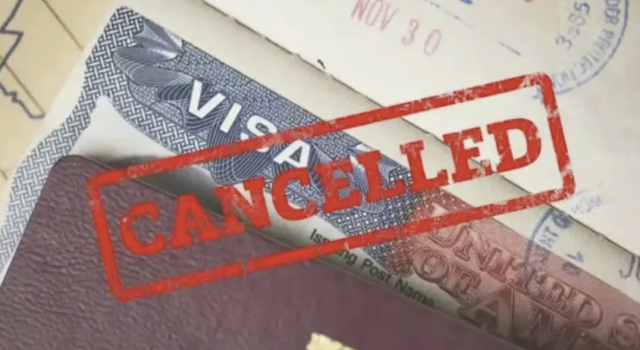
On May 28, US Secretary of State Marco Rubio announced that the United States would begin revoking the visas of some Chinese students, targeting those connected to the CCP or studying in critical fields, and would tighten visa screening for applicants from mainland China and Hong Kong.
This is an unfortunate development for Chinese international students. Why is that? It is certainly not because of hostility toward Chinese students, but rather a countermeasure the United States is taking against the CCP to protect its own security and national interests. At bottom, it is the CCP that has hurt Chinese international students. Although CCP Foreign Ministry spokeswoman Mao Ning claimed firm opposition, protesting that the US move "seriously undermines the legitimate rights and interests of Chinese students and disrupts normal people-to-people exchange between the two countries," the true culprit behind all this is the CCP itself.
As is widely known, the United States has always been known for its openness and freedom. After the Cultural Revolution ended, American universities opened their doors to Chinese students. On December 26, 1978, 52 "pioneer scholars" departed for the United States as the first group of Chinese students to study abroad after reform and opening up began. From then until now, a steady stream of Chinese students has continued to study in the United States. As of the 2023-24 academic year, Chinese students have remained the largest group of international students at American universities, contributing billions of dollars annually to the US economy and reinforcing America's reputation for attracting global talent. Although the number of Chinese students studying in the US has declined somewhat in recent years, Chinese students' interest in studying there remains strong. In the 2023-24 academic year, approximately 277,000 Chinese students were studying in the United States, second only to India.
But it cannot be denied that, even as a steady stream of Chinese students has continued to head to the United States, the crafty CCP has also continuously exploited America's openness and freedom, using, directing, or coercing Chinese students into activities of an espionage nature to serve its own political ends — thereby posing a serious threat and causing serious harm to US national security and interests.
The Stanford Review published an in-depth report on May 7 exposing a long-running CCP espionage network operating at Stanford University, which used tactics such as impersonation and social infiltration to target students researching China-related topics and collect sensitive research information, drawing widespread attention.
The investigation also noted that some Chinese students, bound by the CCP's National Intelligence Law, were required to cooperate with intelligence work, even periodically reporting on their research progress to Chinese diplomatic missions in the US. Some students revealed that if they refused, their families back in China could face financial and political retaliation.
US Secretary of State Rubio told Congress on May 21 that Chinese students — graduate students in particular — are suspected of intellectual property theft, posing a security risk. He said: "It's hard to ignore the fact that a large and recurring number of intellectual property theft cases in business, industry, education, and research have been traced back primarily to graduate students from China."
The House Select Committee on the CCP expressed its approval of Rubio's decision, calling it "exactly the kind of action we need."
In a pinned post on X on Wednesday evening, the committee wrote: "America's student visa system has become Beijing's 'Trojan horse,' granting students unrestricted access to our top research institutions and posing a direct threat to our national security."
In March of this year, the Select Committee also warned six top American universities that the CCP was exploiting student visas and academic relationships to circumvent export controls and steal sensitive research findings.
On Thursday morning, the committee continued to comment on the revocation of Chinese student visas. It said that if the problem is not addressed, this trend would result in "American talent being displaced, research integrity being compromised, and the CCP's technological ambitions being advanced at our expense." It added: "Our campuses must never become a gateway for espionage and the theft of military technology!"
US State Department spokeswoman Tammy Bruce emphasized at a regular press briefing that "the United States will not tolerate the CCP's exploitation of American universities, or its theft of American research, intellectual property, or technology, to strengthen its military power, conduct intelligence gathering, or suppress dissent."
Some analysts believe that the US government's move to revoke Chinese student visas, along with the support it has received across the American political spectrum, reflects a belated awakening within American society after painful reflection. It shows that the Trump administration has clearly recognized that, in order to protect the security of America's institutions and its national interests, it can no longer tolerate the CCP's rampant abuse of America's openness to infiltrate, steal secrets from, and manipulate the United States.
This move also sounds an alarm for international students: whoever serves as a tool of CCP espionage may well be expelled from the United States.
As Secretary of State Rubio has repeatedly emphasized, a student visa is not a right — it is not something you are automatically entitled to. It is a privilege granted by the US government. If you abuse it, of course it can be taken away.