
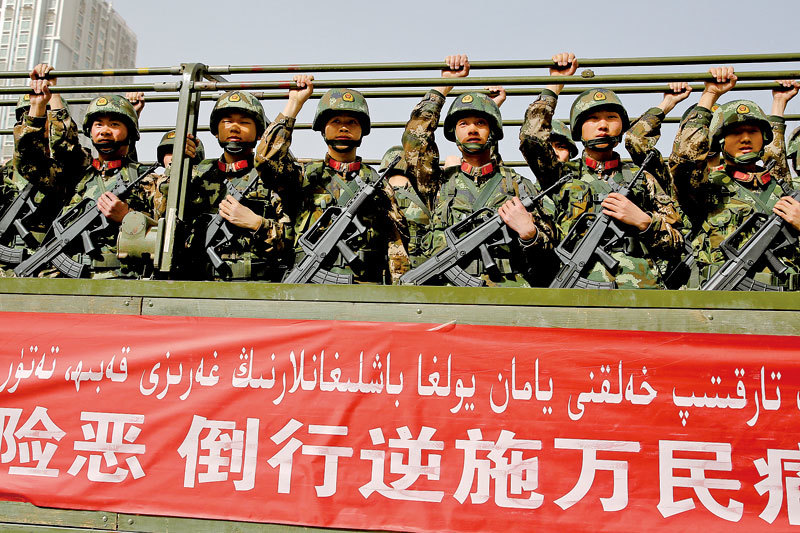
Spanning more than 1.6 million square kilometers, "Xinjiang" has always held multiple meanings for China. Over the past decade, especially through the promotion of the "Belt and Road Initiative," it has become more than just a vast frontier region with rich geological features and stunning landscapes. Large industrial parks and economic cooperation zones have sprung up one after another, the world's largest solar power plant has appeared, and desert oasis projects are proceeding at full tilt — just as official propaganda puts it, Xinjiang is becoming a Shangri-La where the modern and the ancient converge.
The "new Xinjiang" has now become a model of rural revitalization under CCP rule, even more qualified than Shanghai to "tell China's story well." Not long ago, Xinjiang's authorities unveiled an ambitious tourism plan, aiming to welcome more than 400 million visits by 2030. The plan claims it could generate one trillion yuan (US$140 billion) in revenue for Xinjiang, but "money" is secondary — what they truly care about is "tourists," because what the CCP needs most urgently is people to bear witness to the "Xinjiang miracle." Since the pandemic began to ease two years ago, Xinjiang has suddenly become a pilgrimage site for internet influencers from many countries, each insisting they personally witnessed "the real face of Xinjiang" and marveling at this microcosm of high-quality development before their eyes.
But 10 or 20 years ago, the atmosphere for tourism in Xinjiang was not like this at all. At that time, although Xinjiang's scenery was magnificent, many tour operators would specifically warn group travelers to "stay away from unfriendly locals." Anyone who traveled in Xinjiang back then could easily sense the unwelcoming looks that local residents gave to outsiders. Most outside tourists assumed this was simply the Uyghurs' xenophobia at work, and so they separated Xinjiang's scenery from its people — praising the beautiful views while ignoring the presence of the "hosts."
But was that really the Uyghurs' problem? In 2019, a BBC investigation exposed the "brainwashing education" the CCP was carrying out in the region. What had once been rumor — the existence of "Xinjiang re-education camps" — was finally confirmed as fact. Unable to deny their existence, the CCP repeatedly claimed the camps were "purely for combating extremism," attempting to obscure the ideological indoctrination, transformation, and punishment inflicted on Uyghurs inside them.
In fact, as early as around 2016, human rights organizations and Western media had already begun investigating how the Chinese government, under the pretext of a crackdown on terrorists (mainly targeting "those who sought Xinjiang's independence"), was carrying out mass arrests of Uyghurs. It was through tracing the hundreds of thousands of adults detained after opaque trials that the inner workings of the re-education camps were finally uncovered. Afterward, sensing that things were taking a dangerous turn, scholars, journalists, and human rights groups established a series of organizations and publications outside China devoted to Xinjiang human rights, relaying to the world the CCP's persecution of Uyghurs. At the same time, more and more Uyghurs who had fled Xinjiang began speaking out about the little-known suffering back home.
To put it plainly, the whole of Xinjiang is one giant re-education camp. First, the CCP has not only ordered kindergartens, elementary schools, and middle schools across the region to fully implement Mandarin-language instruction, but has also banned Uyghur teachers and students from using their mother tongue on campus. Second, beyond instilling communist ideology, it requires Uyghurs of Islamic faith to adopt Han Chinese traditional customs, forcing them to celebrate the Dragon Boat and Mid-Autumn festivals. Furthermore, not only has it introduced traditional Han foods (such as eight-treasure porridge) into Xinjiang, but most alarmingly, it no longer respects the Uyghurs' religious prohibition against eating pork. One of the CCP's "modernization" projects in Xinjiang has even been the large-scale construction of pig farms.
One account after another, Uyghurs who fled Xinjiang have testified to their unhappy experiences back home. Some describe being taken by colleagues to a Han Chinese restaurant and forced to sample the house specialty — braised pork knuckle — precisely because the "re-education camp" loomed as a threat, and who would dare refuse? Some were even deliberately forced to eat pork on Fridays (the Muslim holy day), leaving them feeling immense shame and guilt.
Today's Xinjiang is, of course, entirely the CCP's own creation — except that its methods have essentially drained an entire generation of Uyghurs of their spiritual and intellectual identity, perfectly constructing a picture of ethnic harmony. Now it can almost be guaranteed that any tourist visiting Xinjiang will no longer sense "hostility from the locals." How many of them have already been "brought to heel" through another CCP scheme — the "homestay" program that forces them to live together with Han Chinese families?
That's right, Xinjiang truly can "tell China's story well" — but how much of that story is composed under duress, with Uyghurs forced to write the script? It is already regrettable enough that foreign influencers, chasing profit, turn a blind eye to the causes of Xinjiang's transformation. Now, the well-known Taiwanese writer Chang Man-chuan has posted a short essay that appears to give an even-handed account of a Xinjiang public restroom. Such a breezy, understated depiction of a corner of ordinary life in Xinjiang is, in fact, all the more shocking.
Angela Ackerman, founder of the writers' platform One Stop For Writers, once expressed her hope for the platform she created: that through writers' pens, readers might be inspired to think more deeply about the world, and that the stories and words writers create might help marginalized groups escape unfair treatment, even rallying "fans" to lead change.
Granted, not every writer needs to become this kind of humanitarian (human-rights advocate), but believing that "life goes on placidly after the iron fist has passed" is itself a form of placidity — one that stands in complete opposition to what Ackerman envisioned a writer to be.
The real point of Chang Man-chuan's post is not how she used plain language to describe a Xinjiang public restroom, but rather what she specifically noted at the end: that she has never done paid promotions or endorsements, has never accepted resources from any political party; please don't pin any other label on her; she belongs to her own party, for the record — all accompanied by a beautiful stream meant to cleanse the soul.
Isn't her act of "clearing her name" really a case of protesting too much? If she was so relaxed and carefree in writing about a Xinjiang restroom, why did she feel the need to state her position again and again? Clearly, she is not unaware of what has happened in Xinjiang, and yet she still chose to write an account of Xinjiang that touches nothing sensitive at all — a post that leaves any reader who reads it twice unable to hold back tears for the Uyghurs.