
He was an active-duty soldier who had just completed a mission before he vanished.
She was an ordinary schoolteacher who disappeared into thin air along with her husband and child.
"They were a family of five. The last images of them were captured on the security camera outside their front door."
"Later, even the parents who livestreamed their search for them disappeared too."
On June 17, active-duty soldiers Huang Manhong and Liu Yong from Jingjiang, Jiangsu, mysteriously lost contact at a bus station. Douyin blogger "Ziyu" posted an appeal: "Calling on the whole network to help find our missing comrades."
Recently, numerous Douyin bloggers have posted videos claiming that "more and more people are going missing now," with the disappeared ranging from infants, elementary and middle/high school students, to college students, and even discharged and active-duty soldiers.
Wang Qishuo, a 25-year-old discharged soldier from Nantong, and Zhang Jiayao, a 22-year-old discharged armed police officer from Bozhou, went missing one after another. Lu Zengrui, a 30-year-old discharged soldier from Hebei, disappeared in January; Feng Shirong, a discharged soldier from Xinghua, Jiangsu, lost contact in May. Hua Caicheng, a 21-year-old firefighter from Neijiang, Sichuan, went missing after leaving home on March 11. One blogger, in shock, remarked: "Even people who served in the military can go missing — what hope is there for ordinary people?"
This shows that in this country said to be "the safest in the world," more and more people are quietly vanishing from reality like grains of sand. Their names never make headlines, nor are they placed on police watch lists — as if they had simply disappeared into one silent "black hole" after another, as though they had never existed at all.
This is not a horror novel — it is the real picture of China today.
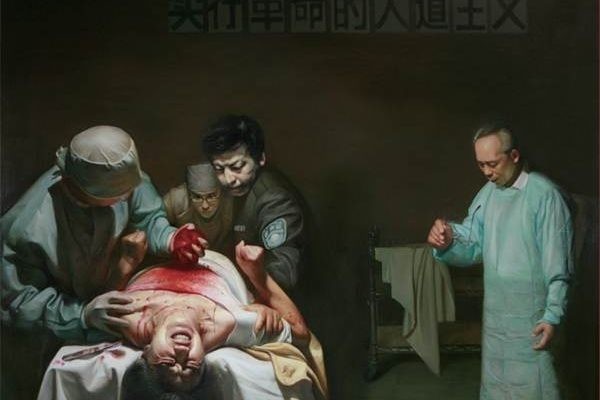
In the past, we assumed that only Falun Gong practitioners, prisoners of conscience, dissidents, and young Uyghurs could become victims of forced organ harvesting. But now, even active-duty soldiers, firefighters, college students, ordinary families, and even infants are going missing time and again — sometimes entire families vanish without a trace.
What does this tell us?
It shows that forced organ harvesting has expanded from targeting specific groups in the past to a much broader, random hunt. The criminal networks behind it no longer "pick and choose."
You think that as an obedient citizen you can rest easy? You think that by staying out of politics you can protect yourself? You think you're just a nobody, not worth anyone's attention? You're wrong.
As long as you have a beating heart, a pair of healthy kidneys, or a strong pair of lungs in the prime of life — you are already worth something.
More terrifying still, "killing on demand, precise matching, silent disposal" — forced organ harvesting has evolved into the darkest, coldest industrial chain in China today.
Images circulating on social media of "mobile health-check vehicles, mobile surgical vehicles, and mobile cremation vehicles" have revealed just the tip of the iceberg of this industrial chain — they operate like a roving "mobile slaughter unit": drawing blood to build a database, harvesting organs on-site, and cremating the evidence, leaving no trace behind. Modern technology combined with totalitarian rule has turned the process of "live organ harvesting" into something industrially efficient and coldly mechanical. One internet user exclaimed in shock: "They've achieved a complete one-stop organ-processing assembly line."
Some analysts point out that since 1999, the CCP has turned forced organ harvesting into an economic and diplomatic weapon — first establishing a "living organ bank," then extending the practice to the re-education camps in Xinjiang. Now, it has even built a nationwide "green transport corridor" capable of harvesting the organs of any chosen Chinese citizen at any time.
As one internet user put it: "Forced organ harvesting — today it's him, tomorrow it could be you."