
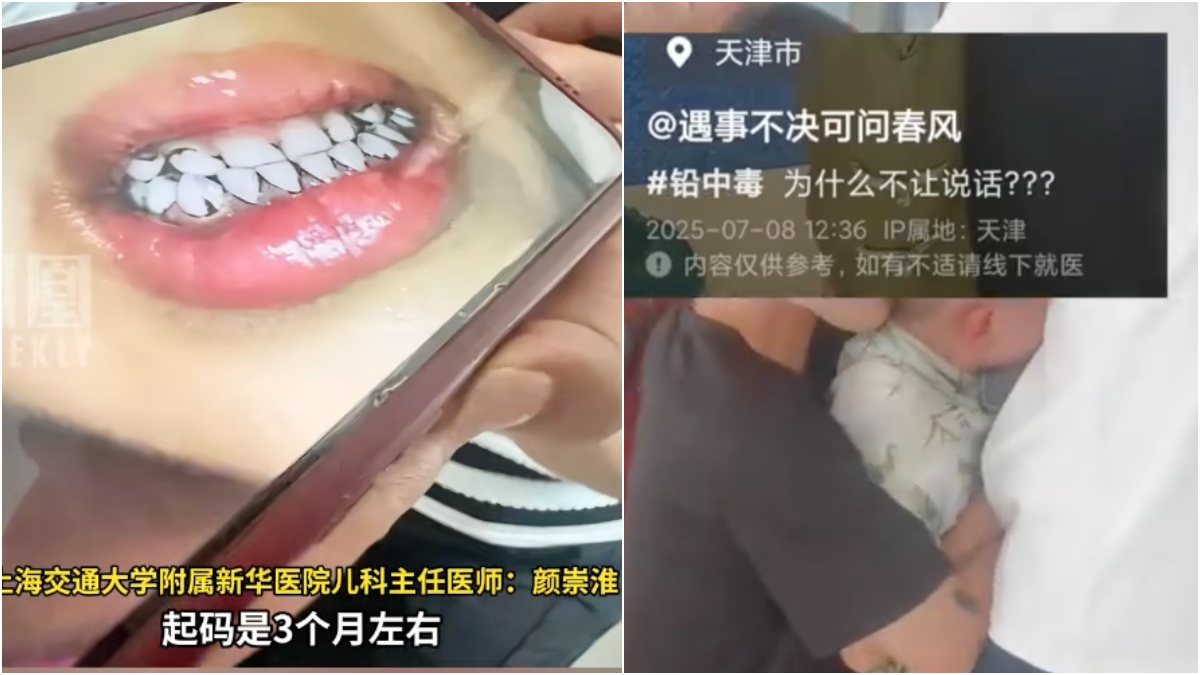
Every parent wishes for their child to grow up healthy and happy. But in China, it is hard to be a parent, and hard to be a child. In early July, heartbreaking news reached countless Chinese parents from Tianshui, Gansu Province: more than 200 children at a kindergarten called Heshi Peixin (also known as Gansu Tianshui Kindergarten) were found to have elevated blood lead levels, triggering nationwide attention and public outrage.
I. Parents Have Nowhere to Turn to File Complaints or Demand Accountability
Some parents reported that their children showed visible symptoms such as weak legs, fever, blackened teeth, and hair loss. Medical experts point out that elevated lead levels can also cause neurological symptoms in young children, including declining memory, delayed language development, and in severe cases, brain damage -- with the younger the child, the greater the harm. After the incident came to light, angry parents began gathering outside the kindergarten to demand an explanation. One parent said tearfully: "If the problem had been detected earlier through testing, would this have happened? The relevant authorities must be held accountable."
In addition, some parents of affected children said they wanted to take their children to the larger city of Xi'an for examination and treatment. But Tianshui city officials threatened the parents, saying: "If your child is treated in Xi'an, you will have to pay out of pocket. If you want free treatment, it can only be done in Tianshui." One parent revealed: "Certain Tianshui officials called parents with so-called 'sympathy calls,' claiming that the test data from Xi'an hospitals were inaccurate."
Some parents had originally planned to take their children to Xi'an for testing. But after hearing that Tianshui city government officials had personally gone to block the entrance of hospitals in Xi'an to interfere with the children's testing, some parents simply took their children all the way to distant Tianjin to have their blood lead levels tested instead. Another parent posted a video of their own child crying and screaming during a blood draw, saying that they weren't allowed to speak out online, and asking who would be held responsible now that they had two children affected. One parent of a lead-poisoned child posted a video showing blood lead test reports for the same tests done at a local Tianshui hospital and a Xi'an hospital, with results that differed drastically -- raising serious doubts among the public about the authenticity of the test data.
Ordinary people all know that in China, whenever an incident occurs that might implicate local officials in responsibility, the local government will go to every length to suppress the news, and then apply intense pressure on the victims, in order to make the big problem small and the small problem disappear.
This kindergarten lead-poisoning incident quickly escalated -- it was not only parents from the affected Heshi Peixin Kindergarten demanding an explanation, but parents from other kindergartens in Tianshui also took action. Parents from Weibei Kindergarten, which shares the same owner as Peixin Kindergarten, gathered at the kindergarten's entrance, demanding that the kindergarten give parents an explanation before they would send their children back.
II. Kitchen Food Coloring Cannot Cover Up the Truth
Just as the Tianshui kindergarten lead-poisoning case was becoming a nationwide hot topic, with people demanding to know who should be held responsible, an undated "surveillance" video surfaced online showing kitchen staff adding brightly colored powder to flour to make yellow corn-shaped buns and multi-colored jujube cakes layered in green, pink, and other colors. As soon as this video appeared, a great deal of public opinion pointed the finger of blame for the children's lead poisoning at the kindergarten's kitchen staff. Some people even claimed that the kindergarten had purchased "painting pigments" online to make the food look appealing to parents, kneading them directly into dough that was then steamed and fed to the children. State media then joined in, and the local government swiftly took action: the Tianshui Public Security Bureau detained several people connected to the case, including the kindergarten's director and its main investor, to investigate them on suspicion of producing toxic and hazardous food.
Just as officials were steering public opinion, misleading people into believing that the kindergarten's use of "painting pigments" was the cause of the children's lead poisoning, some internet users raised doubts: painting pigments cost far more than food coloring, so who would give up cheap food coloring in favor of expensive toxic pigments? Sharp-eyed internet users also noticed, from the surveillance video, that what the kitchen staff were actually using was indeed food coloring, not expensive painting pigments. Many members of the public quickly realized that someone was likely controlling public opinion, muddying the waters, and trying to cover up the truth. This food-safety scandal exposed not only gaps in local management but pointed to a deeper environmental problem. From the innocent cries of the children, to the parents' furious accusations, to the silence of the kindergarten's management, the response of local government, and the countless members of the public continuing to ask "where is the truth, really?" -- public opinion kept intensifying. People questioned whether this matter would be limited to investigating just a few individuals within the kindergarten. The affected kindergarten sits less than a few kilometers from a lead-zinc ore transfer station -- why aren't the authorities investigating these environmental factors?
In fact, as far back as 2006, Tianshui had already drawn nationwide attention over a lead-poisoning incident, when more than 200 people were likewise found to have elevated blood lead levels. Officials never ultimately disclosed the cause of that disaster either, but at the time, it was already revealed that a nearby lead-zinc smelting plant was discharging large quantities of waste, causing long-term contamination of the region's soil and air. Environmental and public-health experts point out that lead contamination can enter the food chain through multiple pathways, including air, soil, and water infiltration, posing a long-term threat to human health -- with young children, whose bodies are not yet fully developed, especially vulnerable.
Internet users kept digging up more worrying details and points of suspicion: the kindergarten is only about a 10-minute drive from the Tianshui lead-zinc transfer station operated by the state-owned enterprise Baiyin Nonferrous Group, raising strong suspicions about surrounding environmental pollution; and there was a clear discrepancy between the children's blood lead test results from Xi'an and Tianshui -- the Xi'an results were much higher, while the Tianshui figures were lower. One parent questioned: "The two results can't both be correct -- clearly, one of them must be falsified."
More shocking still, several teachers were also found to have elevated blood lead levels, yet were forbidden from receiving hospital treatment. One teacher publicly cried out: "Not allowed to be hospitalized, not allowed to be treated -- what does this even mean?" It is said that local authorities not only refused to let the lead-poisoned kindergarten teachers be hospitalized, but also dispatched plainclothes police to prevent any non-official personnel from reporting on the matter. The public has come to realize that the government's entire apparatus for suppressing the exposure of the truth has already swung into action.
For the victims of lead poisoning in Tianshui, making their voices heard is no easy task, and obtaining the truth is even harder. As for suing the government or the company, that is not even worth contemplating. The only thing they can do is wait for the CCP government's so-called investigation results -- and will the CCP authorities even cover the children's future treatment costs? The way this lead-poisoning case has been handled bears a striking resemblance to the 2006 incident: "both the government and hospitals concealed villagers' elevated blood lead levels and altered test reports, the offending company's rectification efforts were merely for show, and accountability was carried out hastily only under public pressure."
III. Reflections Amid the Crisis
1. Local Government in Michigan, USA, Admits Its Mistake and Thoroughly Corrects It
In 2014, a lead-poisoning crisis broke out in Flint, Michigan, affecting approximately 100,000 people, including about 9,000 children. Unlike the CCP's approach of "covering up the crisis," American media fully exposed the truth of the incident, and the public had the right to sue the government, hospitals, and companies through legal channels, ultimately winning compensation.
The crisis originated when the local government, in order to cut costs, switched the water supply from Detroit to untreated water from the Flint River. As a result, the aging lead pipes corroded, allowing large amounts of lead to leach into the water supply. In 2015, pediatrician Dr. Mona Hanna-Attisha published research showing that children's blood lead levels were seriously elevated, drawing attention across the entire United States.
In 2016, the state government urgently switched the water source back to Detroit and launched a lead-pipe replacement project costing hundreds of millions of dollars. In 2020, a U.S. district court approved a $641 million settlement, with compensation to be paid jointly by the state of Michigan, the city of Flint, hospitals, and the engineering companies involved. About 60 percent of the settlement funds were allocated to minor children, with the entire compensation process supervised by the federal court to ensure transparency and fairness.
In America's lead-poisoning case, no one was suppressed or "disappeared" for exposing the truth. The media, experts, and the public exercised their oversight rights within the system, ultimately driving corrective action and compensation. This also shows that genuine accountability systems and judicial independence can prevent such tragedies from happening again.
2. Communist China Sings "Our Party Is Always Correct," Refusing to Fix the Root Problem and Consistently Shirking Blame
As mentioned earlier, whenever a crisis or disaster occurs in China, the CCP's standard practice is to go to every length to suppress the news, then apply intense pressure on the victims. Official propaganda from the CCP in Tianshui, Gansu, misled the public into believing that the kindergarten's use of "painting pigments" caused the children's lead poisoning. After shirking responsibility and finding a scapegoat, the authorities either turn the tragedy into a celebration of their own "success," or continue singing the tune that "our Party is always correct." People either grow accustomed to this and drift along with it, or simply keep their heads down to stay safe. So what happens going forward? Will something like this happen again? This is not needless worry -- it is a real, concrete problem.
The Gansu kindergarten lead-poisoning case is still far from settled. In mid-July, news broke -- again making the trending topics list -- that at Hangzhou's Wenhai No. 2 Experimental School, over the past year, numerous students had developed symptoms of physical discomfort such as nosebleeds, with some parents suspecting a link to emissions from a tire factory adjacent to the school. A year has passed since a similar case, much like the Tianshui kindergarten lead-poisoning incident: when children's symptoms fail to draw the timely attention of parents, who then proactively expose the situation to the media, it is simply impossible to rely on the school itself to voluntarily investigate and gather evidence. Public crisis after public crisis keeps recurring, papered over again and again by the CCP government, always ending in a "hasty resolution" that "covers up the root problem" -- and tragedies will only happen again. Amid these disasters, people have come to realize all the more that, aside from life and death, everything else is trivial; aside from staying alive and healthy, nothing else really matters. One should not work oneself to death purely for money and material things -- one needs a sense of crisis-awareness. Many ordinary people have already realized that the authorities are not there to solve problems, but to create them; what they actually seek to resolve are the people brave enough to raise problems in the first place. This is why the media can only report on the symptoms of a problem, but can never point to its root cause.
IV. A Lesson in Karma from "The Life Story of Milarepa"
Over the past twenty-six years, Gansu Province has treated Falun Gong practitioners with extreme brutality. In China, whether Han Chinese or ethnic Tibetans, people actually know deep down that persecuting spiritual practitioners carries an extremely heavy karmic debt. No matter what role one plays or what excuse one uses in taking part in such persecution, karmic retribution in the end is unavoidable, and many will face retribution even within this very lifetime. Here I would like to share a story with everyone -- friends may decide for themselves whether it holds any insight for them:
"The Life Story of Milarepa" was once widely known in both Han Chinese and Tibetan regions. It recounts a small episode: a group of hunters happened upon Milarepa and, on a sudden impulse, not only tried to seize the food of this spiritual practitioner but also took pleasure in tormenting him -- and as a result, suffered severe karmic consequences:
One day, a group of hunters with their hunting dogs, having caught nothing all day, wandered by chance to the mouth of my cave. The moment they saw me, they cried out in fright: "Are you a man or a ghost?" I said: "I am a man -- a man who practices spiritual cultivation!" They said: "Why have you become like this? Why is your whole body green?" "It is because I have eaten nettles for so long that I have become this way." "Where is the food you cultivate on? Lend us your food to eat, and we will repay you later. If you don't hand it over, we'll kill you!" They searched the whole cave and fiercely threatened me. "I have nothing but nettles. If I had anything else, I would have no need to hide it, for I believe that toward a spiritual practitioner, people only ever make offerings of food -- never rob one of it!" One of the hunters said: "What good is there in making offerings to a spiritual practitioner?" I said: "Making offerings to a spiritual practitioner will bring blessings." He laughed and said: "Fine! Fine! Then let me make an offering to you myself!" With that, he lifted me up from where I sat and hurled me to the ground, then picked me up and threw me upward, letting me fall, and slammed me down again. My frail body naturally could not withstand such throwing and slamming, and I suffered greatly. But even as they abused me this way, compassion arose in my heart toward them; I pitied them deeply, and tears kept streaming down my face. Another hunter, who sat off to the side and had not taken part in tormenting me, spoke up: "Hey! Don't do this. He really is an ascetic practitioner! Even if he weren't a spiritual practitioner, bullying someone as skin-and-bones as this could hardly be called an act of a real man! Besides, it isn't because of him that our stomachs are empty. Stop this senseless behavior at once!" Then, turning to me, he said: "Yogi, I truly admire you. I did not disturb you -- please dedicate merit to protect me." The hunter who had tormented me said: "I have already made you a most generous offering, up and down. You ought to dedicate merit to protect me too!" And with that, he walked off laughing loudly. I cast no curse upon them. Perhaps it was the punishment of the Three Jewels, or perhaps simply the retribution of his own evil deeds -- but not long afterward, I heard that, over some other matter, a judge sentenced that hunter to death. Except for the one hunter who had spoken up against tormenting me, all the others received severe punishment.
Perhaps that hunter simply had the bad habit of bullying others and preying on the weak; perhaps he was simply a hooligan by nature, unruly and undisciplined. But regardless, having created karma against a spiritual practitioner, Heaven will absolutely not let it go lightly. Karmic retribution will inevitably follow.