
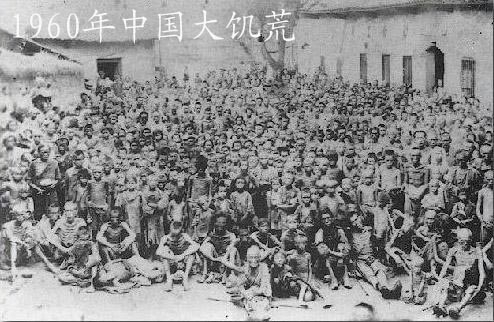
In 1958, CCP leader Mao Zedong launched the Great Leap Forward, aiming to "catch up with Britain and surpass America" and "sprint into communism." As the fever of this movement kept rising, policy grew ever more radical, ultimately triggering the greatest famine in Chinese history, in which an estimated 36 to 45 million people nationwide starved to death.
The province where the most people starved to death was Sichuan -- long known as the "Land of Abundance," a place where, as the old saying goes, "water and drought bend to human will, and famine is unknown." So how many people actually starved to death in Sichuan? Conservative estimates put the number at 10 million, with the actual figure possibly reaching as high as 12.5 million.
I. Where the Figure of 10 Million Starvation Deaths in Sichuan Came From
From June 19 to July 9, 1962, the Communist Youth League held its Third Plenary Session of the Seventh Central Committee in Beijing. Liao Bokang, a member of the League's Central Committee, secretary of the League's Chongqing Municipal Committee, and deputy director of the Chongqing Municipal Party Committee's General Office, traveled to Beijing to attend the meeting, together with Yu Keshu, an alternate member of the League's Central Committee and deputy secretary of the League's Chongqing Municipal Committee.
Beforehand, Liao Bokang had gathered a great deal of material, hoping to use this opportunity to report the grim situation in Sichuan to Hu Yaobang, first secretary of the League's Central Committee.
During the meeting, Hu Yaobang specifically sought out Liao Bokang for a conversation, then wrote up a briefing to report to the Central Committee, and also gave a verbal report to Yang Shangkun, alternate secretary of the Central Secretariat and director of the Central Committee's General Office.
Yang Shangkun, himself a native of Sichuan, cared deeply about conditions back home, and decided to have a thorough conversation with Liao Bokang and Yu Keshu.
On the afternoon of June 28, 1962, in a small meeting room inside Zhongnanhai, Yang Shangkun held a long conversation with Liao Bokang and Yu Keshu.
Yang Shangkun said he had already spoken with a number of Sichuan cadres, some of whom claimed "not to know the situation," others who "had reservations," and still others who "dodged the question and changed the subject."
"We know the death toll in Sichuan is severe, but we haven't been able to confirm the details. We asked Sichuan to report, and Sichuan never did. We went to the Ministry of Civil Affairs and asked: Sichuan's situation is this severe, and you're in charge of relief -- how many people have actually died there? The Ministry of Civil Affairs said 4 million -- but that figure actually came through Sichuan's own provincial Civil Affairs Department, so the central leadership didn't believe it. Then we went to the Ministry of Public Security, since they're in charge of household registration, and back then, grain coupons, cloth coupons, oil coupons, soap, matches -- every daily necessity -- were tied to household registration, so when a person died, they'd be struck from the rolls, and that number should be accurate! The Ministry of Public Security's figure, which of course also came through Sichuan's own provincial Public Security Department, was 8 million. The central leadership still didn't believe it, but we simply don't know how many people actually died. So tell me -- how many people in Sichuan actually died?"
Liao Bokang held up one finger and said: "Ten million died."
"Ten million? Where did you get this figure?"
"It comes from an official provincial party committee document." "In reality, I'm afraid it's more than that."
"Why?"
Liao Bokang said: "This figure only covers up to 1960. From 1961 through the first half of 1962, conditions improved across the country as a whole, yet people in Sichuan were still starving to death. At the end of 1961, people were still starving to death in Jiangbei County; the Fuling region alone saw a cumulative 3.5 million starvation deaths; when the provincial party committee relayed the results of the Seven Thousand Cadres Conference in March 1962, the party secretary of Yingjing County in the Ya'an region reported that half the population of his county had starved to death... Based on all this, I estimate the actual death toll in Sichuan is at least 2.5 million higher than what I calculated. But in my official report, I only stated that 10 million had died."
Upon hearing this, Yang Shangkun slapped his own thigh and said: "That matches your figure exactly!" He then instructed his secretary to open a locked safe in the Secretariat's small meeting room, took out a folded ledger-style notebook, glanced through it, and said again: "That matches your figure exactly!"
II. The Horrors of the Great Famine in Sichuan
Pi County and Wenjiang were the most fertile areas of the Chengdu Plain, with almost no historical record of famine deaths.
According to now-verifiable records, Pi County's population fell from 280,000 to 230,000 over the four years from 1958 to 1961, a net decline of 50,000. The county's overall labor force fell by nearly 20 percent compared with 1958, with seven communes seeing declines of 30 percent.
The population of the Wenjiang region was 4.94 million in 1957 and 4.33 million in 1961, a net decline of 610,000 over four years. Total unnatural deaths were estimated at approximately 900,000.
Yingjing County, located on the northeastern slopes of the Daxiang Mountains in western Sichuan, received abundant rainfall, boasted lush green mountains and clear waters, and stayed green year-round -- a place that had never before had to worry about famine. Yet during the Great Leap Forward, it became a living hell on earth.
At the time, Yingjing County had a total population of 90,000, of whom as many as roughly 50,000 starved to death -- more than half the county's entire population. Of the three years, 1959 saw the highest death toll, with 35,000 deaths.
According to the book A True Account of the Great Famine in Yingjing, Sichuan, in October 1959, mass edema and death broke out across Yingjing County. Cadres and ordinary people alike resorted to every means of survival: going up into the mountains to strip bark from trees, dig up roots, gather wild greens, and dig for "Guanyin clay" (edible clay); when all other options were exhausted, they stole collective animal feed and seed grain; cases of cannibalism even emerged, including the killing of living people to eat. Most tragic of all were cases in which starving family members ate their own dead relatives.
Yang Liurong, a farmer from Xingxing Village, Liuhe Township, was one of seven family members; her father and two others had already starved to death. Around the Lunar New Year in December 1959, she, her mother, her grandmother, and her younger brother went to the communal canteen to wait for a small ration of food. Her mother fainted from hunger, and her portion was eaten by someone else. Once her grandmother received her own ration, she paid no mind to her own daughter-in-law and instead told her two grandchildren, "Hurry up and go, or your mother might come to and want to eat ours too, and we didn't even get her share." After Yang Liurong went home with her grandmother, she never saw her mother again. Her mother had starved to death in the canteen that very day. It was not until the evening of the following day that she learned the truth: "My mother had been chopped into pieces and carried home to be eaten."
At that time, throughout the county, "every township and every field was filled with the sound of weeping. Refugees streamed toward the county seat and toward other regions; along the roads from the communes to the county seat, corpses of the fallen lay every single day. In every street and alley of the county seat, the bodies of those who had starved to death were everywhere -- some withered, some swollen, some already rotting!" "Thousands of courtyards and villages were emptied of all human life."
Liao Bokang wrote of the Yingjing famine in his memoir: "In some villages, not a single person was left alive -- there weren't even enough people left to bury the dead, so people had to be sent from another village to bury them. But these gravediggers themselves had nothing to eat, and digging graves was heavy physical labor, so the gravediggers themselves died too -- and people had to be brought in from yet other villages to bury the gravediggers who had died burying the dead."
III. The Causes of the Great Famine in Sichuan
Why did such a devastating famine occur in China? And why was the famine in Sichuan Province even more tragic than in other provinces? There are likely four main reasons:
First, the "fever" of central leaders such as Mao Zedong and Deng Xiaoping.
One outstanding feature of the Great Leap Forward was this: inflated targets, inflated production estimates, and inflated procurement quotas. This trend of the "three highs" originated from the very top of the CCP leadership.
In March 1958, the CCP convened the Chengdu Conference and adopted "Opinions on the Second Set of Accounts for the 1958 Plan and Budget," which raised several key economic targets well above what had already been approved at the Fifth Session of the First National People's Congress that year -- for example, the steel production target was raised from 6.248 million tons to 7 million tons, and the grain production target was raised from 392 billion jin to 431.6 billion jin.
At the end of May 1958, an enlarged meeting of the CCP Politburo recommended raising the 1958 steel production target further, to 8 to 8.5 million tons, and raising the 1962 target to 40 million tons.
In August 1958, the "Resolution on Issues Concerning the 1959 Plan and the Second Five-Year Plan," adopted at the CCP's Beidaihe Conference, stated: "The main goals of the 1959 national economic plan are: grain output to reach 800 to 1,000 billion jin, and steel output to reach 27 million tons, with a target of 30 million tons."
All these inflated targets were the product of the "feverish" thinking of Mao, Deng, and other leaders.
Guided by these "inflated targets," starting in June 1958, reports of "high-yield satellite" harvests -- wildly exaggerated production claims -- flew thick and fast across the country, and the "Five Winds" blew fiercely: the wind of communization, the wind of exaggeration, the wind of arbitrary commands, the wind of cadre privilege, and the wind of blind command over production.
In the second half of 1958, serious problems emerged in production and daily life among the people in some localities, and leaders at various levels raised the issue of "correcting leftist excesses." Mao himself made a few remarks along these lines as well.
But by July 1959, at the Lushan Conference, when Mao read a letter Peng Dehuai had written to him speaking the truth, he flew into a towering rage, launching a mass denunciation campaign against Peng, followed by a nationwide campaign against so-called "right-leaning opportunism" -- unleashing an even more radical leftist frenzy that swept across the entire country.
Second, the extreme leftism of Sichuan Provincial Party Secretary Li Jingquan.
During the Great Leap Forward, Mao Zedong placed great trust in Deng Xiaoping, and Deng in turn relayed Mao's intentions to Li Jingquan, who then faithfully carried out Mao and Deng's wishes without the slightest hesitation. This was a key factor behind Li Jingquan's extreme leftism during the Great Leap Forward in Sichuan.
In 1952, Mao promoted Deng Xiaoping, then first secretary of the Southwest Bureau, to a position in the central leadership, and Deng in turn had Li Jingquan installed as Sichuan's provincial party secretary and chairman of the provincial government. From that point on, Deng became Li's "patron" within the central leadership, and Li became Deng's "agent" in Sichuan. According to Li Dazhang, another Sichuan provincial leader at the time: "Every time Li Jingquan came to Beijing for a meeting, the first thing he did after getting off the plane was rush straight to Deng Xiaoping's home."
From 1958 to 1962, as Mao moved ever further toward the extreme left, Deng followed closely behind him. By the time this extreme leftism from Mao and Deng was transmitted down to Li Jingquan, it had doubled in intensity.
For example, in 1958, Sichuan's actual grain output was 22.45 million tons, but through layer upon layer of false reporting, the figure passed up the chain became 40 million tons. Mao, delighted upon seeing this figure, proposed that Sichuan's grain output for 1959 should reach 150 billion jin (75 million tons).
In February 1959, Li Jingquan convened a meeting of party secretaries from every city, prefecture, and district across the province to implement Mao's directives. Li proposed that Sichuan build 10 million mu of "10,000-jin fields" (fields claimed to yield 10,000 jin of grain per mu), and forcibly allocated this quota to every locality. When someone at the meeting openly questioned the feasibility of these "10,000-jin fields," Li angrily denounced them, declaring that anyone who doubted the 10,000-jin fields was a "fence-sitter" or a "bean-counter," and was "no true Communist" at all.
In mid-March, the Sichuan provincial party committee convened a mass rally of ten thousand people in Chongqing, at which Li Jingquan forcibly demanded that cadres at every level sign written pledges committing themselves, under penalty of severe consequences, to meeting the inflated target of 10,000 jin per mu.
Once cadres at every level had signed these written pledges, the only path forward was escalating high-pressure tactics at every level, with every kind of coercive measure deployed at once -- and anyone who dared object was crushed.
Against those cadres who dared report the reality of the Sichuan famine to the central leadership, Li Jingquan struck back mercilessly.
He pursued anyone deemed to have done something "disloyal to the provincial party committee" relentlessly. In the end, he uncovered what he called the "Xiao-Li-Liao Anti-Party Clique." "Xiao" referred to Xiao Zekuan, then head of the Organization Department of the Chongqing Municipal Party Committee; "Li" referred to Li Zhizhou, then deputy secretary-general of the Chongqing Municipal Party Committee; and "Liao" was Liao Bokang himself. Their "crime" was described as follows: "In 1962, at a time when our country was suffering three years of severe natural disasters... Xiao, Li, Liao, and others maliciously attacked the Party and attacked the Three Red Banners."
Liao Bokang, for his part, was punished with "two years of Party probation and the revocation of all positions inside and outside the Party," and was "sent down" to do manual labor at a construction site. He suffered greatly for the next twenty years.
Liao Bokang later recalled: "During the Great Leap Forward era, there was a slogan: 'One year equals twenty years.' For me, my own 'Great Leap Forward' was: three hours equals twenty years" -- referring to the three-hour conversation he had with Yang Shangkun, which cost him twenty years of suffering.
Li Jingquan, by closely following Mao and Deng in Sichuan, was rewarded again and again. At the Fifth Plenary Session of the Eighth Central Committee in May 1958, he was promoted to membership in the CCP Politburo -- the only provincial first secretary in the entire country to receive such a promotion. In early 1960, Li Jingquan was elevated from first secretary of the Sichuan provincial party committee to first secretary of the Southwest Bureau.
From that point until the outbreak of the Cultural Revolution in 1966, Li Jingquan reigned as the unchallenged "King of the Southwest."
Third, Sichuan was the largest exporter of grain to other provinces in all of China.
From the founding of the People's Republic in 1949 through the Great Leap Forward, Sichuan's grain procurement and its outbound shipments to other regions were both the highest in the entire country.
During the Great Leap Forward, when the central government requisitioned grain from Sichuan, CCP General Secretary Deng Xiaoping, Premier Zhou Enlai, and Vice Premier Li Xiannian all personally weighed in -- in effect, issuing an inflexible order that had to be carried out no matter the cost.
When Deng Xiaoping visited Sichuan, he once said that on the matter of grain requisition, Sichuan would still have to supply its quota -- if people had to die, better they die in Sichuan than in Beijing or Shanghai, otherwise the international repercussions would be far too great. These words circulated among some cadres in Sichuan, and were summed up by Yan Hanmin, party secretary of Wanxian prefecture, as: "It's better for people to die in the mountain gullies (of Sichuan) than on Wangfujing Street (in Beijing)."
Over the three years from 1958 to 1960, Sichuan shipped out 15.7 billion jin of grain to other regions -- nearly equal to the entire total shipped out in the preceding five years combined. In 1960 alone, a year of severely reduced harvests, 6.84 billion jin were still shipped out, amounting to more than a quarter of that year's total production.
Even as Li Jingquan proudly proclaimed that Sichuan's grain shipments to other regions ranked "first in the nation," rural areas across this so-called "Land of Abundance" were seeing mass starvation deaths, hunger was widespread in the cities as well, and ordinary people's grievances went unheard.
Conclusion
Since ancient times, traditional Chinese culture has held that "human life is a matter of Heaven itself." A human life is not only precious -- it is bound up with "Heaven," that is, with the divine.
Sichuan, the "Land of Abundance," saw more than 10 million of its people starve to death within the span of just a few short years, all because of the CCP's extreme leftist policies.
Killing a single person is a capital crime. What crime, then, is it when the CCP's "extreme leftist" policies caused the deaths of more than 10 million people?