
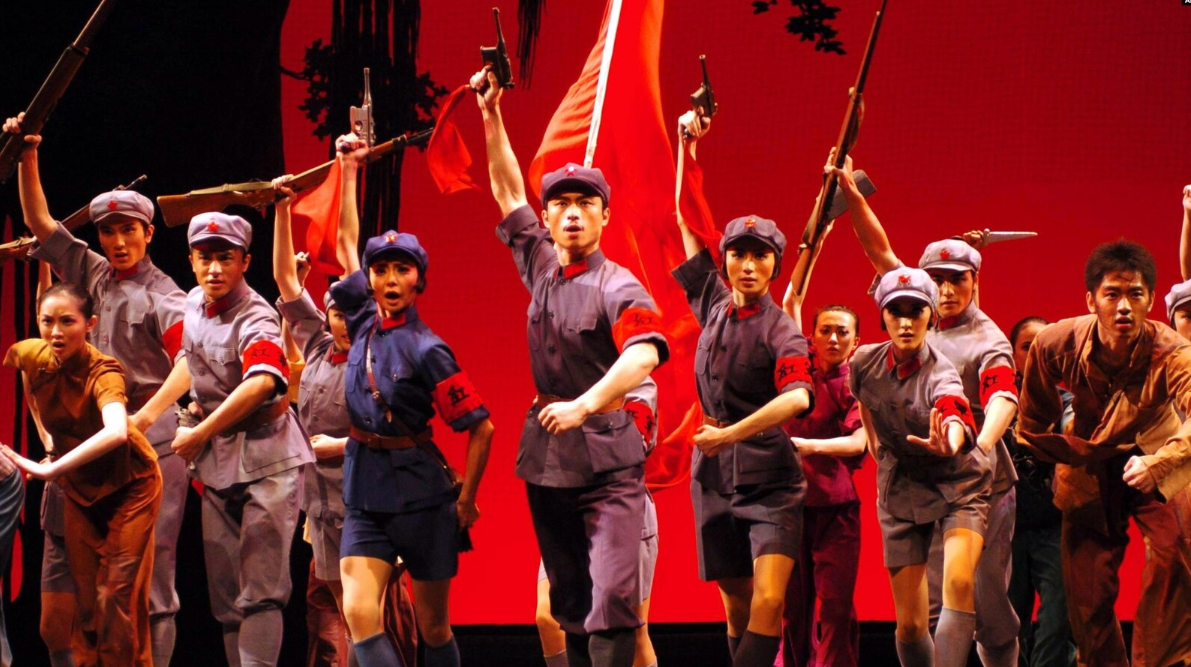
The CCP's Claim: The Long March Was to ‘Go North to Resist Japan’
The first to describe the Long March as ‘going north to resist Japan’ were Mao Zedong, chairman of the central government of the ‘Chinese Soviet Republic,’ and Zhu De, chairman of the Chinese Workers' and Peasants' Red Army's Revolutionary Military Council. In a jointly issued ‘Declaration on Resisting Japan and Saving the Nation’ in November 1935, the two stated: ‘The central government of the Chinese Soviet Republic and the Revolutionary Military Council of the Chinese Workers' and Peasants' Red Army have continuously called on the people of the whole country to unite and fight Japan, and have dispatched the main force of the Red Army, which, after a march of twenty-five thousand li through untold hardships, went north to resist Japan.’
Here, Mao and Zhu were asserting that the Long March was a deliberate, proactive action by the CCP, undertaken for the purpose of ‘going north to resist Japan.’
But a growing body of CCP historical materials and participants' memoirs shows that the Long March was in fact a forced ‘strategic transfer’ undertaken by the Red Army for the sake of survival and continued existence—more accurately described as a ‘retreat’ or a ‘great flight.’ Even so, no CCP scholar has yet dared to openly admit that this transfer had nothing to do with ‘going north to resist Japan.’
The ‘Anti-Japanese Vanguard’ Was Not Headed for the Front Lines Against Japan
Before the Long March, the CCP Central Red Army dispatched a so-called ‘Vanguard for Going North to Resist Japan.’ The CCP has always cited this vanguard as proof and a symbol that the Party was resolutely committed to resisting Japan from the very start. ‘The Red Army's Vanguard for Going North to Resist Japan was the first to raise the banner of resistance against Japan, fully proving that the Chinese Communist Party was the core force in saving the nation and achieving national liberation.’
As for the purpose of sending out this vanguard, the CCP's 2021 edition of its concise party history places the account within the section on the ‘failure of the fifth counter-encirclement campaign.’ It states: ‘In order to divert and pin down the enemy and relieve pressure on the important revolutionary base areas, in early July the Red Seventh Army Corps was reorganized into the Vanguard for Going North to Resist Japan and moved into the border region of Fujian, Zhejiang, Jiangxi, and Anhui.’ The vanguard's actual movements thus reveal that its real destination was not the anti-Japanese front in the northeast or north China, but the Fujian–Zhejiang region. It is worth noting that at the time there were no Japanese troops in Fujian or Zhejiang at all—on the contrary, this was a core strategic area of the Nationalist government.
Materials later disclosed by the CCP itself show that this unit's real purpose was ‘to test the ground for a breakout by the main Red Army force.’ It ‘tied down roughly 200,000 Nationalist troops, providing effective support for the Central Red Army's strategic transfer.’
On November 16, 1936, a month and a half after the Central Red Army set out on the Long March, the 25th Red Army, under the name ‘Second Vanguard for Going North to Resist Japan,’ left the Hubei-Henan-Anhui region and moved west. This army did indeed issue a declaration on going north to resist Japan, and it did eventually move north—but it ended up in Shaanxi, where there were no Japanese troops, and upon arrival it did not head to the anti-Japanese front in north China but instead moved west into Gansu.
The Long March Was, From the Very Start, an Aimless Flight
The ‘Long March’ that began on October 10, 1934, when the CCP central government, the Central Revolutionary Military Commission, and the main force of the Central Red Army set out from Ruijin, Jiangxi, likewise had nothing to do with resisting Japan.
Otto Braun (Li De), the Comintern's military adviser to the Red Army in its early years, offered this assessment of the Long March and ‘going north to resist Japan’ in his book Chinese Chronicles, 1932–1939: ‘At the time, in truth, not a single person had even dreamed of going north to resist Japan. Although resisting Japan was the main political slogan, it was by no means part of the military plan of the Party and Red Army leadership.’
The new edition of the history textbook states: ‘In early September 1934, Nationalist forces intensified their assault on the heartland of the Central Revolutionary Base Area, and the Red Army no longer had any possibility of turning the situation around where it stood.’
According to the eight-part historical documentary The Long March Forever, produced in 2016 by the CCP Central Party History Research Office, because the Central Red Army was defeated in the Nationalists' fifth encirclement campaign, the Central Soviet Area was ‘nearly reduced to a desperate situation’ and was forced to ‘break out,’ ‘withdraw,’ and ‘carry out a strategic transfer.’ Historical records show that at the time, it was not yet called the ‘Long March’—it was called the ‘Western Expedition’ or the ‘breakout.’
This propaganda film, made to glorify the Long March, inadvertently reveals that when the Red Army withdrew from the Jiangxi Soviet Area it had no clear direction, and that during the march it repeatedly changed its route and its plans for a final destination because of the Nationalists' pursuit and blockades.
It was not until June 1935, when the Central Red Army reached Lianghekou in Maogong, Sichuan, and joined forces with the troops of another CCP leader, Zhang Guotao, that the policy of ‘going north’ was decided upon—‘because going south offered no way out.’
Jin Yinan, a CCP military affairs expert and major general in the People's Liberation Army, likewise wrote in his 2009 book Suffering and Glory, discussing the Lianghekou Conference's ‘northward policy’: ‘The only viable option was to expand northward and link up with the Soviet Union in order to obtain international assistance.’ To open a route to the outside world, Mao Zedong even proposed organizing an expeditionary force to occupy Xinjiang ‘at an appropriate time.’
Although much later CCP material claims that the Lianghekou Conference laid the foundation for the Red Army to ‘go north to resist Japan,’ for the CCP Central leadership at the time the more urgent task set at the conference was for the Central Red Army and the Red Army forces led by Zhang Guotao to move north together and jointly establish a base area spanning Sichuan, Shaanxi, and Gansu. Because of Zhang Guotao's disagreement—what CCP party history calls Zhang Guotao's ‘splittism’—this plan was never realized.
After the Lianghekou Conference, the Central Red Army changed its planned destination once more before finally settling on the Shaanxi-Gansu base area. On September 12, 1935, after breaking with Zhang Guotao, the Central Red Army under Mao Zedong, while at Ejie in Gansu, decided to advance toward the China-Soviet-Mongolia border region in order to ‘establish a base area close to the Soviet Union,’ ‘open a channel of communication with the international [communist movement], regroup and rest the troops, expand the Red Army's ranks... and in the future expand eastward.’
The Red Army's final decision to head for northern Shaanxi came about entirely by chance. On September 18, 1935, in the small northwestern town of Hadapu, Mao Zedong happened upon an old copy of Ta Kung Pao and learned that a sizeable Red Army force was still active in northern Shaanxi with a fairly large base area of its own. Only then did he decide to head for northern Shaanxi to join forces with the Red Army there under Liu Zhidan.
From the start of the Long March on October 10, 1934, to the announcement on September 22, 1935, that the destination would be northern Shaanxi, the CCP Central leadership's planned ‘final destination’ changed seven times.
Xie Youtian, a former visiting scholar at Stanford University's Hoover Institution, wrote in his book The Mystery of the CCP's Rise—The Concealed Truth of China's War of Resistance Against Japan: ‘The truth of the Long March is this: it was nothing more than a military action of flight and survival following a military defeat.’
He summarized the Central Red Army's Long March experience as follows: ‘At first the plan was to link up with He Long in western Hunan; after that failed, they moved west into Guizhou. After Mao Zedong took control of the Party's supreme power, the plan was to cross the Yangtze and head north into Sichuan; that failed too. They then fled to Yunnan, a desolate region with fewer pursuing troops. By this point there was no longer—and could no longer be—any fixed objective; they simply wandered through the Yunnan-Guizhou-Sichuan region, avoiding battle wherever possible in order not to be wiped out. This Central Red Army then moved north for the first time, joining up with the Fourth Front Army, which was already waiting for them in the Xikang region of Sichuan. Only through a chance discovery that Gao Gang and Liu Zhidan were in northern Shaanxi did Mao Zedong decide, on his own, to head north again. There was never any strategic northward ‘Long March’ undertaken for the purpose of resisting Japan.’
On October 19, 1935, the CCP Central leadership and the Central Red Army reached Wuqi Town in northern Shaanxi and joined up with the Red Army forces already there. With this, the Central Red Army's Long March—which had ‘lasted a full year, crossed eleven provinces, and covered 25,000 li’—came to an end. The Central Red Army's strength had also plummeted from 86,000 troops at the outset to just 7,200.
The Eastern and Western Expeditions After the Long March Were Aimed at Opening a Route to the Soviet Union
In CCP propaganda, northern Shaanxi is portrayed both as the ‘final destination’ of the CCP Central leadership's and the Red Army's Long March and as the ‘starting point’ for resisting Japan. Shortly after settling in northern Shaanxi, Mao Zedong and Zhu De did indeed issue a ‘Declaration on Resisting Japan.’ Even so, the Red Army's top priority at the time was not resisting Japan but ‘defending and expanding the northern Shaanxi Soviet Area.’
At a meeting held in Wuqi Town on October 22, 1935, the Central Politburo explicitly stated that the important task facing the Shaanxi-Gansu Corps (the name given to the Red Army in the later stage of the Long March) was to ‘defend and expand the northern Shaanxi Soviet Area,’ and that ‘the main enemies are Chiang Kai-shek, Zhang Xueliang, and Yan Xishan.’
In December 1935, the CCP held the pivotal Wayaobao Conference in its party history. In the CCP's own words, this conference marked the Party's ‘turn from the Agrarian Revolutionary War to the War of Resistance Against Japan.’ Although the conference put forward theories and strategies for building a national united front against Japan, the CCP's top priority remained ‘consolidating and expanding the existing Soviet areas’ and ‘opening a route to the Soviet Union.’
The ‘Central Resolution on Military Strategic Issues’ adopted at this conference set the Red Army's strategic policy and tasks for 1936 as ‘opening a route to the Soviet Union’ and ‘consolidating and expanding the existing Soviet areas,’ with opening a route to the Soviet Union as the central task, and Shanxi and Suiyuan designated as the main directions for the Red Army's operations and the expansion of Soviet areas.
According to Jin Yinan's Suffering and Glory, the ‘Eastern Expedition’ and ‘Western Expedition’ launched in 1936 by the Red Army under the name ‘Anti-Japanese Vanguard of the Chinese People's Red Army’ were all related to this same goal, because the CCP knew at the time that the Soviet Union supported the CCP's establishing a base area on the Soviet-Mongolian border.
He wrote: ‘Both the Eastern and Western Expeditions stemmed from the message Zhang Hao [one of the CCP's early leaders] brought back, that Stalin did not object to the Red Army expanding northward and northwestward, closer to the Soviet-Mongolian border.’ He considered this message ‘the hope for the Red Army's survival and development.’
A 2017 study by Wang Shulin of the First Research Department of the CCP Central Party History Research Office stated that the Comintern and Soviet factors were crucial in the final determination of the Red Army's Long March destination.
The article states that, in view of Japan's occupation of northeast China and its control over north China, and the CCP's loss of its Soviet base areas in central and south China, the Comintern and the Soviet Union proposed that the Chinese Red Army establish Soviet base areas in Sichuan and Shaanxi, and if possible in the direction of Xinjiang. This led to a plan to support the Sichuan Soviet area and develop the revolutionary movement in northwest China, gradually forming a new strategic policy for advancing the Chinese Soviet revolution—namely, to support and help the CCP and the Red Army expand into northwest China and establish, close to the Soviet Union and Mongolia, a strategic base area for the Chinese revolution.
He also stressed that ‘the Comintern's support for China's Sichuan Soviet area and the development of the revolution in northwest China stemmed from the Soviet Union's practical need, in the Far East, to counterbalance Japan's forces of aggression against China and thereby safeguard its own national security.’
Neither the Eastern nor the Western Expedition succeeded. At the time, the CCP Central leadership even prepared contingency plans for yet another transfer, in case northern Shaanxi could not be held. Mao Zedong sent a telegram to Stalin proposing to abandon northern Shaanxi and break out southward.
It was the Xi'an Incident, which broke out on December 12, 1936, that truly brought the Chinese Communist Party its turning point of fate—and from that moment on, the course of Chinese history fundamentally changed.