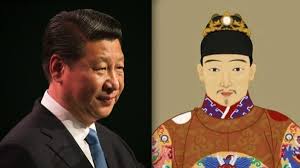
A short, easy-to-read essay once published on the NetEase platform, titled “When Chongzhen's Dynasty Was Collapsing, Everyone Was Waiting for His Orders,” explained how the last Ming emperor, Chongzhen, ran out of options as the Ming empire collapsed. The piece spread like wildfire; although it was deleted online long ago, countless copies still circulate on WeChat Moments large and small. Judging from the range of commentary it has sparked, people are not simply indulging in nostalgia for the past -- rather, they seem to see certain parallels between the fall of Chongzhen and Xi Jinping's rule.
Commentator Liang Jing likewise argues that political centralization runs against the natural order, and that if the Chinese people continue to cling blindly to the culture of imperial power, they will not only “bring destruction upon themselves” but endanger all of humanity. He believes the essay mentioned above explains this mechanism in remarkably clear and accessible terms. “I believe this article will enlighten countless millions of Chinese people.” The essay opens with its central point: “Why did Chongzhen's dynasty fall? Because when the crisis came, everyone was waiting for his instructions.” It goes on to analyze: “By the end, nearly every capable minister who could actually get things done had been executed by him, leaving behind only those who stayed silent, did nothing, and simply obeyed whatever the emperor said. So when, at the very end, he still blamed his ministers for failing him, he was in fact still refusing to understand -- never grasping that it was he himself who had failed his ministers, and failed the entire fate of the Ming dynasty.”
The essay goes on to analyze the fatal flaw of Chongzhen's rule: “Once a sudden crisis hit, the shortcomings in his ability to respond became glaringly obvious. Because everyone else was afraid to take responsibility, no one made independent judgments or their own decisions -- instead, everything was passed up the chain of command, and people waited for instructions from above. If no instructions came, they simply refused to act, because that was the safest course for them personally.” “And another clear consequence of this kind of excessive concentration of power was that everyone else lost any sense of loyalty to or identification with the system as a whole, coming to see themselves merely as hired hands working for the emperor.”
The essay concludes: “This, in fact, is the common condition of the bureaucratic system at the end of every dynasty -- officials feel no real loyalty to the court, nor any real sense of whether they are loyal or disloyal to the emperor; it is simply treated as an ordinary job. They only carry out tasks explicitly assigned from above; if no instructions come down, then even the greatest and most beneficial thing for the country and the people will simply not get done. Because in such an atmosphere, anyone who does act on their own initiative appears suspicious, becomes an easy target, and ultimately gets weeded out by everyone else through a kind of reverse selection.”
The Wuhan epidemic was still raging at the time, so drawing conclusions may have been premature -- but summarizing various analyses, at least one of the biggest lessons was this: when Wuhan officials, or the technocrats within China's health authorities, discovered the severity of the outbreak -- even that it was already spreading from person to person, and that even medical staff could not escape infection -- they still dared not disclose it to the public. They still dared not report it upward, or they concealed and underreported it.
Dr. Li Wenliang merely disclosed a little information in a private chat group, and was promptly summoned by police and reprimanded; eight doctors were reprimanded by police with no medical training whatsoever and told to keep quiet. Everyone then continued to conceal the outbreak, with no consequences, while Wuhan authorities went ahead with their New Year gatherings, banquets for tens of thousands of families, and local “two sessions” political meetings. This is an extremely strange phenomenon, and many analysts conclude it was the result of excessive centralization of power -- because ultimate authority over all of China had been concentrated in the hands of one man, national leader Xi Jinping, who personally headed every key leading group. Whether it was the Hubei provincial committee or the Wuhan municipal committee, once they received bad news, they had two options: try to contain it locally, and if that failed, minimize it and underreport it -- anything to avoid upsetting a leader who craved good news.
It would not be accurate to say that the Hubei authorities, or the national disease-control center, managed to suppress this outbreak entirely on their own, because China had already established a round-the-clock system for reporting epidemics directly to the central government. And who is “the center” in this case? From a health-policy perspective, it should first be the State Council, whose top leader is Li Keqiang. Why couldn't Li Keqiang order action against the epidemic in time? Clearly, he did not hold that real power. Had Li Keqiang bypassed Xi Jinping and unilaterally ordered a response to the epidemic, it would have been seen as violating the principle of “upholding the two safeguards,” and treated as an act of disloyalty toward Xi Jinping -- an extremely serious accusation. So the most Li Keqiang could do was report the situation to Xi Jinping. In the end, how quickly or slowly the country responded to the epidemic depended entirely on Xi Jinping's own level of awareness.
Why did Xi Jinping wait until the 20th of the month to finally order action on the epidemic -- by which point it was already seriously too late? Analysts suggest two possibilities: either Xi Jinping lacked sensitivity to the epidemic, perhaps believing that infectious disease was nothing to fear and that, at most, a few people would die -- which was also Mao Zedong's attitude -- or Xi Jinping wanted to wait until the US-China trade deal had settled before making a decision. A third possibility is that Xi Jinping shared the same thinking as Hubei's officials: get through the Spring Festival happily, hold the local “two sessions” smoothly, and prepare for the national “two sessions” in March.
Wang Xinxian, director of the Institute of East Asian Studies at Taiwan's National Chengchi University, has analyzed that Xi Jinping likely knew about the Wuhan pneumonia outbreak early on, but because China was at the time in the middle of signing the phase-one trade deal with the United States, and because Xi had concentrated so much power in his own hands, the epidemic -- while it still remained ambiguous -- “simply couldn't make it onto Xi Jinping's list of top priorities.” As the epidemic spread to this extent, “the most important issue is a problem with the CCP system itself.” Kou Chien-wen, director of the Institute of International Relations at National Chengchi University, believes Xi Jinping still bears responsibility for the spread of the epidemic -- even though the central government is now trying to steer public opinion and shift the blame onto local governments, the very officials being held accountable were all appointed during Xi's own tenure.
The hallmark of empire is that every official across the land takes their cues from the emperor's mood, and any independent view or opinion becomes dangerous. And so it was that this terrifying epidemic in Hubei, first detected as early as the beginning of December, was delayed again and again, suppressed again and again, until it spiraled completely out of control -- spreading from person to person, with even medical staff unable to escape it, and the whole of China facing enormous danger -- before Xi Jinping finally spoke up. That statement was followed by the empire's traditional wartime approach to crisis management: sealing off the city, sealing off the province, total lockdown management. Chaos erupted everywhere, the people's grievances mounted, people died, people were injured; in the early stage medical resources were severely inadequate and patients had nowhere to turn for help, while in the later stage came door-to-door arrests and violent inspections, leaving deep psychological wounds on the people.