
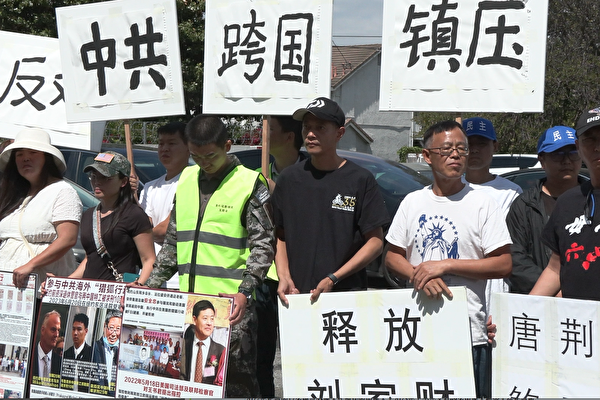
The International Consortium of Investigative Journalists (ICIJ) has released a widely praised cross-border investigation called “China Targets,” which, through numerous case studies, once again demonstrates that dissidents from China and Hong Kong face the same threat from the CCP's repression machine reaching overseas, even after they have left the country. On this subject we are publishing two articles; this is the second of the two.
In April, the International Consortium of Investigative Journalists (ICIJ) released its 17-page “China Targets” investigation, examining how the CCP has extended its policing repression overseas.
Especially over the past decade, the CCP's repression machine has no longer confined itself to domestic borders, extending its long arm across the globe instead. Dissidents living in exile abroad, civil-rights activists, ethnic minorities, and left-wing organizations have all become “targets” of the CCP's transnational crackdown, subjected to systematic surveillance, threats, and harassment.
The Methods of Transnational Repression
This transnational repression mechanism operates through the coordinated efforts of multiple state agencies -- public security, foreign affairs, the United Front, and cyberspace administration among them. The ICIJ report explains that such transnational repression tactics include revoking passports, threatening family members to force silence, overseas surveillance and intimidation, disrupting protests, hacking attacks, and mass data surveillance, as well as abusing Interpol's “red notices” to pursue extradition. At the same time, Chinese embassies abroad have built up networks of agents and informants, mostly drawn from among overseas students, tasked with gathering intelligence, suppressing protests, and maintaining “order” at gatherings of visiting CCP officials.
As China's economy sinks into a historic crisis and class conflict intensifies, the CCP must cut off opposition political forces from using the “safety” of environments abroad to criticize official policy, in order to prevent any critical voices from “flowing back” into the country. As a result, repression is also intensifying on a global scale.
The most severe case this year came in February, when Thailand deported 48 Uyghurs back to Xinjiang after they had been held for ten years in a detention center in Bangkok. Needless to say, nothing has been heard from them since, and human-rights organizations warn that these 48 people may face torture or even death. As Thailand's economic and military ties with the CCP grow ever closer, Thai authorities claim that no third country came forward to offer these Uyghurs asylum -- even though the United States says it had offered to take them in. This was a heavy blow not only to Uyghurs, but to every group the CCP regards as a “threat.”
In October 2022, Han Yutao, a 23-year-old Chinese student studying in the United States, held up a sign on campus in support of the “Sitong Bridge” protest. Within a single day, Beijing police had already shown up to interrogate his mother and other family members, and several relatives, under pressure, called Han Yutao to plead with him to stop taking part in protests. The speed and precision of this response exposes the seamless cooperation between the CCP's overseas surveillance apparatus and its domestic public-security network.
Embassies abroad are not simple diplomatic institutions -- they function as forward operating bases (FOBs) of the state's repression machine. Chinese embassies in numerous countries require overseas students to “report in regularly,” and organize student associations to act as informants, monitoring and reporting on dissident activity; whenever a protest or gathering occurs, they mobilize “little pinks” disguised as “spontaneous patriots” to surround and disrupt it, filming footage to send back for the record. Many overseas students are forced to choose between “political apathy” and “loyalty to the CCP.” Even when taking part in political protests on subjects unrelated to China or CCP policy, they are strongly advised to hide their identities by wearing masks and similar means.
On May 29, 2025, a speech calling for “global solidarity” by student representative Jiang Yurong at Harvard's commencement drew widespread attention -- only for it to later be revealed that in 2024, when China's ambassador to the United States, Xie Feng, spoke at Harvard, she had been in charge of “crowd control,” directing the forcible removal and expulsion of two Taiwanese and Tibetan students who were protesting the CCP's policies toward Hong Kong, Taiwan, and its oppression of ethnic minorities.
In 2022, four “little pinks” attempted to disrupt a meeting organized by the International Solidarity Alliance (ISA) at University College London. The meeting was attended by roughly 30 people, the vast majority of them from China, gathered to discuss the “blank paper” protest movement. The four disrupted the meeting in a coordinated fashion, repeatedly interrupting other speakers and throwing the proceedings into chaos. At the time, the meeting's organizer urged all Chinese attendees to wear masks, as a safety measure to protect their identities against CCP infiltration. But these four agitators openly refused to wear masks themselves, and even encouraged other Chinese students to take theirs off, claiming that doing so would demonstrate the “courage” to openly criticize the CCP. There is no doubt their real aim was to identify as many attendees as possible, in order to increase their own “value” when reporting back to their handlers. Fortunately, none of the other attendees fell for it, and everyone kept their masks on. Realizing that the meeting's security had been compromised, the ISA organizers quickly ended the session and invited the genuinely engaged students to continue the discussion at another location.
Thoroughgoing Democrats
Socialists have always stood at the forefront of the struggle against authoritarian rule. Lenin described Marxists as “thoroughgoing democrats” -- the polar opposite of bourgeois politicians, who only pay lip service to democratic rights when doing so happens to serve their own interests. In the face of the CCP's transnational repression, overseas Chinese social activists must never be naive. Feeling fear, and never underestimating the power of the state machine, is entirely normal and simply common sense. At the same time, this must never become an excuse to fall into paralysis or abandon the struggle. Because the economic crisis has left thousands upon thousands of CCP enforcers demoralized, with wages delayed or cut, the CCP's repressive state machine may well already be approaching its “peak.” To defeat state repression, those fighting for change need to organize, become more organized still, and recognize that the struggle against authoritarian rule is also a struggle against capitalism -- one that must be waged internationally if it is to succeed.