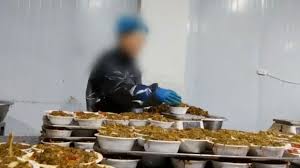
March 15 is China's long-observed "World Consumer Rights Day." As is customary, various forms of chaos across consumer sectors are exposed en masse around this date, and this year, shocking food-safety problems once again became the focus of public attention. Chicken feet "bleached" with hydrogen peroxide, freeze-dried strawberries with severely excessive heavy-metal content, rice-crust snacks baked alongside stinking shoe insoles — these ever-more-brazen abuses of food-industry trickery are nothing new, yet remain shocking enough. Even state media had to admit that this amounts to "a disgrace of governance."
Taken in isolation, these incidents might seem like nothing more than the moral corruption of a few unscrupulous merchants. But once placed within China's overall institutional context, it becomes clear that what they reveal is not an individual problem, but the systematic erosion of ordinary people's daily lives under a system of highly concentrated power.
What truly deserves vigilance about these incidents is not their absurdity, but their recurrence. Over the past twenty years, from tainted baby formula and "gutter oil," to cadmium-contaminated rice and fake mutton, and now to today's "poison chicken feet" and "poison strawberries," the problem has never disappeared — it has simply kept reappearing in new forms. When a society can continuously and massively produce the same type of risk, the problem is no longer a matter of morality — it is a matter of institutional mechanism.
Officials commonly explain all this away as "regulatory failure," but the more pressing question is: why does regulation fail, again and again, over the long term? In a normal society, the core goal of food safety is to reduce risk and protect public health, and regulatory agencies derive their legitimacy from being accountable to the public. But in China's reality, regulation serves, first and foremost, not the consumer, but political order. Whether an incident triggers public outrage, whether it affects stability, whether it might turn into a mass incident — these considerations often matter more than whether the food itself is actually safe.
When the goal of governance shifts from "eliminating risk" to "controlling the visibility of risk," food safety problems are downgraded into public-opinion problems, no longer treated as public-safety problems. As a result, the regulatory logic becomes fundamentally distorted: if it isn't exposed, it's as if the problem doesn't exist; if nothing goes wrong publicly, that counts as successful management; and if the data looks good, that counts as a political achievement. This produces the absurd reality of an official narrative claiming a "spot-check pass rate above 99%" on one side, while on the other, poisonous food keeps surfacing endlessly in real life. This is an institutional outcome — the data is reported upward to superiors, while the food is what ordinary people actually eat.
This logic is especially evident in the "3/15" mechanism. Every year, at a fixed time, problems are exposed en masse, rectification campaigns are launched en masse, and pledges are made en masse — after which things quickly fade back into silence. This cyclical operation is no accident: it releases public discontent while avoiding any disturbance to the regime itself. In other words, "3/15" is not a tool for solving problems, but a means of managing them. The problems are not eliminated — they are simply scheduled to be "resolved" at a controllable moment; at that point, it is no longer oversight, but a carefully staged performance.
"3/15" is usually followed by a round of "severe crackdowns" — surprise inspections, mass closures, media follow-ups — which appear swift and decisive, but are, in essence, cyclical mobilization rather than institutional governance. This approach targets hot topics of public opinion rather than systemic risk, and emphasizes displays of attitude rather than the building of rules. The result is a fixed cycle: exposure, rectification, silence, recurrence, and exposure again. This cycle cannot be broken precisely because genuinely effective regulation depends on transparency, independence, and accountability — all of which run directly counter to the operating logic of a totalitarian system.
From the perspective of businesses, the problem likewise has its own "rational basis." In the real-world environment, the cost savings from violating regulations are often far greater than the potential cost of punishment. Given limited probability of being caught and limited severity of punishment, producing in violation of regulations becomes, instead, an economically calculable choice. What's more complicated is that these problem enterprises often simultaneously serve functions in local government finance, employment, and industrial supply chains. Under a system that treats GDP growth and social stability as its core performance metrics, local governments are forced to choose between "regulation" and "development" — and that choice tends to favor the latter.
This does not mean there is no enforcement at all — rather, it means enforcement is markedly selective and episodic: when a problem has not yet been exposed, its existence is tacitly tolerated; once exposed, it is swiftly dealt with; once public outrage subsides, controls are relaxed again. This "incident-driven governance" is destined never to establish a stable order of safety.
At the same time, distortions in the information structure further amplify the risk. Food safety fundamentally depends on transparency mechanisms — media investigation, public oversight, third-party testing. But under the CCP's tight information controls, these mechanisms cannot function normally. A great many risks are not resolved, but simply undiscovered; a great many problems do not not-exist — they are simply not permitted to be discussed.
As a result, public awareness of food safety tends to appear fragmented: most of the time, the problem seems not to exist; then, at certain moments, it suddenly erupts en masse, appearing utterly out of control. This is itself a consequence of restricted information.
If the failure of market and information mechanisms explains why the problem persists, then the lack of judicial independence under the CCP's authoritarian system explains why the problem cannot be reversed. Food safety requires a stable, predictable system of punishment, but in reality the cost of seeking redress is prohibitively high, mechanisms for class-action lawsuits are limited, and the cost of breaking the law fails to produce genuine deterrence. When rules cannot stably constrain behavior, violations become the norm.
Looked at even more deeply, none of this is an accidental flaw — it is the inherent product of a totalitarian system. Effective food-safety governance requires media oversight, judicial independence, information transparency, and social participation — but under an authoritarian system, these elements are often treated as sources of risk rather than as the foundations of governance. Food safety is therefore not an isolated livelihood issue, but the direct manifestation, at the most everyday level, of how the whole system operates. So when people ask why the food safety problem "can't be solved," the answer is in fact not complicated: when the root of the problem is the system itself, solving the problem means changing the system — and that is precisely the part of this system that must never be touched. And so what we see is not the disappearance of the problem, but its normalization.
A system that cannot even guarantee the safety of food still claims that "everything the Chinese Communist Party strives for is for the happiness of the people" — and this, in itself, is the greatest irony of all. Food safety has become a chronic disease not because it cannot be managed, but because it cannot truly be managed — because to manage it seriously would require confronting authoritarian power itself. And a power structure that refuses to be constrained can, in the end, guarantee no one's safety — including its own.