
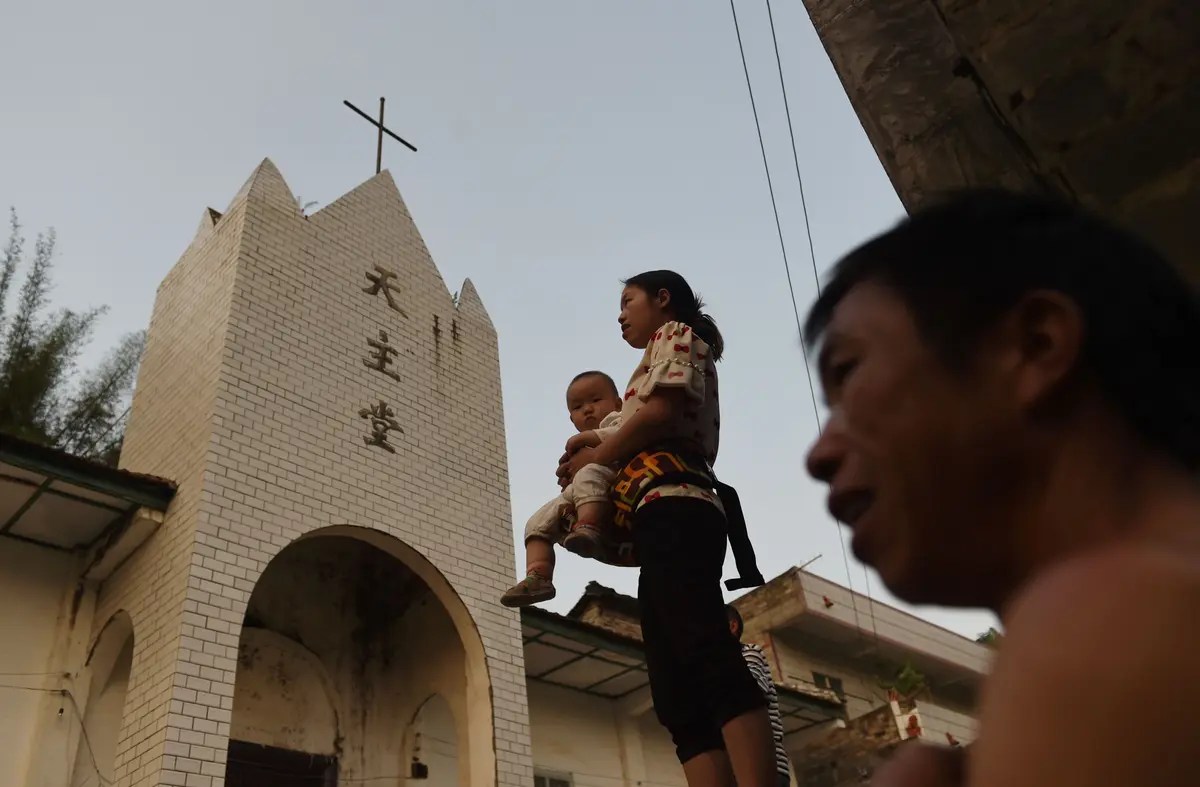
Since CCP leader Xi Jinping took power, the Party has spent nearly a decade pursuing a so-called "sinicization" of religion, and Catholics across China have faced intensified ideological control, close surveillance, and travel restrictions. Human Rights Watch has released a report saying the CCP authorities have further tightened control over Catholic and other religious groups.
On April 15, 2026, Human Rights Watch, the New York-based human rights organization, released a report stating that China has roughly 12 million Catholics, who are permitted to practice their faith only within the official Chinese Catholic Patriotic Association system. Underground churches that refuse to join this system have continued to be a key target of CCP suppression in recent years.
After the CCP authorities introduced their "sinicization of religion" policy in 2016, churches were demolished nationwide, unofficial gatherings were restricted, unapproved religious publications and apps were banned, and religious believers and clergy faced threats and restrictions.
Under the 2018 Vatican-China agreement, the CCP government may nominate candidates for bishop, with the Pope holding veto power — though the full text of the agreement has never been made public. The agreement has since been renewed three times and now extends through October 2028, yet neither of the last two popes has ever exercised that veto, even standing by as the CCP government violated the agreement by unilaterally appointing bishops. Since taking office in May 2025, Pope Leo XIV has likewise accepted, without objection, all five bishops appointed by the CCP government.
Underground bishops have faced suppression by the CCP authorities. For instance, 94-year-old underground bishop Su Zhimin (the legitimate bishop of the Catholic Diocese of Baoding) remains missing; Xing Wenzhi (former auxiliary bishop of the Catholic Diocese of Shanghai) has also not appeared publicly; Guo Xijin (former auxiliary bishop of the Catholic Diocese of Mindong) and Shao Zhumin (legitimate bishop of the Catholic Diocese of Wenzhou) have long had their movements restricted; and Cui Tai (legitimate bishop of the Catholic Diocese of Xuanhua) and Ma Daqin (auxiliary bishop of the Catholic Diocese of Shanghai) have previously been detained and barred from carrying out their duties.
Clergy face restricted lives and tight political control. One priest was barred from opening a bank account or obtaining a mobile phone SIM card or a passport. The report shows that clergy in some parts of China are required to attend political training sessions on a regular basis, with some areas requiring attendance more than once a week.
The report states that these measures violate the principles on religious freedom set out in the Universal Declaration of Human Rights, and touch on multiple basic human rights, including freedom of expression, association, and movement.
The report also shows that the CCP authorities are increasingly restricting children across the country from entering Catholic churches. These restrictions on children's participation in religious activities violate China's obligations as a signatory to the Convention on the Rights of the Child.
Recently, the CCP government has mandated strict controls on contact between clergy and people from overseas, including foreign travel or cooperation with foreign churches.
On December 16, 2025, the Chinese Catholic Patriotic Association and the Bishops' Conference of the Catholic Church in China jointly passed an internal management regulation requiring unified custody and strict approval procedures for the travel documents of Catholic clergy across mainland China seeking to go abroad.
Human Rights Watch called on governments around the world to pay attention to the situation, and urged the CCP authorities to end their restrictions on religious groups.
It is worth noting that while the CCP forcibly pushes the "sinicization" of religion, in reality, ever since taking power, the CCP has aggressively promoted atheism, not only destroying traditional Chinese culture but also installing its own agents within every religion, directly overseen by the CCP's religious affairs bureau — meaning that, in effect, religions that believe in a deity are being led by an atheist Communist Party.