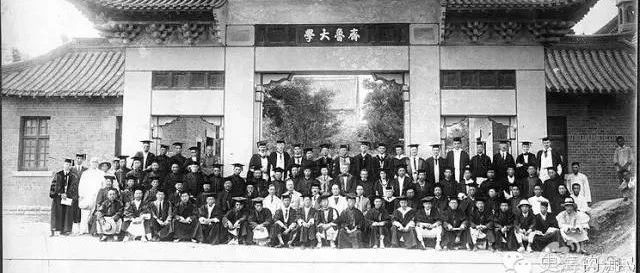
Before the CCP came to power in 1949, China had a number of Christian mission universities founded by Western missionaries. Many of them ranked among China's top universities at the time and played an important role in cultural exchange between East and West.
But after the CCP seized power, every one of these mission universities was abolished. Why did this happen? It is a question well worth reflecting on today.
The Sixteen Famous Mission Universities
Before the CCP came to power, China had sixteen well-known mission universities. Thirteen were run by Protestant churches: Yenching University, Cheeloo University, St. John's University, University of Shanghai, University of Nanking, Ginling College, Soochow University, Hangchow University, Huachung University, Fukien Christian University, Hwa Nan Women's College, West China Union University, and Lingnan University. Three were run by the Catholic Church: Aurora University, Fu Jen Catholic University, and Tsinku University.
These sixteen mission universities were spread across major cities including Beijing, Jinan, Shanghai, Nanjing, Suzhou, Hangzhou, Wuhan, Fuzhou, Guangzhou, and Tianjin.
Yenching University was regarded as the foremost of China's mission universities. Cheeloo University, at its peak, was known as ‘the leading institution of North China,’ rivaling Yenching in reputation — hence the saying ‘Cheeloo in the south, Yenching in the north.’ St. John's University was known as ‘the Harvard of the East.’ Ginling College was China's first women's university. And Peking Union Medical College was, at the time, China's best-equipped and highest-quality institution for medical education and research.
The Role of the Mission Universities
Wang Zhongxin, a PhD in philosophy from Boston University, once assessed it this way: ‘The mission universities closed the gap between Chinese and Western higher education by several hundred years, virtually overnight.’
The historian Zhang Kaiyuan wrote in his essay ‘The Historical Fate of China's Mission Universities’ that, compared with mission schools in Africa, China's mission universities operated at a higher educational level; compared with mission universities in India, they were fewer in number but higher in quality; and compared with mission universities in Japan, they were more competitive relative to public universities.
Although the mission universities had the limitations of their historical era, objectively speaking they made many contributions to China. They trained a large number of well-educated, outstanding people, promoted cultural exchange between East and West, and spurred the development of both government-run and private higher education in China.
By 1949, more than 15% of all Chinese university graduates had come from mission universities, and they produced a remarkable number of notable figures. For example:
Notable figures trained at St. John's University in Shanghai include the modern Chinese diplomat Wellington Koo; Zhang Boling, founder of the Nankai school system; the writer Lin Yutang; T.V. Soong, who served as the Republic of China's Minister of Finance, Minister of Foreign Affairs, and acting President of the Executive Yuan; the industrial magnate Liu Hongsheng; and the renowned architect I. M. Pei.
Notable alumni of the University of Nanking include Li Ching-Chun, a pioneer of human genetics who later served as president of the American Society of Human Genetics; Tso Tien-Chioh, a tobacco expert who directed the tobacco research laboratory at the U.S. Department of Agriculture; the educator Tao Xingzhi; Sun Mingjing, known as the ‘father of Chinese television’; François Cheng, the first ethnic Chinese member of the Académie française; and the Nobel laureate in literature Pearl S. Buck.
The Dismantling of the Mission Universities
The CCP's campaign against the mission universities began with Fu Jen Catholic University, which the CCP took over in October 1950.
On January 11, 1951, the CCP issued its ‘Directive on Handling Mission Schools and Other Educational Institutions Receiving American Subsidies,’ forcing all mission universities to sever ties with foreign churches.
In 1952, the CCP carried out a sweeping reorganization of university departments nationwide. All mission universities were dissolved, and their departments were dismantled and merged into other institutions.
For example, Yenching University's humanities and science departments were merged into Peking University and its engineering department into Tsinghua University, and its campus, ‘Yenjing Yuan,’ became part of Peking University's grounds. St. John's University's departments were merged separately into Fudan University, Shanghai Jiao Tong University, Tongji University, and East China Normal University, and East China University of Political Science and Law was built on its original site. Hangchow University's departments were merged into Zhejiang University and Tongji University, and Zhejiang Normal College was established on its original site. Cheeloo University's theology school and its institute of Chinese studies were abolished; its college of arts and sciences was divided among Shandong University, Nanjing University, and Shandong Normal College; its agricultural school was assigned to Shandong Agricultural College; and its medical school was renamed Shandong Medical College.
Why Did the CCP Set Out to Eliminate All the Mission Universities?
There appear to be four main reasons:
First, the CCP embraces atheism.
The founders of China's mission universities were, without exception, either Protestant or Catholic believers in God. One of their purposes in founding these universities in China was to spread Christianity and Catholicism there, so that the Chinese people would come to believe in the God they revered.
Believers hold that the Creator made heaven, earth, humanity, and everything else in the universe. The Creator is the supreme god, and the culture he handed down to humanity is a divinely-inspired culture. Only by believing in, revering, and worshiping God can people receive divine protection.
The atheism embraced by the CCP is fundamentally opposed to the theism embraced by the founders of the mission universities.
If the CCP does not believe in God, what does it believe in? It believes in Marxism-Leninism, which is fundamentally opposed to traditional and universal values; it believes in the Party that is guided by Marxism-Leninism; and it believes in the Party's supreme leader, who is regarded as the one who has grasped the truth of Marxism-Leninism.
As early as the 1940s, when the CCP used the Yan'an Rectification Movement to establish Mao Zedong's position as its core leader, it had already elevated Mao to the position of a god.
In 1945, at the CCP's Seventh National Congress, Liu Shaoqi extolled Mao as ‘the greatest theorist and scientist in Chinese history,’ possessing ‘the highest theoretical accomplishment and the greatest theoretical courage,’ and declared Mao Zedong Thought to be the CCP's ‘sole correct guiding ideology.’
If Mao was the greatest spiritual leader in history, then once the CCP seized power, whom should the entire Party, the entire army, and the entire nation worship? The CCP's answer, naturally, was: worship Mao.
But the founders of the mission universities worshiped God, and the missionaries at these universities taught students to worship God — how could the CCP possibly allow that to stand?
Second, the CCP holds Marxism-Leninism as its sole orthodoxy.
On August 30, 1949, Mao Zedong wrote in his essay ‘Friendship’ or Aggression?: ‘Compared with other imperialist powers, American imperialism has, over a long period, placed greater emphasis on activities of spiritual aggression, extending from religious enterprises to “charitable” and cultural enterprises... Many of our country's well-known schools — Yenching, Union Medical College, Wesley, St. John's, Ginling, Soochow, Hangchow, Yale-in-China, West China, Lingnan, and others — were all established by Americans.’
Mao's analysis of the mission universities was guided by Marxism-Leninism, which created an entire discourse system for the Party's culture. Within this discourse system, ‘imperialism’ was something thoroughly bad.
As early as 1916, Lenin declared that imperialism was ‘monopolistic, parasitic, decaying, and moribund’ capitalism, representing the ‘highest and final stage’ of capitalist development. Therefore, he argued, the proletarians of the world must unite and, through violent revolution, overthrow the rule of imperialism to ‘liberate all of humanity.’
By the logic of this Party-culture discourse system fashioned out of Marxism-Leninism, imperialism was bad, American imperialism was bad, and mission universities established by American imperialism were therefore certainly bad — and naturally slated for elimination.
Yet today, in the 21st century, ‘American imperialism’ remains the most powerful nation on earth. This fact fully demonstrates that Lenin's 1916 theory of imperialism was extreme and absurd, not the truth.
This is not to say that imperialism had no problems of its own — rather, that Marxism-Leninism's understanding of imperialism does not conform to objective fact.
As noted above, the mission universities founded in China by the British and Americans were far from being purely negative; they played a very important, positive role in modern Chinese education.
But once the CCP seized power, it was determined to make Marxism-Leninism the guiding force over China's universities.
Starting in 1952, the CCP launched a thought-reform campaign targeting intellectuals at universities, aiming to ‘eliminate the influence of American imperialist cultural aggression and seize back the strongholds of American imperialist cultural aggression in China.’
As a result, at Chinese universities — and especially the mission universities — anyone who had returned from studying in Britain or the United States, or who had received a long education under the British or American system, was subjected to intensive campaigns to root out ‘views that worshipped the British and American bourgeoisie, sectarianism, parochialism, and individualism,’ in order to bring their thinking, speech, and actions into line with the Party's position and with Marxism-Leninism.
Third, the CCP ‘leaned entirely to one side’ — toward the Soviet Union.
On the eve of taking power, the CCP had already established a foreign policy of ‘leaning entirely to one side’ toward the Soviet Union — that is, joining the socialist camp led by the Soviet Union and copying the Soviet model wholesale in politics, economics, culture, and every other field.
The Soviet Union sent large numbers of experts to China to help the CCP overhaul China's education system. The Soviet expert Arsenyev became the chief adviser to the CCP's Ministry of Education. Statistics show that between 1949 and 1959, a total of 861 Soviet experts worked at Chinese universities.
By adopting Soviet ideas about higher education, an entire higher-education system modeled on that of the Soviet Union was established in China. Between 1952 and 1953, the number of comprehensive universities in China fell from 55 to 14, while the number of engineering colleges rose from 28 to 38 and the number of teacher-training colleges rose from 12 to 33. The share of students in the humanities, law, politics, and finance/economics fell sharply — students in liberal arts, law, and business made up 47.6% of all university students in 1947, falling to 22.5% by 1952 and to 9.6% by 1957.
After the 1952 reorganization of university departments, China became the country in the world with the fewest comprehensive universities and the fewest students enrolled in the humanities.
The mission universities, run on principles utterly different from the Soviet Communist Party's model of Party-controlled education, were naturally all slated for elimination.
Fourth, the CCP regarded the United States as an enemy.
On June 25, 1950, North Korean Communist forces under Kim Il-sung launched a surprise attack on South Korea. North Korean troops quickly crossed the 38th parallel and captured the South Korean capital, Seoul; by early September they had occupied 90% of South Korean territory.
In response to North Korea's invasion of South Korea, the United Nations passed a resolution on July 7 of that year forming a UN command led by the U.S. military to help South Korean forces resist the invaders. On September 15, UN forces landed at Incheon, South Korea, and quickly pushed north across the 38th parallel; North Korean forces collapsed along the entire front and were driven to the brink of disaster.
On October 8, 1950, Mao Zedong ordered by telegram that the CCP's Northeast Field Army be reorganized as the ‘Volunteer Army’ and secretly enter Korea to join the fighting. CCP forces soon met American forces on the Korean battlefield.
The People's Republic of China and the United States became hostile nations.
According to He Fang, former deputy director of the General Office of the CCP's Ministry of Foreign Affairs, before invading South Korea, Kim Il-sung first secured the backing of Soviet Communist Party General Secretary Stalin, then traveled to Beijing to meet Mao Zedong in hopes of gaining his support as well. Mao said that since Stalin had already made his decision, he had no objection.
In other words, North Korea's invasion of South Korea had been secretly planned in advance by Kim Il-sung, Stalin, and Mao Zedong.
After UN forces landed at Incheon, North Korean forces collapsed in disarray. Mao Zedong did not wait for Stalin or Kim Il-sung to make any request — as soon as American forces entered the fighting, he had already begun preparing to send troops into Korea.
In late September, Kim Il-sung sent urgent appeals for help to Stalin and Mao. Stalin at one point considered abandoning North Korea altogether. Before Stalin finally decided to aid Korea, Mao had already issued the order to form the Volunteer Army in preparation for entering the war. Seeing that Mao's mind was made up, Stalin turned to support Mao's decision.
After deciding to ‘Resist America and Aid Korea,’ Mao put forward the slogan ‘Defend the Home, Protect the Nation.’ Mao's true intent in coining this slogan was to deceive the Chinese people.
On October 10, 1970, in conversation with Kim Il-sung, Mao said: ‘If you don't bring up “defending the home and protecting the nation,” they [the Chinese people] wouldn't go along with it either! They'd say, is it acceptable to fight only for the Koreans and not for the Chinese? So I said it was to defend the home and protect the nation! That is, to defend your home and protect your nation, you have to go there to defend it and protect it. If you don't help the Korean people defend Korea, how can you defend your own home and protect your own nation? Put it that way, and the soldiers understood.’
In other words, even before the Korean War broke out, Mao was already prepared to treat the United States as an enemy; and once the war began and China and the U.S. clashed militarily on the Korean battlefield, Mao became directly hostile to the United States.
Given that Mao had made an enemy of the United States, he was certainly determined to eliminate the mission universities that Americans had established in China.
Conclusion
Although the CCP claims not to believe in any god, in reality it does believe in a ‘god.’ Who is this ‘god’ the CCP believes in? It is whoever holds the most power at the very top of the CCP. The entire Party, the entire army, and the entire nation must believe in him, obey him, place him upon an altar, and worship him with reverence.
Given this, all believers in true faiths who worship God become thorns in the CCP's side that must be plucked out, without exception. The fate that befell China's mission universities — total elimination after the CCP seized power — was thus sealed from the start.