
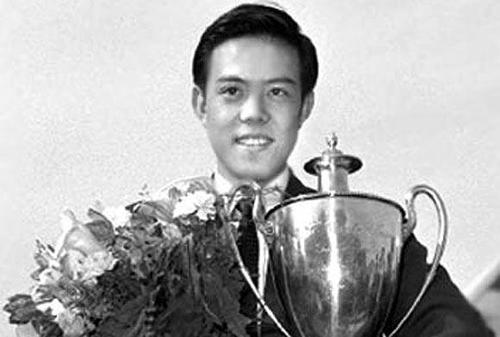
East of the Temple of Heaven in Beijing runs a street called Xingfu Dajie — Happiness Street. In apartment 12, building 9, on Xingfu Dajie once lived a family of four. On the evening of June 19, 1968, a man walked out of that home. Head bowed, saying nothing, he walked silently north, then east, and finally arrived at a commune's duck farm.
That duck farm became the end of his life's journey. The next day, he was found hanged from a locust tree.
He was Rong Guotuan, the Chinese Communist Party's first world champion. He was only 31 when he died.
On April 5, 1959, Rong Guotuan won the men's singles title at the 25th World Table Tennis Championships — the first world championship won by the People's Republic of China since its founding.
At the time, this achievement was extensively covered by CCP newspapers, magazines, radio, and television. After returning home, Rong was received by Premier Zhou Enlai, President Liu Shaoqi, and Party Chairman Mao Zedong. Almost overnight, Rong Guotuan became a household name across China, showered with flowers, applause, and praise.
Yet this once wildly celebrated figure walked down the irreversible road to suicide in 1968. Why did it come to this?
There appear to be five possible reasons:
First, his longtime patron He Long was purged.
The Cultural Revolution erupted in May 1966. Soon after, Liu Shaoqi, the CCP's number-two figure, was denounced and purged as ‘the biggest capitalist-roader within the Party.’ A wave of purges then swept through party, government, and military officials from the central government down to the local level, including Marshal He Long — vice chairman of the Central Military Commission, vice premier of the State Council, and director of the State Sports Commission.
On May 12, 1968, the CCP Central Committee, the State Council, the Central Military Commission, and the Central Cultural Revolution Group jointly issued an ‘Order on Placing the State Sports Commission Under Military Control,’ deciding to place the entire national sports system under military administration. The order declared that the State Sports Commission had been built entirely along Soviet revisionist lines by Liu Shaoqi, the Party's number-one capitalist-roader, together with the counter-revolutionary revisionist He Long and others; that it had long broken away from Party leadership and proletarian politics; that it had let in many bad elements; and that it had become an ‘independent kingdom.’
He Long had served as director of the State Sports Commission since 1952 and remained in that post right up until he was purged in the Cultural Revolution. Rong Guotuan was transferred from the Guangzhou team to the national team in 1958 and for years worked under He Long's leadership.
When Rong Guotuan returned home a world champion in 1959, He Long personally met him at the Beijing airport; back at the team's residence, He Long specially hosted a dance to welcome Rong and his teammates. Afterward, Rong became He Long's ‘golden signboard,’ whom he took everywhere to show off. He Long, for instance, brought Rong to Zhongnanhai to perform for Party leaders, and whenever important foreign guests visited, he often brought Rong along to state banquets.
In short, throughout Rong Guotuan's rise, He Long gave him a great deal of encouragement and support.
After He Long was purged in the Cultural Revolution on trumped-up charges, Rong Guotuan was branded as belonging to He Long's ‘black line.’
Second, his two coaches — famous Hong Kong table tennis players — were driven to suicide.
Fu Qifang, Jiang Yongning, and Rong Guotuan were known as the ‘Three Titans of Table Tennis’ who, in the 1950s, left British-ruled Hong Kong and returned to the mainland to serve their motherland.
All three were outstanding table tennis players who, both in Hong Kong and after moving to the mainland, won numerous championship titles. All three also became outstanding coaches who trained a number of world champions.
Fu Qifang and Jiang Yongning were both older than Rong Guotuan and both had served as his coaches, pouring enormous effort into helping him win his 1959 world championship.
In 1960, after becoming head coach of the national table tennis team and chief coach of the men's team, Fu Qifang led the men's team to consecutive men's team and men's singles titles at the 26th, 27th, and 28th World Championships. Under his tutelage, Zhuang Zedong won three consecutive men's singles titles at the 26th, 27th, and 28th championships.
But after He Long and other State Sports Commission leaders were purged, Fu Qifang, as head coach of the national table tennis team, was among the first to be targeted. He was falsely accused of being a ‘hidden spy,’ a ‘bourgeois element,’ and ‘a favorite of He Long's revisionist clique,’ and was locked in a small room where he was subjected to day-and-night denunciation sessions and both psychological and physical torment.
On April 15, 1968, Fu Qifang was severely beaten by Red Guard rebels, leaving him covered in injuries. On April 16, unable to bear the torment any longer, Fu hanged himself from a windowsill with a rope. He was only 45 years old; his son was not yet 10.
Jiang Yongning had been personally invited by He Long, through an intermediary, to come from Hong Kong to the mainland to play table tennis. Once on the national team, he received the highest salary of anyone, whether among the coaches or the players. After retiring as a player in 1957, he coached the national team for more than seven years, and in 1965 was transferred to become head coach of the Beijing table tennis team.
After He Long and other State Sports Commission leaders were purged, Jiang Yongning was falsely accused of being a ‘traitor to China’ and a ‘Japanese spy’; he was detained and his home was ransacked.
At the place of his detention, four burly men beat him with fists and kicks until his face was bruised, swollen, and covered in blood. He crawled under a bed, but was dragged out and beaten further, until he was knocked unconscious.
On May 16, 1968, he was ordered to clean the toilets. When he finished, he quietly went to a room on the fourth floor and never came out again.
When he was found, he had hanged himself from a window. He was only 41. His youngest daughter was barely 50 days old at the time.
The deaths of Fu Qifang and Jiang Yongning affected Rong Guotuan deeply. His longtime teammate Xu Yinsheng said: ‘Rong Guotuan truly couldn't bear it. Once he couldn't bear it, he couldn't see a way through. And so, in the end, he took his own life.’
Third, he was denounced as a ‘suspected spy.’
Rong Guotuan was born on August 10, 1937, into a working-class family in Hong Kong. He loved table tennis from childhood, and his uncle was his first coach. At 15 he competed for the Hong Kong Federation of Trade Unions' table tennis team; at 17 he won the Hong Kong Championship; at 19 he swept the men's singles, men's doubles, and men's team titles at the Hong Kong Open. That same year, he also defeated Ichiro Ogimura, the two-time world men's singles champion from Japan, by a score of 2-0.
Precisely because he had come from Hong Kong, which was still under British rule, once He Long fell from power Rong was treated as a ‘suspected spy’ and investigated. Leaders of the rebel faction summoned him and demanded that he honestly confess his ‘suspected espionage,’ warning that if he did not, ‘revolutionary action’ would be taken against him.
The rebels had already taken ‘revolutionary action’ against Fu Qifang and Jiang Yongning, driving both of them to suicide. Rong Guotuan was next in line.
Rong Guotuan's wife, Huang Xiuzhen, said: ‘Rong lived in Hong Kong for over a decade and had never experienced any political struggle. When the political movement came, it was as if calamity had struck, and he simply couldn't find a way out. Here was a man who had devoted his entire life to table tennis, a man who lived very simply, and yet they insisted on pinning the huge label of “suspected spy” on him. The injustice of it weighed on him so heavily he could barely breathe.’
Fourth, he could not understand the logic that ‘the more championships one won, the more reactionary one became.’
When the Cultural Revolution erupted, chaos reigned and right and wrong were turned upside down — not only did ‘the more knowledge one had, the more reactionary one became,’ but ‘the more championships one won, the more reactionary one became’ as well.
Huang Xiuzhen said: ‘The more championships he won, the greater his supposed “crime” became — this was something he simply could never make sense of.’
On November 29, 1957, Rong Guotuan left Hong Kong for Guangzhou to study at Guangzhou Physical Education Institute. From then on, whether representing the Guangzhou team or the national team, he won many championships.
In March 1958, as the leading player of the Guangzhou table tennis team, he took part in the ‘Nine Cities Table Tennis Championship’ held in Shanghai, featuring teams from Beijing, Tianjin, Shanghai, Guangzhou, Wuhan, and other cities. He defeated Wang Chuanyao, a leading national-team player then ranked eighth in the world, 3-0, to win the title.
That same year, representing the Guangdong team at the National Table Tennis Championships, he won the men's singles title and was subsequently selected for the national team.
In 1959, at the World Championships held in Dortmund, West Germany, he decisively defeated the veteran Hungarian player Ferenc Sidó 3-1, winning the CCP's first world championship title.
On April 9, 1961, Rong Guotuan and his teammates won the men's team title at the 26th World Table Tennis Championships held in Beijing.
In 1965, as coach of the Chinese women's table tennis team, Rong led the women's team to victory in the team event at the 28th World Championships. Two of his players, Zheng Minzhi and Lin Huiqing, also won the women's doubles title.
The day after Rong Guotuan's death, Zheng Minzhi said: ‘I understand Coach Rong. To him, dignity came above all else. I believe he was that kind of person — a man of integrity. He wouldn't wait for you to denounce him, because he believed he was innocent.’
Fifth, his dream of competing at the 30th World Championships was shattered.
The 30th World Table Tennis Championships was scheduled to be held in Munich, Germany, in 1969.
As a coach, Rong Guotuan very much wanted to lead his players to this international competition, hoping to prove through concrete action that he was wholeheartedly devoted to bringing honor to the country, and was not any kind of ‘suspected spy.’ In May 1968 he wrote a formal letter to the State Sports Commission requesting to compete. Not only did the letter vanish without a response, but a far greater storm was about to descend on him.
After the State Sports Commission came under military control in May 1968, the nationwide sporting world entered a further phase of ‘purifying the class ranks.’ Regarding Rong's request, the Commission's military control committee not only refused it, but ordered him to write a self-criticism and demanded to know why he had dared to write such a request at all.
This meant that any chance of his leading a team to the World Championships had dropped to zero. The political movement raged on around him with no end in sight. For a man whose entire life was table tennis, being unable to play, seeing no hope ahead, and having lost two coaches who were also mentors and friends to forced suicide, life no longer seemed to have any meaning.
Conclusion
The ‘Three Titans of Table Tennis’ who left Hong Kong for the mainland — Fu Qifang, Jiang Yongning, and Rong Guotuan — went to the mainland and fought tirelessly for the CCP's table tennis program because they genuinely believed in, supported, and loved the Communist Party. Along the way, all three joined the Party.
Rong Guotuan's close friend Steven N. S. Cheung wrote in a memoir that he had heard from mutual friends that Rong ‘had come to worship Chairman Mao deeply and was filled with tremendous enthusiasm for communism.’
Not long after being recruited to the national table tennis team, Rong Guotuan brought his parents from Hong Kong to Beijing as well, cutting off any path back to Hong Kong.
Yet during the Cultural Revolution, all three of these CCP party members — Fu Qifang, Jiang Yongning, and Rong Guotuan — were driven by the Party itself to their deaths.
Why did this happen? Mao Zedong, the very man Rong Guotuan worshiped, once said: ‘Struggling against heaven is endless joy; struggling against earth is endless joy; struggling against man is endless joy.’
Mao spent his entire life true to those words. ‘Struggling against man,’ in particular, never ended. If there was an enemy, he fought it; if there was none, he conjured one up to fight.
Many of the senior party, government, and military officials who were purged during Mao's 27 years in power — and later rehabilitated — were ‘enemies’ that Mao had simply conjured up. Fu, Jiang, and Rong were likewise ‘enemies’ conjured up by the rebel factions who zealously followed Mao during the Cultural Revolution.