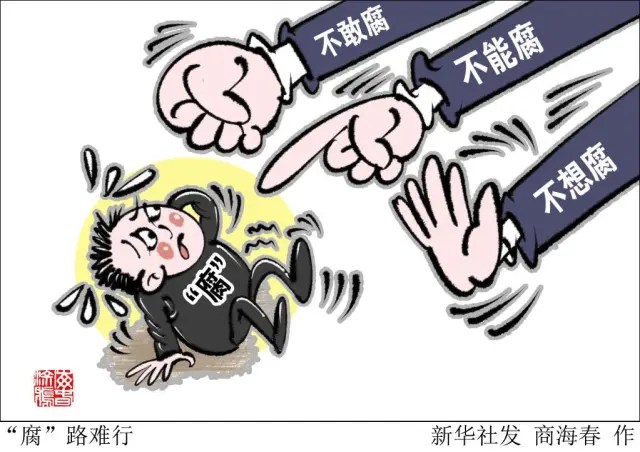
An article published Wednesday by France's Le Monde describes how China's former anti-corruption investigators have now themselves become targets of anti-corruption investigations. What's more, several senior officials who have now become targets of anti-corruption probes were once trusted aides of Wang Qishan, the former vice president once hailed as China's anti-corruption "tsar." Through the cases of several senior anti-corruption officials falling one after another, the Le Monde article reveals how China's anti-corruption campaign has gradually evolved from its original mission of "hunting tigers and swatting flies" into a form of routine, normalized political purging. Xi Jinping has shaped this ongoing, uninterrupted political purge into a mode of governance in itself.
The Le Monde article opens with the investigation of Li Xiaohong, former director of the General Office of the Central Commission for Discipline Inspection (CCDI). Li was long responsible for overseeing state-owned enterprises and financial institutions, and later held an important post within the CCDI during the most critical phase of Xi Jinping's anti-corruption campaign, where he was responsible for investigating a large number of senior officials. Yet nine years after retiring, he himself is now under investigation — by the very Central Commission for Discipline Inspection where he once held a key position — on suspicion of "serious violations of discipline and law."
Dong Hong, co-author with Li Xiaohong of a book titled On Financial Anti-Corruption, fell from power as early as 2020 and was sentenced in 2022 to death with a two-year reprieve for accepting bribes.
Le Monde notes that Li Xiaohong and Dong Hong share something in common: both served, at different times, as deputies to Wang Qishan, the commander-in-chief of Xi Jinping's anti-corruption campaign. In China's political system, even those responsible for fighting corruption cannot guarantee their own safety.
The article also notes that Li Xiaohong and Dong Hong were both important aides to Wang Qishan. Although Wang himself has not been investigated, the fact that his former subordinates have fallen one after another shows that the anti-corruption campaign has begun extending into the very ranks of the anti-corruption apparatus itself.
Le Monde says this phenomenon is bound to raise public doubts about the effectiveness of the anti-corruption campaign. If those responsible for overseeing and cleansing the system are ultimately found to be corrupt themselves, then just how meaningful were the achievements of the past decade-plus of anti-corruption work? As some experts have suggested, China's anti-corruption campaign may be not merely a tool for fighting corruption, but also an important instrument for maintaining political authority and consolidating rule.
Political Loyalty
The article further analyzes the characteristics of Xi Jinping's governance since taking power, noting that ever since rising to power in the autumn of 2012, Xi has consistently used anti-corruption investigations as his primary tool for consolidating personal authority and eliminating rivals within the system. In 2024, he once again called for "turning the blade inward," demanding that the discipline inspection and supervision system undergo self-rectification. This means that anti-corruption enforcement is no longer a periodic campaign, but has become a permanent, institutionalized arrangement.
Over the past decade-plus, a large number of senior officials have fallen from power one after another, including a foreign minister, a defense minister, an agriculture minister, the head of Interpol, heads of state-owned banks, and senior leading cadres in various provinces. Many of those who fell had been promoted during the Xi era, yet still could not escape being investigated. This shows that political loyalty has become the key yardstick for evaluating cadres.
The Military Becomes a Key Target of Purges
Le Monde's article also specifically emphasizes that the military has become a key focus of anti-corruption efforts in recent years. Xi Jinping appears particularly worried about corruption eroding the military; however, the accusations of "disloyalty" and "betrayal" that appear in many of these cases also hint that some form of political resistance may still exist within the ranks. The Central Military Commission and the top leadership of the People's Liberation Army have undergone massive personnel upheaval in recent years, with large numbers of generals investigated or having simply vanished. According to statistics, of the major generals still in their posts in early 2023, only a small number remained active by 2026. This shows that the scale of the purge within the military far exceeds what outside observers had imagined.
Political Purges Becoming Institutionalized and Routine
Le Monde says that this acceleration of China's anti-corruption machinery is closely tied to the political calendar. The CCP's 21st Party Congress will convene in the autumn of 2027, and it is widely expected that Xi Jinping will secure a fourth term at that congress. Ensuring absolute loyalty among top-level cadres has therefore become especially important.
But the significance of these political purges goes far beyond that. Today, they have become a core component of China's political system, and are becoming ever more institutionalized and routine.
However, this prolonged, high-pressure anti-corruption campaign has also produced an obvious side effect: on the surface, everything continues to function normally, but in reality, officials' motivation to take initiative has dropped sharply. Everyone is afraid, unwilling to take on any risk. As one township-level cadre put it: "No matter what we're doing, the first thing we think is: will this get me into trouble?"