
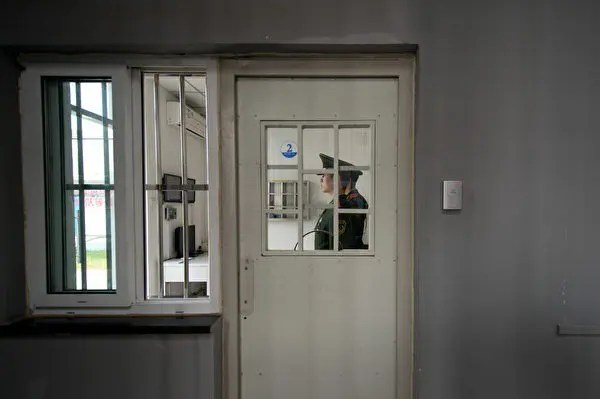
While investigating China's black jails, researchers unexpectedly discovered several companies openly advertising, on Douyin, padded anti-suicide facilities designed specifically for "liuzhi" [residential surveillance/detention] use. The narration in these videos claims that padded, collision-proof furniture and walls can "prevent accidents from happening during questioning" — implying the presence of physical abuse — and that the cries of detainees will be absorbed by the room; one video even states, "Not many people can actually hold up under these conditions."
China's black jails refer to facilities where CCP authorities detain people and restrict their personal freedom without any legal process.
In recent years, CCP authorities have legalized two systems of black-jail detention: the first is "liuzhi" (retention in custody), a form of secret detention used since 2018 by the National Supervisory Commission, which operates jointly with the Central Commission for Discipline Inspection, primarily targeting CCP members and state employees, but also applicable to non-state employees, including private individuals connected to cases involving Party and government officials — with a maximum detention period of 14 months. The second is "residential surveillance at a designated location" (RSDL), which applies to everyone else, including human rights advocates, rights-defense lawyers, and businesspeople.
Those held in black jails are interrogated for extended periods in complete isolation from the outside world, under round-the-clock surveillance by two guards. The windows of the rooms are always covered, and fluorescent lights stay on day and night. This kind of psychological torment often drives some detainees to the brink of suicide — which is precisely the coercive tactic the CCP uses to extract confessions, which is why officials have the cells specially treated to prevent suicide.
Safeguard Defenders, in a report published on June 11, said that mobile phones are not allowed inside China's black jails, victims are not permitted to meet with lawyers, and journalists and family members are also barred from entry; detainees are often hooded to obstruct their vision whenever they are transferred. It has been extremely difficult for outsiders to obtain photos or videos of facilities such as these anti-suicide installations. But the organization recently discovered, to its surprise, that several business-to-business (B2B) companies supplying equipment to China's security agencies are openly advertising their anti-suicide facilities on the Douyin platform.
Searching Douyin using the keyword "liuzhi" along with anti-suicide-related terms such as "padded walls," Safeguard Defenders found videos posted by three companies showcasing their padded anti-suicide furniture and fittings, including tables, chairs, and wall panels. The descriptions of "liuzhi" in these videos correspond closely to the various forms of inhumane treatment reportedly suffered by black-jail victims, as described elsewhere.
Two of the videos were posted by Guangzhou Youyinhui Building Materials Co., Ltd. The videos appear to show a liuzhi holding room, the entire space uniformly gray, furnished with an interrogation table, several chairs, and a hidden bed folding out from the wall. This also suggests that in some liuzhi rooms, detainees actually live inside the interrogation room itself.
The room has no windows at all, lit only by harsh strip lighting. The narration in the video says: "Under 24-hour lighting, with no blind spots for the high-definition surveillance... the entire room's gray color scheme seems to cast a shadow over your mood as well." "Two guards, following you like your own shadow." "Most of the time, all you can do is sit in a chair, staring at the padded walls... unable to contact the outside world. Visits aren't allowed either — as if you've been forgotten by the world."
(Video screenshot)
Youyinhui's second video describes the materials used to build this liuzhi room, noting that the padded anti-suicide fittings can "prevent accidents from occurring during questioning": the padded walls use "high-quality nano-cotton padding (polyethylene cotton padding) or fireproof cotton padding (glass-wool padding)." The product meets fire-safety and environmental standards, providing both sound absorption and "safety protection." The floor is covered with slip-resistant, noise-dampening flooring; all edges and corners of the tables and chairs are given "collision-proof padding treatment." The door is likewise given collision-proof padding and fitted with a coded lock, further enhancing confidentiality and security, and so on.
The second account to post Douyin videos was named "Interrogation Table and Chair Factory," reportedly based in Henan Province, though the specific company behind it could not be confirmed.
Its first video appears to show an old building being converted into a liuzhi facility. The video's narration says: "The walls are soft, the floor is soft — want to throw something? You can't. Want to scream? The sound gets absorbed." The narration continues that you have to report everything you want to do first. "Not many people can actually hold up under these conditions."
(Video screenshot)
The second video opens with "the lights stay on 24 hours a day": "You have no idea what time it is — all you know is that your three meals arrive on schedule. Want to sleep? The glaring white light keeps you wide awake. Want to roll over? Two pairs of eyes are watching you closely. The most tormenting part isn't the questioning — it's an environment so silent you can hear your own heartbeat."
(Video screenshot)
The third video was posted by Henan Mushi'er Smart Furniture Co., Ltd. The liuzhi interrogation room it exposes is likewise gray in tone, with the same padded interrogation table, chairs, and walls. At the far end of the room is a set of double doors leading to a bathroom, which has no mirror — only a rubber sink and toilet.
(Video screenshot)
Safeguard Defenders said: "These images evoke an unsettling sense of being inside a psychiatric hospital. The narration in the videos is even more chilling, seemingly reveling in listing off, one by one, the forms of torment its products can inflict." (Link to original report)
Official CCP data show that 38,000 people nationwide were placed under liuzhi in 2024, a 46.15% surge from 26,000 in 2023. In 2025, 47,000 people were placed under liuzhi, an increase of roughly 23.68% over 2024 — with the total number remaining at a historic high. Safeguard Defenders estimates that the cumulative number of people affected over the years likely reaches into the tens of millions.