
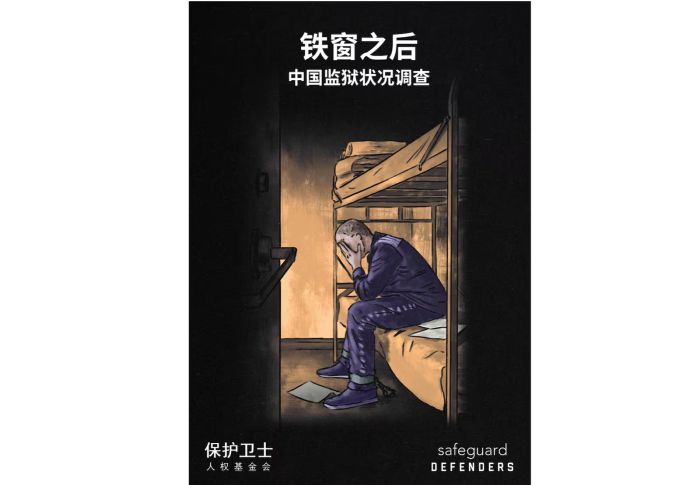
The international human-rights organization Safeguard Defenders released a report on July 16 titled “Behind Iron Bars: An Investigation Into Conditions in China's Prisons.” Based on the experiences of 59 former inmates from 16 Chinese provinces and municipalities, the report finds that violence, prolonged solitary confinement, forced labor, inadequate medical care, restricted communication, and mandatory political indoctrination are widespread in Chinese prisons. The report concludes that China's prisons lack effective outside oversight, and that the rights the law grants to inmates are frequently left unenforced in practice.
The report interviewed Matthew Radalj, an Australian businessman who served time in Beijing No. 2 Prison from May 2021 to October 2024. He said he was once held in solitary confinement for 194 days, his leg shackled the entire time to a bolt in the floor; when his ankle was chafed raw and became infected, he received no medication for it, and he was subjected to repeated electric shocks by prison guards during this period. China's Prison Law stipulates that solitary confinement of an inmate may not exceed 15 days.
Prolonged Solitary Confinement Called a Form of Torture
Li Fangping, a Chinese human-rights lawyer now living in the United States, told our station that China's Prison Law specifies that punishments for inmates include warnings, demerits, and solitary confinement, with confinement periods ranging from 7 to 15 days.
“194 consecutive days of solitary confinement clearly violates the Prison Law,” he said. “A prison cannot keep holding someone in isolation indefinitely simply because that inmate refuses to submit to management. Prolonged solitary confinement is, in effect, a form of abuse and torture.”
The report states that violence in prison comes both from guards and from inmates who have been granted managerial authority. Guards use fists, stun batons, pepper spray, restraints, and solitary confinement to punish inmates, and some prisons rely on cell bosses, room leaders, or corridor supervisors to help maintain order.
The report also notes that after suffering violence or being denied medical treatment, inmates often find it difficult to file an effective complaint.
Li Fangping, who has represented cases including those of Hu Jia, Chen Guangcheng, and Ilham Tohti, said that inmates have almost no access to legal assistance, with lawyers typically involved only in filing appeals.
“When inmates suffer various forms of violence in prison, or run into medical problems, lawyers cannot handle it as a normal part of their practice -- they cannot meet with the inmate normally to learn what happened, nor can they enter the prison to investigate. This is essentially a blank space in the legal system as well,” he said.
Low-Wage Labor Feeding Into the Commercial Market
Forced labor was another major focus of the report's investigation. Interviewees described widespread problems including unpaid or extremely low-paid labor, excessively long working hours, unreasonably high production quotas, and inadequate safety protections.
The report cites Radalj as saying that from February to August 2022, he worked 22 days a month, eight hours a day, and received a total of just 4.2 yuan in compensation over six months. His work included bagging documents, sorting labels, and processing medical supplies, some of it linked to China Post, Luckin Coffee, and medical-supply companies.
Chinese legal scholar Wang Kuide told our station that the wages Radalj received are shocking. Inmates producing goods at such extremely low wages, once those goods enter the market, inevitably create a form of unfair competition.
“Their wages are extremely low, and so is their cost of production. When the goods they produce enter the market, there really is a kind of unfair competition at play, which is clearly inappropriate. I think it should be entirely permissible to simply not require inmates to work,” he said.
The report also examines Chishan Prison in Hunan as a case study. According to media reports, the prison holds roughly 2,900 inmates and has, in recent years, held Li Mingzhe, Cheng Yuan, and Ou Biaofeng. The report notes that Hunan Yuanli Industrial Co., Ltd., which participates in prison labor production, has a parent company whose head simultaneously serves as director of the Hunan Provincial Prison Administration Bureau and secretary of its Party committee.
Political Indoctrination and Information Isolation
The report also examines the prison system's ideological remolding regime. Inmates are required to attend political classes and write reflection statements and confession materials; some foreign inmates are required to attend even when they cannot understand Chinese. Political education, labor, and demonstrated “confession” performance are all tied to a points system linked to sentence reduction.
Wang Kuide said that from a human-rights perspective, prisons should not force inmates to undergo political indoctrination, but noted that this problem is not confined to prisons alone.
“Everyone in China is subjected to this -- civil servants and employees of public institutions also have to attend regular political study sessions. It's a systemic problem, and very hard to solve by fixing just one part of it,” he said.
Interviewees mentioned that inmates suffering from infections, hepatitis, tuberculosis, and other illnesses often failed to receive timely treatment. Radalj said he was usually allowed only one phone call with family per month, lasting five minutes, and that letters were subject to censorship, often taking months to be sent or received.
The report, citing official data, states that China had roughly 680 prisons in 2018, holding approximately 1.7 million inmates; the authorities have not released complete figures since. The report estimates that, including those already sentenced but still held in detention centers or awaiting transfer, the total number of imprisoned people may be around 2.34 million.
China passed a revised Prison Law on April 30 this year, which will take effect in November. The new law stipulates that information involving state secrets, personal privacy, or matters that, if disclosed, could endanger national security, social stability, or prison order, may be withheld from disclosure. Safeguard Defenders believes this could further restrict public access to data on prison populations, deaths, medical care, labor conditions, and complaints of rights violations.
International Community Urged to Investigate Prison Supply Chains
Chen Yanting, a researcher at Safeguard Defenders, told our station that the report once again shows that China's prisons provide seriously inadequate protection of inmates' rights -- including the fact that forced labor is permitted under law, and that the legal definitions of torture and of who counts as an abuser are far too narrow; inmates granted managerial authority, such as cell bosses and production-line leaders, effectively act as agents of the authorities and can subject other inmates to violence and abuse. “The international community should pressure Chinese authorities, demand that multinational companies investigate whether their supply chains involve prison forced labor, and impose boycotts or administrative penalties on companies found in violation. Governments should also review their judicial and law-enforcement cooperation with China, and suspend the enforcement of extradition treaties,” he said.
This is the latest investigation by Safeguard Defenders, following its earlier investigation into China's detention centers, this time focusing on conditions inside prisons after sentencing. The organization recommends establishing an independent external inspection mechanism, making information on prison enterprises, labor conditions, and the destination of prison-made products public, and allowing United Nations human-rights mechanisms to conduct investigations inside Chinese prisons.