
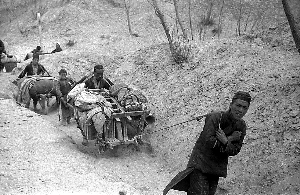
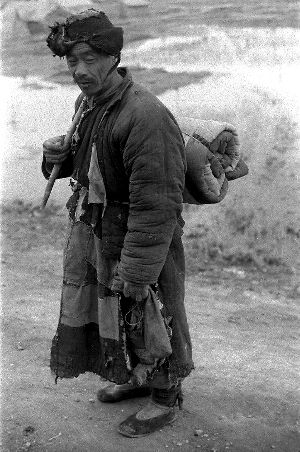
Between 1959 and 1961, the CCP's reckless policies caused a severe famine across mainland China. Various estimates put the number of unnatural deaths at between 15 million and 55 million, making it widely regarded as the largest famine in human history and one of the most catastrophic man-made disasters ever recorded. Under conditions of extreme starvation, some areas even saw horrific tragedies of cannibalism.
On April 23, 1961, a report on 'special cases' by the Anhui Provincial Public Security Department noted that '1,289 cases [of cannibalism] have occurred since 1959,' and that 'of 1,144 cases investigated, 36 involved selling human flesh to others, while the remaining 1,108 involved eating it within the family.' Zhao Jianmin, then deputy secretary of the Shandong Provincial Party Committee and governor of the province, said in one address that, according to incomplete statistics, 23 cases of cannibalism had occurred over the year and a half from the winter of 1958 to the first half of 1960, with more than a dozen additional cases reported orally but never documented in writing. On May 13, 1960, the Qinghai Provincial Public Security Department, in a 'Report on the Current Public Security Situation in the Xining Area' submitted to the provincial Party committee, stated that more than 300 cases of cannibalism had occurred in Xining City and Huangzhong County. On November 20, 2013, the Laogai Research Foundation released official Chinese investigative documents to the press on Capitol Hill in Washington, showing that 75 people were eaten in Linxia and Hezheng, 11 of whom had been killed specifically to be eaten.
Deng Zili, former Party secretary of the Luzhou prefectural committee in Sichuan, said: 'Horrific incidents of selling and eating human flesh also occurred. In Yibin, there was a case of a child being lured into someone's home, killed, cooked, and then sold in the street disguised as rabbit meat.'
Li Lei, then Party secretary of Linxia Prefecture in Gansu, wrote in his autobiographical book Long, Slow Years that in the ten communes under Linxia City, '588 people ate 337 corpses. For example, in the Xiaomengou production brigade of Hongtai Commune, a total of 125 corpses were eaten, along with 5 living people. Of the 8 work teams in the Xiaomengou brigade, cannibalism occurred in six of them. Twenty-three households ate a combined 57 people. A commune member named Bai Yinu ate eight people in succession, including three generations of his own family — his father, wife, and daughter. Li Galiu ate his own two dead children; after Li Galiu himself died, he was eaten by fellow commune member Hu Ba; and after Hu Ba died, he was in turn eaten by Xiao Zhengzhi.'
Yan Lebin, who worked at the Guizhou Provincial Public Security Department from 1959 to 1979, recalled that in 1961 he 'discovered a woman in her forties hacking at the corpse of a child with a kitchen knife in the main room of her house. The child's limbs had already been dismembered and the head cut off and set aside; the body gave off a foul stench. When we asked her why she had killed the child, she replied: "No, no, no, I didn't kill it — the child starved to death this morning. The whole family is starving, there was no other way, we had to eat it to survive!" She added: "What kind of person would be cruel enough to eat their own child!"'
In 1988, writer Sha Qing's book A Hazy Memory of Dadiwan recorded a real episode from the Great Famine: 'In one farming household, only the father and two children — a boy and a girl — remained. One day, the father sent his daughter out on an errand. When she returned, her younger brother was gone; a layer of pale, greasy substance floated in the pot, and a bone lay discarded by the stove. A few days later, the father again added water to the pot and called his daughter over. Terrified, the girl hid outside the door, weeping and begging: "Daddy, don't eat me — I'll gather firewood and tend the fire for you. If you eat me, there'll be no one left to work for you."'
Yang Jisheng, a former senior Xinhua News Agency journalist, wrote in Tombstone: 'Xinyang, Henan, had a population of 8 million at the time, of whom 1 million starved to death. Starving people even resorted to eating corpses — in winter, bodies buried shallowly in graveyards were dug up and eaten. Cases of cannibalism also occurred, with some people eating their own children.'
Based on his investigation, Yang Jisheng estimated that between 4,000 and 5,000 incidents of cannibalism occurred across China during that period.