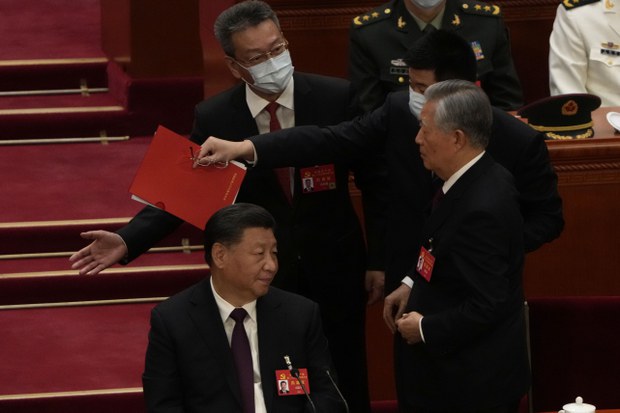
The most shocking impression left by the CCP's 20th Party Congress on the mainland and the world was not, in fact, Xi Jinping purging every CCP faction he distrusted and replacing the entire decision-making leadership with cronies from his own political career — men who pledged loyalty to him during his years in Hebei, Fujian, Zhejiang, and Shanghai. Although this move by Xi actually went even further than Mao Zedong ever did — Mao, after all, while only promoting the loyal, still made some show of drawing from every corner and faction, whereas Xi's naked reliance on nothing but his own clique of cronies is stunning in itself — this greater consolidation of political power still drew less attention than the sight of Xi gesturing to have Hu Jintao physically removed from the hall. That moment, which continued to dominate international and mainland public discourse, proved to be the far hotter topic.
Hu Jintao was not merely Xi Jinping's predecessor — he was also the single greatest force behind Xi's ability to rapidly consolidate real power. In fact, none of the CCP leaders before Xi ever truly held supreme power; they were merely front men, while real control remained in the hands of retired-but-not-really-retired Party elders operating behind the scenes. Former general secretaries Hu Yaobang and Zhao Ziyang, Jiang Zemin (while Deng Xiaoping was still alive), and Hu Jintao himself all had to defer to the elders behind the curtain or to the broader clique of Party elders. But Hu Jintao took the decisive step of stepping down completely and unreservedly, severing his own hold on power and thereby cutting off, once and for all, the elders' ability to manipulate power from behind the scenes. Without Hu Jintao's clean and total withdrawal, Xi Jinping would not only have failed to rapidly seize real power within the CCP — even if he had eventually managed to gain the upper hand after years of protracted power struggles with the old guard, there is no telling how long that might have taken, let alone how he could have achieved the position he holds today.
Whether Xi Jinping's brazen, personally-directed removal of Hu Jintao before the world's media was, as some commentators have analyzed, an ostentatious display of dictatorial power aimed at purging the Communist Youth League faction, or, as lip-reading experts have suggested, a last-minute coup to swap out the Politburo lineup, either way it highlights Xi's extraordinary ruthlessness in repaying kindness with enmity. And this kind of cold-blooded betrayal is by no means unique to Xi Jinping — it is a shared trait among the ambitious 'princelings,' the so-called red second generation of the CCP. Take Bo Xilai, for instance, widely regarded as far more capable than Xi. A princeling handpicked by the CCP who had already risen to the rank of Politburo member, Bo once said, without the slightest hesitation, that once he held supreme power he would kill 500,000 capitalists who had grown wealthy. This was no offhand remark made on a whim — as party boss of Chongqing alone, he could not wait to persecute local private entrepreneurs through his 'sing red, strike black' campaign, and even proudly invited senior Politburo officials, Xi Jinping among them, to come observe and cheer on his killing fields.
What Xi Jinping has done since seizing supreme power may differ in method from Bo Xilai, but his ruthlessness and regressive instincts are, if anything, even more extreme. In pursuit of dragging China back to the kind of tightly controlled political order Mao once imposed, Xi has openly declared that the Chinese people should be prepared to 'eat grass' for years if necessary, and has more recently even put forward the theory that socialism must be paid for in lives — meaning he is prepared to press ahead regardless, even at the cost of repeating a catastrophe of mass starvation. Generally speaking, the first generation of despots who seize power through violence tend to be extremely brutal and savage, while the second generation and beyond tend to grow comparatively weaker, gradually developing a more orderly and tolerant style of rule. Yet the CCP has dominated mainland China for more than seventy years — by historical standards, well past three generations — and its authoritarian rule has shown no sign of loosening; if anything, Xi Jinping's generation has become even more ruthless. What accounts for this reversal of the usual historical pattern?
First, of course, are the childhood and youthful circumstances of figures like Xi Jinping and Bo Xilai, since this stage of life plays a decisive role in shaping character and mindset. Family lineage undoubtedly played a crucial role in shaping the generation of Xi and Bo. Although both families suffered persecution during the Mao era, that experience led only a minority of victims to genuinely wake up to the truth; the overwhelming majority, despite their painful ordeals, still saw themselves as aristocracy of the red dynasty, and having endured persecution with nowhere to escape, fell instead into a kind of Stockholm syndrome, seeking to prove their worth through fanatical loyalty. Family influence occupies a special and important place within broader social influence: during the Cultural Revolution, to demonstrate his loyalty to the CCP, Bo Xilai broke several of his own father Bo Yibo's ribs by kicking him — and Bo Yibo, far from being upset, said gleefully that his son's ruthless streak showed the makings of a CCP leader. Xi Jinping's mother, after her son escaped from a Cultural Revolution detention facility and made his way home, marched him straight back through pouring rain without a moment's pause. This kind of merciless cruelty displayed between the closest of blood relatives undoubtedly served as a searing example for Xi Jinping's generation.
The personally harrowing experiences of Xi Jinping, Bo Xilai, and others further reinforced their ruthlessness, moving it from abstract awareness into lived, practical experience. During the Cultural Revolution, both Xi and Bo were well-known figures in Beijing among the 'Old Red Guard' princelings, and most Beijing residents who knew anything about that circle at the time knew their names. Both were also detained at various points because of their conduct during the Cultural Revolution — whether in study classes, juvenile detention centers, or prisons, these were all crucibles where the CCP used brutal methods to brainwash people and grind down their humanity. Few who endured such treatment emerged without a twisted, warped character, and for princelings like Xi and Bo, raised in the Communist mold and burning with ambition, this could only make their ruthlessness more entrenched and more thorough.
Of course, the most fundamental and decisive factor behind such ruthlessness is the Communist Party's own religion — its so-called theory of Marxist-Leninist violence. The Party has declared, openly and in black and white, its aim of annihilating every class and building a world in which only Party loyalists are permitted to survive. This ruthless doctrine, flying the banner of justice and liberation, unleashes the most savage, bloodthirsty impulses buried in human nature; within Party doctrine, and in the minds of its most fanatical adherents, any degree of ruthless bloodlust becomes ultimate truth. This is why Zeng Zhi, the wife of Tao Zhu, in her memoirs written in old age, showed no remorse whatsoever and instead recounted her bloody past with pride, treating the killing of others back then as an act of Party necessity and loyalty. Zhou Enlai not only ruthlessly killed more than a dozen members of Gu Shunzhang's family, young and old alike, but also murdered the very friends who had risked everything to help rescue him from prison. Liu Shaoqi, when a friend who had once helped rescue him was later detained and investigated by the CCP, kicked him while he was down and sent him straight to the execution ground to be shot. This kind of innate ruthlessness among CCP loyalists is precisely the Party spirit they strive to embody and express — for having no humanity at all is the very essence of the Communist Party's spirit. So one should never expect the ruthlessness of Xi Jinping's and Bo Xilai's generation to soften or hold back.