
Beijing resident and lawyer Liang Xiaojun wrote on Facebook describing his daily life: 'These days, entering any public place in Beijing requires proof of a negative PCR test within the last 48 hours. Without a recent test, you can't take a single step. My children have long since given up hoping for a return date to in-person school and are studying and attending class at home, but every day they still have to sign up in the parents' group chat for the day's PCR testing. Testing begins at 7 a.m.; my wife goes downstairs before 6 to line up, trying to get near the front. I wake the kids at 6:30 and take them downstairs — better to get it done early. Then it's back home for breakfast, reporting in the group chat, and opening the laptop to get ready for class. PCR testing has quietly become just another part of our daily routine.'
Liang Xiaojun suddenly realized: 'Through round after round of PCR testing, all of us have gone from adapting to being tamed. We no longer stop to think about whether these tests are actually necessary or scientifically sound for disease prevention — we simply line up mechanically every day and open our mouths for the "big whites" [health workers in white hazmat suits] to swab our throats, because the school demands it, the workplace demands it, the supermarket demands it, the park demands it... Domestication is easy. Once we become as dependent on PCR testing as the testing agencies themselves, we have been tamed, institutionalized — and those agencies, driven by profit, keep reinforcing this system of domestication.'
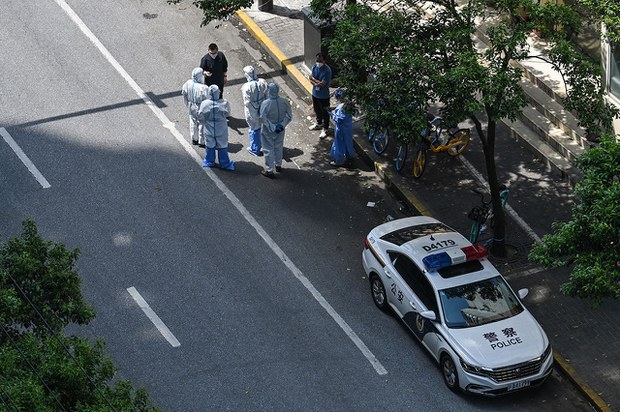
The virus has become the CCP's finest tool for controlling the people. The 'big whites' Liang Xiaojun mentions are also known among the public as 'white devils,' 'white guards,' 'white Nazis,' 'white-clad enforcers,' or 'white ghosts of death.' In the past, the CCP regime relied on state security and domestic security police to monitor and persecute dissidents; ordinary people generally believed that as long as they didn't actively oppose the Party and pretended to live contentedly in this 'age of peace and prosperity,' the government would leave them alone — and indeed, ordinary citizens rarely had occasion to be 'invited for tea' by state security. Now, with the virus spreading, a megacity of twenty million people can be locked down at a moment's notice, and the ones deployed to enforce it are not state security or domestic security agents but the so-called 'volunteers' known as the 'big whites.'
More than two years of the virus running rampant has not weakened Communist Party rule at all — it has, on the contrary, greatly strengthened its totalitarian mode of control. Xi Jinping has been unable to fashion himself into a charismatic great leader the way Mao Zedong was — Mao inspired most of the population to love him with utter devotion, to the point that some Red Guards pinned their Mao badges directly into the flesh of their own chests. But Xi Jinping is able to make people afraid, and the virus has become his best helper — people may not fear Xi Jinping, but they fear the virus and the specter of death it represents, and a people terrified enough of dying is a people easy to rule.
Xi Jinping has claimed that he enjoys reading The Book of Lord Shang. Whether someone with only an elementary-school-level education could actually understand a text written entirely in classical Chinese is questionable. But he has at least mastered Shang Yang's 'five techniques of controlling the people': unify the people (unify thought, control culture); weaken the people (a strong state and a weak populace, leaving people with no capacity to resist); exhaust the people (keep them so physically busy that they have no time left for spiritual pursuits); humiliate the people (strip away their self-respect so they willingly accept servitude); and impoverish the people (keep them in poverty, meeting only their most basic survival needs, since a poor person has no ambition left to want freedom). This describes exactly the condition of the tens of millions of residents locked in their homes in various cities — including Shanghai, superficially the most Westernized of them all.
The people of Shanghai celebrated joyfully when the lockdown was lifted, only to see many residential districts locked down all over again shortly after. Those under lockdown rarely curse Xi Jinping or the Communist Party — they simply chalk it up to bad luck. Those in areas not locked down count themselves lucky; as long as there is always someone worse off than themselves, people can still feel good about their own situation.
China is the largest laboratory in the world for domesticating human beings into pigs. Everything that happens in China is stranger and more exaggerated than anything in Orwell's Animal Farm or Nineteen Eighty-Four. This laboratory is a sealed prison, its high walls inscribed with the words 'peaceful and untroubled times' — stay quiet, and you get to live; complain or resist, and the guards will drag you out to make an example of you before everyone else. People have learned that silence is golden, and gradually adapted to conditions they once thought unbearable. Stratification has emerged among the prisoners themselves — cell bosses and bullies have arisen, gaining privileges by helping the guards maintain order. Day by day, people have gone from complaining about rat droppings in their rice bowls to feeling deeply grateful for a single bowl of thin gruel. The guards allow, and even deliberately provoke, infighting among the prisoners, since this is the best way to sap their energy. After a few years, this group of people no longer feels the absence of freedom; when a newly imprisoned arrival tells them how wonderful the outside world is, they respond in unison: the outside world is just prison after prison too, and out there you might not even get a bowl of thin gruel — it's better in here, so don't you dare entertain any foolish notion of escape. And whoever does entertain such a notion, the rest will surely band together to take him down.
From 'Hitler's Willing Executioners' to 'Xi Jinping's Willing Executioners'
The American scholar Daniel Goldhagen wrote a book that caused a huge stir, Hitler's Willing Executioners, in which he concludes, based on extensive historical evidence, that because ordinary Germans believed the extermination of the Jews was a just cause, they often actively and enthusiastically took part in killing Jews — sometimes carrying out executions on orders from above, and sometimes killing Jews on their own initiative even without any such orders. He cites the example of Reserve Police Battalion 101's massacres of Jews to show that these were ordinary civilians, not regular army or police, whose official duties had nothing to do with killing Jews; no one ordered or forced them to kill. They volunteered to kill Jews of their own accord, swept up in the broader tide of extermination at the time. Their desire to kill Jews was not regarded as some pathological or abnormal mindset — some of them even took pleasure in the killing.
The American scholar Robert Jay Lifton, in his book The Nazi Doctors, studied the psychology of medicalized killing and genocide, observing: 'The Nazi doctors were given great responsibility within the Auschwitz killing system: selecting victims, keeping this machine of physical and psychological murder running, and balancing the camp's killing function against its labor function. Though the doctors did not administer Auschwitz, they lent it a corrupted medical aura.' One survivor who witnessed this process up close said: 'Auschwitz was like a medical operation,' and 'from beginning to end, the killing was led by doctors.' Most of these doctors were ordinary medical practitioners who had never killed anyone before. But the brutal truth is this: human beings can be very easily socialized into killers. 'The human gift for adapting to one's environment, which has served our species so well, can also enable men and women of every kind to adapt to a genocidal system once it has taken hold, and to a prevailing genocidal mindset.'
The American scholar William Sheridan Allen, in his book The Nazi Seizure of Power: The Experience of a Single German Town, drew on years of interviews with residents of an obscure small town to reveal the hidden mechanics of how the Nazis operated at the local level. He found: 'The social cohesion of the town resided in its club life, and this was destroyed in the early period of Nazi rule. With the disappearance of social organizations and the reality of a system of terror, the townspeople became, to a great extent, isolated — this was true of the middle class and even of the workers, since the destruction of the Social Democratic Party and the trade unions disrupted the entire web of social connections that the town's clubs had built up. By breaking the townspeople down into disconnected atoms, the Nazis could then direct the resulting mass in whatever direction they wished.' The Nazis were masters of crowd psychology: 'The Nazis in this small town seemed to know exactly what to say and when to say it, what to do and how to do it, in order to win over the majority of the town's voters. Election after election, they meticulously staged lectures and rallies, elaborate parades, dances, military drills... After each event, they would carefully review the feedback and adjust the plans for the next one. Everything was done for the sake of seizing power.' The Nazis turned elections into a kind of 'coup carried out in installments,' using the electoral process itself to put an end to elections, to democracy, and to freedom.
These three studies of Nazism can equally serve as a mirror for today's China, overrun as it is by 'white guards.' Years ago, Mao Zedong wrote his Report on an Investigation of the Peasant Movement in Hunan; today, Xi Jinping — more cunning than Mao — will not be writing a Report on an Investigation of the Shanghai Lockdown. Yet the two men's secrets of rule are remarkably similar: Mao used rural riffraff, and later the Red Guards, to smash the order, ethics, and moral standards of traditional society; Xi has used society's urban outcasts and failures as his 'white guards.' One Facebook friend in Shanghai posted that a 'big white' in his community had once been a scoundrel that all his neighbors despised, someone no one wanted to even speak to — but the moment he put on the white protective suit, he was transformed, as if by some incantation, into a Boxer-rebel-like figure possessed of supernatural power, strutting about arrogantly, barking orders at the elderly, at women, and at children alike, exactly as a slave-owner treats a slave. This is precisely the effect Xi Jinping wants. As a boy, he personally witnessed his father — then a vice premier of the State Council — beaten by Red Guards who had been utter nobodies until they picked up the Little Red Book as their imperial sword of authority. Rather than sympathizing with his father's downfall, Xi instead found in the Red Guards a ring of power, and he means to use that ring to consolidate his own rule. The virus has thus become his best excuse, and the 'white guards' his best tool. He has no need to order tanks into the streets the way Deng Xiaoping once did — all it takes is a wave of his hand to send the 'white guards' rampaging like zombies.
Hannah Arendt observed: 'The effectiveness of terror depends almost entirely on the degree of social atomization. Before the full force of terror can be let loose, all organized resistance must have disappeared.' In the sense of making the populace willingly enslave themselves, Xi Jinping has succeeded more thoroughly than any CCP leader since Mao Zedong.