
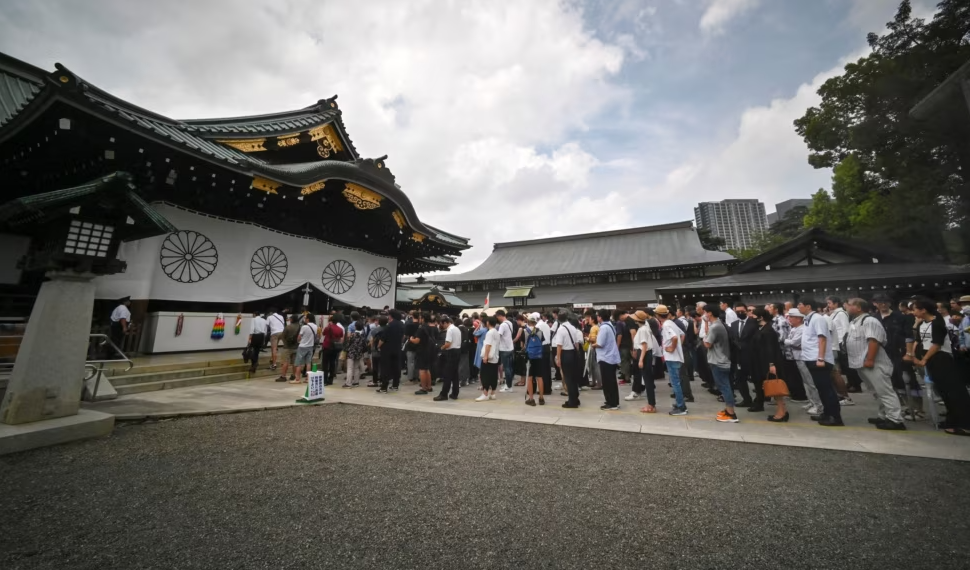
A Chinese internet personality named "Tietou" ("Iron Head") recently posted an English-language video showing him climbing up next to a stone pillar at the entrance to Tokyo's Yasukuni Shrine and urinating there, while spray-painting the English word "toilet" on the pillar in red. In addition, four American university instructors were stabbed with a knife while sightseeing in a park in Jilin, China; the motive remains unclear, but the evidence available so far indicates the victims were innocent bystanders.
The point this raises is exactly what the title of this piece suggests: China's social collapse is already producing an "international spillover" effect — the consequences of a "society where people harm one another" are now being visited upon foreigners as well, spreading beyond China's own borders and eroding and poisoning even the most basic norms of civilized human society.
"Petty Hooligan Terrorism" in International Protest
Both of the above cases can be analyzed from several angles, but what I want to emphasize is the social collapse they reveal. As noted earlier, the essence of social collapse is the breakdown of civilized norms — human relationships filled with hostility and harm, the formation of a "society where people harm one another." From one's own family members, to the people one serves in one's profession, to complete strangers on the street, no one is willing to trust or treat others kindly; everyone is filled with malice and ready to harm at any moment — this is the most common manifestation of social collapse. Now that this phenomenon's targets have expanded to include foreigners, spreading beyond Chinese soil, we are witnessing the international spread — or global diffusion — of China's social collapse.
This is also one measure of just how far China's social collapse has progressed. My previous two essays emphasized the alienation of family bonds and the loss of trust and goodwill between acquaintances that social collapse produces — that reveals the depth of China's social collapse. What I am discussing now, however, concerns interactions between strangers, especially between Chinese people and foreigners. In truth, regulating social interaction between strangers is precisely one of the major functions of civilization. Strangers naturally lack trust in one another, let alone any emotional bond; if they fail to interact according to civilized norms, they easily fall into the darkness of a so-called "jungle society." In any society, even a very small one, strangers inevitably make up the overwhelming majority — and this is especially true of international society. If social collapse takes hold here, its "surface area" is bound to be vast, and its consequences bound to spread outward on an enormous scale.
Conversely, one of the clearest hallmarks of a civilized society is goodwill toward strangers and foreigners. Whatever one might say about Chinese xenophobia, Chinese society has traditionally treated guests with courtesy, extending special courtesy to foreigners in particular, and placing great importance on its international reputation. There used to be a saying, "to lose face all the way to the international stage," meaning to be disgraced to the utmost degree. Perhaps that saying has fallen out of fashion now, because a new social trend has emerged — one that, first, no longer knows what "losing face" even means, no longer recognizes the very idea of shame; and second, treats foreigners as enemies, treats the international community as an adversary, and regards "the international stage" as a lawless zone for beating, robbing, and stealing, where seemingly any despicable act is fair game. Scholars of Chinese society used to emphasize how much Chinese people valued "face" — but is that notion not hopelessly outdated now? Is "shamelessness" not becoming the new trend in Chinese society?
The man who urinated there claimed he was protesting the Japanese government's decision to allow the discharge of contaminated nuclear wastewater. Some might ask: is international protest not allowed? But protest has its own norms. In democratic societies, all kinds of protests take place every single day, but they generally follow relevant norms and laws. Take protesting Japan, for instance: a protester may burn a Japanese flag, but he may not smash an innocent person's Japanese-made car, let alone pull a knife on any Japanese passerby he happens to see.
Of course, as terrorism has escalated worldwide, trampling on norms and laws to stage international protests is no longer a rare phenomenon anywhere in the world today. What I am discussing here is China's social collapse — this does not mean international society is free of social collapse of its own. Furthermore, urinating in a public place and broadcasting it on video is already sordid and degrading enough; but taking pride in such sordid, degrading behavior represents an even more extreme form of collapse, one utterly devoid of dignity or civilization. Perhaps the only fitting name for it is "petty hooligan terrorism."
Authoritarian Politics Catalyzes Social Collapse
Let me stress again: I am not opposed to international protest, whatever its target may be. What I am addressing here is the "degradation" of protest — that is, disregarding even the most basic civilized norms and expressing one's wishes, emotions, opinions, or grievances through means that fall below the baseline of everyday civilized social interaction. One more point must be made: it is precisely authoritarian political systems that continually catalyze this kind of degradation — in other words, that catalyze social collapse itself.
The causal chain here has many layers, and this short piece cannot cover them all, so let me address just two points. First, the man who urinated at the shrine boasted that he was "doing something significant," striking a righteous, high-minded pose — does that not eerily resemble the style of a Chinese Foreign Ministry spokesperson? Indeed, some analysts believe this man exploited the nationalist atmosphere promoted by Beijing, willing to resort to extreme means to achieve his own personal ends. As we know, the essence of nationalism lies in placing one's own nation's interests above all else. So exactly how did this act of urination advance the interests of the Chinese nation? Dressing up petty hooliganism (and one's own crotch) in the language of "national interest" is a favorite trick of authoritarian politics, because it is the authoritarian regime that monopolizes the right to interpret what "national interest" even means. If the state itself can play this game, then surely "Iron Head" can play it too — if the monk can touch her, why can't Ah Q? Call this the catalyzing effect of the "regime's demonstration effect."
Second, authoritarian politics also produces a "political prohibition-and-redirection effect" that likewise catalyzes social collapse, and likewise catalyzes its international spread. Just imagine: if a foreigner wanted to protest some policy of the Chinese government by urinating at the entrance of the Mao Zedong Memorial Hall, what would happen? Even a Chinese citizen — supposedly the very "master of the house" according to the Chinese government's own rhetoric — could never get away with relieving himself at the entrance to Mao's mausoleum. Without question, the authoritarian regime would crush him instantly! The three young men from Hunan who splashed ink on Mao's portrait during the 1989 Tiananmen protests, and Dong Yaoqiong, who livestreamed herself splashing ink on a portrait of Xi Jinping a couple of years ago, were both thrown in prison for it. By contrast, doing bad things is often perfectly safe in China, and playing the hooligan toward foreigners is something the CCP secretly delights in. How could a society like this not collapse? And how could a collapse like this not spread internationally?