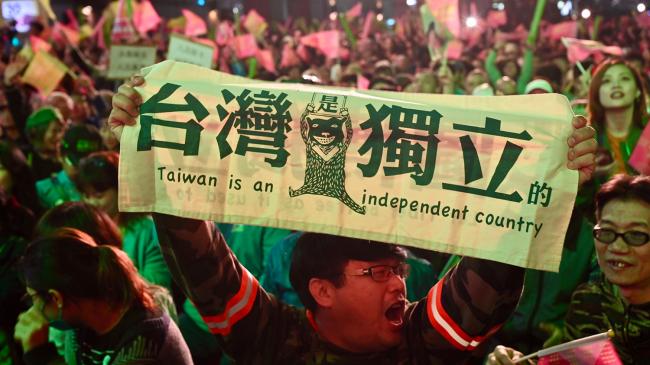
Taiwan's national status is a hot and highly important political issue in this year's presidential election. Ruling-party candidate Lien Chan appears to have inherited party chairman President Lee Teng-hui's "special state-to-state" theory, making UN membership the core of his diplomatic platform while still opposing Taiwan independence. The DPP's Chen Shui-bian takes as his central theme the position that Taiwan is an independent sovereign state, and advocates full normalization of relations between Taiwan and China, while taking no preset position on the future direction of cross-strait development. The New Party's Li Ao still holds firmly to an anti-independence, pro-unification-with-China stance. Independent candidate James Soong echoes the self-determination platform once put forward by the tangwai (outside-the-party) movement—"Taiwan's future shall be decided by the people of Taiwan"—while framing Taiwan-China relations as quasi-international relations. Hsu Hsin-liang, for his part, aims above all not to provoke China, leaving his actual position on Taiwan's status thoroughly unclear. In any case, it remains to be seen how each presidential candidate will handle this issue so vital to Taiwan's future—whether they will speak plainly and clearly or dodge the question, whether they will remain consistent or waver back and forth, or whether they will evade and obscure the issue to shift attention elsewhere. Whoever is elected, however, cannot escape the choice once in office. Because the overwhelming majority of Taiwan's residents—whether indigenous peoples, longtime residents, or newer arrivals—oppose the "one country, two systems" or "one country, three systems" formula proposed by the Chinese Communist Party that would turn Taiwan into a mere region of China, Taiwan will ultimately have no choice but to take the path of independence and statehood, unless it simply maintains the current status quo of neither unification nor independence. This article analyzes the question of Taiwan's founding of a new state as follows:
I. The Rationale for Statehood
Why should Taiwan become independent and found its own state? The answer is simple: since it does not wish to become part of China, the only path left is to become a new, independent nation. The overwhelming majority of Taiwanese people—whether indigenous peoples, longtime residents, or newer arrivals—have no wish to be ruled by China. Maintaining the status quo of neither unification nor independence not only strips Taiwan of national dignity and reduces its people to a stateless people, but also means that preserving its limited diplomatic relations is like repeatedly paying ransom to a kidnapper just to scrape by—a hard situation to break out of. What's more, China has never promised to refrain from using force against Taiwan simply because Taiwan maintains the status quo or refrains from declaring independence. In the end, only by building Taiwan into a new and independent nation can lasting security for Taiwan be guaranteed, and only as a new state distinct from China can it join international organizations and avoid the tragic fate of being extinguished at China's hands.
II. The Citizens of the New State
Taiwan's more than twenty-two million people are the rightful body of citizens for an independent Taiwanese state. Anyone unwilling to become a citizen of Taiwan would be free to choose to become a Chinese citizen in China instead, or to remain in Taiwan as a Chinese resident, in which case they would be treated as a foreign national. No foreign country—be it China or the United States—has any right to interfere in Taiwan's independence and statehood; this is a domestic matter for the people of Taiwan, and no foreign power has the right to intervene.
III. The Territorial Scope of the New State
In reality, Taiwan's national territory is confined to Taiwan, Penghu, Kinmen, and Matsu. After independence, Kinmen and Matsu—territories that formerly belonged to China—should have their fate decided by their own local residents, who would choose whether to belong to China's or Taiwan's territory and nationality. Founding an independent Taiwanese state can be accomplished at once, simply by building on the territory Taiwan already occupies. Taiwan's national territory would never need to conflict with or overlap China's territory. An independent Taiwan would not need to, and would not, encroach upon China, nor could China encroach upon Taiwan's territorial sovereignty—this is the most peaceful way to resolve the Taiwan-China dispute. By contrast, the current "Republic of China" still formally claims territory including mainland China under CCP rule, and even the territory of the Republic of Mongolia—a claim so grandiose and detached from reality that it is nothing but delusional, an absurd and ignorant position that only invites international ridicule and easily becomes a pretext for China to seize Taiwan.
IV. The Timing for Founding the State
The sooner Taiwan becomes independent, the better. The stronger China's ambition to annex Taiwan grows, the greater the danger to Taiwan becomes. Founding an independent state as early as possible is the correct way to avert crisis. After China took over Macau this past December, it will actively press forward with its plans to annex Taiwan. Next year, therefore, is also a good opportunity for Taiwan to achieve independence and statehood—whenever the people of Taiwan have the resolve to be masters of their own destiny, that is the moment for independence to be realized. Taiwan already lost opportunities for independence and statehood when it was expelled from the United Nations in 1971 and when China and the United States established diplomatic relations in 1977. If the new president, once inaugurated on May 20 this year, has the resolve and the boldness to act as a true president of Taiwan, he or she can rally the will and strength of the Taiwanese people and gradually advance a peaceful nation-building movement. As a last resort, should things come to the point of a CCP military attack on Taiwan, the great spirit of solidarity and action that the Taiwanese people displayed after the 921 Earthquake could likewise turn crisis into an opportunity for founding the nation.
V. Steps Toward Founding the State
(1) Abolish the One-China Policy:
Since Taiwan's full legislative re-elections and the direct popular election of the president, the One-China policy has survived in name only. Clinging to it any longer would only lend legitimacy to China's ambition to annex Taiwan. This is especially true now that China, having already recovered Hong Kong and Macau and having no more unfinished business there, is urgently plotting to annex Taiwan as well; failing to break free of the One-China constraint as soon as possible can only harm Taiwan, with no benefit whatsoever. The Kuomintang itself understands this well and has been gradually changing course: before the National Development Conference in mid-December 1996, it reached a consensus with the DPP and the New Party affirming that "Taiwan is not part of the People's Republic of China; Taiwan and the People's Republic of China are two equal political entities"—in substance, already abandoning the One-China policy. This lesson was driven home further when Nelson Mandela, president of South Africa, the largest country then maintaining formal diplomatic relations with Taiwan, announced the severing of ties with Taiwan in favor of relations with China—showing just how deeply the "One-China policy" harms Taiwan. Refusing to abandon the One-China policy is tantamount to cutting oneself off from the international community. What foreign country would ever want to establish diplomatic relations with "a province of China"? By abandoning the One-China policy, Taiwan would make clear that it harbors no ambition to unify China (the idea of Taiwan unifying China is, in truth, a fantasy), and that it bears no ill will toward China. Once the Taiwanese government stops bluffing about "recovering the homeland and retaking the mainland," China would have no grounds for objection, much less any pretext for using force against Taiwan.
(2) Publicly Recognize the People's Republic of China as the Sole China:
Ever since the Chinese Communist Party defeated the Kuomintang in 1949, seized control of China, and established the People's Republic of China, it has represented China. Its entry into the United Nations in 1971 made it, internationally, the recognized sole representative of "one China." Only the Kuomintang and the New Party continue to obscure this fact and mislead the people of Taiwan about it. Once the One-China policy is abandoned, "one China" simply means the People's Republic of China, and Taiwan's public acknowledgment of that fact would merely be facing reality and complying with UN Resolution 2758—something China should naturally welcome. Faced with such a goodwill gesture from Taiwan, China would have no reason to reject it or turn hostile in response.
(3) Declare That Taiwan Is Not Part of China:
Since the People's Republic of China is the sole China, and Taiwan has never been ruled by it—China has never had a single soldier stationed in Taiwan—the fact that Taiwan does not belong to China is common knowledge. What offense could such a declaration possibly give China? It would leave China with even less of a pretext to use force against Taiwan. If China were to act so overbearingly as to forbid even Taiwan's declaration of a fact—that it is not part of China—such conduct would certainly find no support in the international community. Moreover, peoples inherently possess the right of self-determination. For Taiwan's government and people to affirm that they do not belong to China is simply a continuation of a state of affairs that has held true both in the past and the present, leaving China no standing to object.
(4) Change the Country's Name from the "Republic of China" to the "Republic of Taiwan":
The name "Republic of China" has repeatedly been used to represent China; Taiwan should no longer keep a name so easily confused with it in the eyes of the international community, one that also robs the Taiwanese people of a clear national identity. Removing this name that falsely claims to be "China" would be a gentlemanly gesture of respect toward the true China—the People's Republic of China—one that would carry full persuasive force with the international community and leave China with no choice but to accept it. Should China nevertheless resort to force over this, and the people of Taiwan bravely resist, the international community would certainly condemn China and come to Taiwan's aid. Since the name "Republic of China" no longer suits Taiwan, it can only be changed, so that the nation's name matches its reality and it can thereby gain international recognition. Changing a country's name is no harder than changing a person's name. Sri Lanka and Myanmar have both changed their national names; when Pakistan split into two countries, West Pakistan kept the name Pakistan while East Pakistan took the name Bangladesh, avoiding confusion without any loss of national dignity. Taiwan should adopt a new name unrelated to China, one to be decided by the whole body of Taiwan's citizens. That said, because the name "Taiwan" is already widely recognized internationally, it is the name best suited to Taiwan's own history and geography.
(5) Draft a New Constitution for the Republic of Taiwan:
Once the country's name is corrected, a new nation naturally calls for a new constitution. Drawing on the sound constitutions of other countries while taking full account of Taiwan's own conditions and needs, a new constitution should be drafted so that the constitution of the new, independent Republic of Taiwan can serve as the foundation for the nation's founding and future development.
(6) Join the United Nations as the Republic of Taiwan:
The greatest obstacles to Taiwan's UN membership are China's objections and the name "Republic of China" itself, and the two feed into each other. Once the Republic of China is properly renamed the Republic of Taiwan, it is no longer part of China but a new, independent nation, leaving China without legitimate grounds for objection and freeing other member states of any concern about interfering in China's internal affairs. When the Republic of Taiwan, with a population of more than twenty-two million, applies to join the United Nations as a new member working for world peace, the UN should naturally welcome it, in keeping with its own founding purpose. Once admitted into the international community, the Republic of Taiwan could adopt the status of a permanently neutral state, establishing peaceful and mutually beneficial diplomatic relations with all countries, including China, and thereby becoming a nation where its people can live and work in lasting peace and security.
Conclusion:
The six steps outlined above fully accord with the principles of peace and reason. For the first two in particular, China would have no room for objection, and the international community would accept this approach as consistent with international realities. Once Taiwan breaks free of "one China" and no longer contests the name "China," it becomes a natural and logical matter for it to become a separate, independent, and self-governing nation. Taiwan already has its own president, people, territory, government, and governing authority—it already possesses all the essential elements of an independent state. To then establish, whether by peaceful declaration or by referendum, a Republic of Taiwan with no connection to China, safeguarding Taiwan's sovereignty and, in doing so, protecting the human rights of the Taiwanese people—what grounds would China have for using force against Taiwan? The international community, too, would support Taiwan on the grounds of human rights and humanitarian principles. But what matters most is that the people of Taiwan, at home and abroad, must have the courage to stand up and work together to defend Taiwan's future. Building a new and independent Republic of Taiwan will surely succeed!