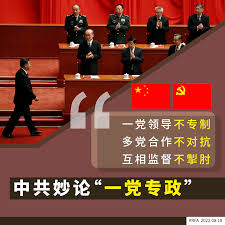
First, resources are embezzled and squandered by cadres. An open society is a multi-centered society, in which different centers check and balance one another; an authoritarian regime, by contrast, is a single-centered society, with the Party leader as its permanent center. This “all-overriding” privileged center monopolizes all resources, which naturally blocks competition and escapes oversight. Such a government is therefore monopolistic, wasteful, corrupt, and incompetent.
Second, policy blunders occur very easily—the Great Leap Forward, which starved fifty million people to death, is one example. Since the 1990s, China has engaged in massive infrastructure construction, leaving ghost cities and empty buildings everywhere; now it throws vast sums of money at the Belt and Road Initiative.
Third, talent is wasted. What a dictator needs is sycophantic flattery, while people of independent mind become precisely the targets of suppression. In an authoritarian society, people's basic rights are not adequately protected, and their initiative and enthusiasm are stifled; freedom of speech is not guaranteed, and the wisdom of intellectuals cannot serve as a basis for policy decisions. In an open society, information flows more horizontally than vertically, but a one-party dictatorship demands that horizontal flows of information serve and submit to vertical control, which is out of step with the times and an object of ridicule. The CCP fears that people will expose its lies; Xi Jinping has demanded that the media and the internet “bear the surname of the Party,” imposing all manner of restrictions on the internet, which inevitably limits the exchange of information and freedom of speech and suppresses people's capacity for innovation. Moreover, the CCP's personnel system, which favors the inferior over the capable, wastes human resources on a massive scale; large numbers of talented people “vote with their feet” and flee this authoritarian society.
In Chinese society, those in power are never wrong. Whoever holds office represents what is correct. The CCP, which styles itself as “eternally great, glorious, and correct,” tolerates no criticism, readily slapping the label “anti-Party, anti-government” on anyone who dissents. It is a party with no capacity for self-correction, one that, once wrong, stays wrong to the end, and once rotten, rots straight through. When Peng Dehuai tried to correct course, he was thrown into prison; when Liu Shaoqi tried to correct course, he was cast into the eighteenth level of hell; when Lin Biao tried to correct course, he ended up dead. When Bi Fujian privately cursed Mao, Xi Jinping had him stripped of his livelihood. When Deng Xiaoping fostered extreme polarization and tolerated rampant corruption, students who marched in protest were hunted down by tanks. Faced with this monstrous crime, the CCP shows no remorse whatsoever—instead it claims to be utterly infallible, and cracks down hard on those who commemorate the victims. Within the CCP system there is no mechanism for self-correction, and no force capable of stopping the Party from erring or even committing crimes. Under this “great, glorious, and correct” leadership, the historical record can be summed up in two words: catastrophe.