
From the moment it seized power in Soviet Russia, communist tyranny has now existed for a century. Records from the U.S. Congress show that communism has killed at least one hundred million people, [1] and The Black Book of Communism documents its bloody history and the facts in detail. [2] From the declassified archives that emerged after the collapse of the Soviet Union and the Eastern European communist bloc, to the casualty figures from successive political campaigns made public by the CCP's own Party History Research Office, to the international tribunal's trial of the former Cambodian communist leaders for the crime of mass murder, to the current totalitarian tyranny of the Kim regime in North Korea, people have gained a fairly substantial understanding of communist tyranny's murderous nature.
Many scholars have compared the differences between communist totalitarianism and Nazi totalitarianism. These comparisons certainly contain many valuable insights, but there is one point scholars usually overlook. The Nazi slaughter of the Jews had extermination itself as its purpose, but for the Communist Party, killing is not the ultimate goal—it is a means. Believers hold that the death of the physical body is not true death; the soul still enters heaven or is reincarnated. The Communist Party, through the method of mass killing, implants fear in people's hearts, forcing them to accept its evil doctrines, and ultimately, through moral corruption, leads human souls into hell. It seeks to destroy not only people's bodies, but their souls as well.
The Communist Party's killing has another characteristic: it strengthens the ruthlessness of its own members by selecting the most evil among them to hold power. What many people cannot understand is why the Communist Party constantly carries out internal purges. Many people simply held differing opinions on some issue—they neither opposed the Party nor its leaders—yet they were ruthlessly purged, even to the extent of implicating their entire extended families. One reason for this is that, because the Communist Party is an enemy of both God and man and its crimes reach to the heavens, it constantly feels a crisis of survival. For this reason, the Party needs to find people with the least sense of right and wrong to serve as its core force. The process of slaughter is itself a process of selecting the most vicious and ruthless evildoers, so that the communist evil spirit can safely hand power to them, ensuring the continuation of this tyranny. For example, during the June Fourth massacre of 1989, every Party member who could not bring himself to act ruthlessly was purged, and through this process the most evil of them all, Jiang Zemin, was selected to become the CCP's next leader. Jiang Zemin later, for the same reason, chose Luo Gan and Zhou Yongkang—the most brutal figures in the persecution of Falun Gong—to enter the top leadership one after another.
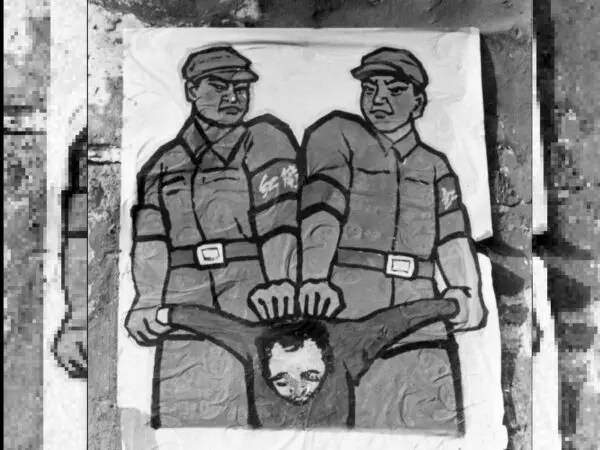
This kind of killing sometimes requires the participation of the entire population, as in the Cultural Revolution, so that everyone's hands are stained with blood; once people have committed crimes together with the Party, they more readily become defenders of this criminal system. To this day, many of the Red Guards who once beat, smashed, and looted still proudly proclaim “no regrets for our youth”—a vivid portrait of exactly this mentality.
Beyond this, the communist cult uses mass killing to eliminate enemies it has manufactured, and to make onlookers, gripped by fear and trembling, abandon all doubts about the Communist Party.
Once we understand these reasons, one phenomenon becomes easy to explain: throughout human history, whether in war or under tyrants, there was always an enemy first, and killing followed. The Communist Party does the opposite—it kills for the sake of killing, and seeks out enemies to kill; when there is no enemy, it manufactures one.
For a country like China, with such a long history and such deep traditional culture, sustained and large-scale killing was an indispensable method. Because the traditional Chinese people believed in gods and revered the Buddha, the cultural depth, intellectual substance, and national spirit accumulated over five thousand years could never accommodate a communism that hates gods and Buddhas and worships violence. The communist heresy therefore had to rely on violence to transplant and sustain itself in China. Before that, it rehearsed this process in the Soviet Union.