
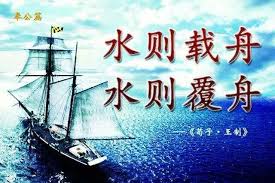
In mainland China in recent years, cases of ordinary people ending their own lives have become an almost constant refrain — jumping from bridges and buildings has become a trend, and young people have taken to arranging group suicides deep in the mountains and forests. This phenomenon of finding life not worth living has become utterly commonplace. Since last year, indiscriminate car-ramming attacks have become a new fashion, with perpetrators showing less and less restraint, as though the more people killed and the deeper the harm to society, the greater the sensational effect, and the more "worthwhile" the act. Many concerned observers have tried to trace the causes of these social tragedies: individuals driven to desperation, careers and families meeting with injustice, entire households wronged with nowhere to appeal — all of this can explain individual cases. But I believe that when the same kind of phenomenon occurs so widely, there must be a deeper, systemic and structural cause. Popular resentment in China is rising fast; the whole country is dry kindling waiting for a single spark. One deep-seated cause is that the state has essentially lost its sense of righteousness. What is a state's moral duty? A state exists to secure the people's happiness, to lead its citizens down a path of shared prosperity, equality, and freedom — without that, a state has no meaning at all for its citizens. But in China today, the state is merely a tool used by a small clique of corrupt CCP officials to enslave the people: the people support the CCP, letting the CCP oppress and exploit them; the people are expected to solve every problem the CCP faces, while the CCP never solves any problem the people face. For a state to lose the very meaning that justifies its existence is the CCP's incurable disease. The People's Republic of China has been the CCP's private property from the very start — China's wealth does not belong to the Chinese people, the Chinese people have no right to have a say in how China is governed, and the word "people" in the country's name carries no substantive meaning whatsoever. The proper relationship of subordination between the state and the people has been inverted: the state is no longer truly a state, and the people can hardly be said to be its people. A second deep-seated cause is that the government has become severely dysfunctional. The function of government is to manage the state effectively, to lead the nation's economic development with sound policy, raise living standards, and open up broad prospects for the future. But instead, the government creates all manner of problems for itself, then proves incapable of handling them correctly once they arise. Politics and the economy grow worse by the day, domestic and external troubles pile up like mountains, and in the end every one of these troubles lands on the people, making their lives ever more unbearable. Recent measures to rescue the property market and the stock market have both failed; efforts to boost consumption lack force, investment has lost direction, foreign trade is running dry, and diplomacy and military affairs alike are strewn with thorns. At the same time, the harder zero-COVID was enforced, the less it worked; the harder corruption was fought, the bigger the corruption grew; the harder stability was maintained, the more unstable things became; the more dictatorial the rule, the harder it became to actually govern. The CCP's current predicament is total, long-term, and deeply entrenched, and Xi Jinping stands helpless before troubles both at home and abroad. With no outlet for popular resentment, tension between officials and the people is intensifying, even as the regime mouths empty praise for itself and enforces stability by force with one hand, while sprinting headlong toward its own dead end with the other. A third deep-seated cause is social disorder, the inevitable result of a state without righteousness and a government without competence. A normally functioning society runs on a workable set of traditional logic, with law and social conscience as its moral baseline: government exercises self-restraint, the public trusts one another, superiors and subordinates follow rules, officials and citizens share common understanding, and people treat each other with kindness and empathy. But this whole customary and once-effective order has rapidly collapsed under the CCP's own prolonged campaign of destruction.
Social disorder did not happen overnight — it has worn away day by day, eroded bit by bit. Those on top do every manner of evil, and those below follow their example; whoever steals the state becomes a lord, whoever enriches himself is called clever, and the common people are treated as nothing more than straw dogs. The people have endured and endured until endurance itself turns to gold, and when they can endure no more, all that is left is to find their own way to survive. And what is that way? To refuse to be a docile subject, to refuse to be a slave, to risk disrupting the social order itself in order to stay alive. Because pent-up resentment can no longer be suppressed, tearing down the social order carries not only a pursuit of self-interest, but also the grim satisfaction of "if I go down, you go down with me." A fourth deep-seated cause is that the people have lost their soul. A nation has a thousand years of traditional culture, and a country should likewise have a positive ideology of its own. The spiritual core of Communist China was imported wholesale from Marxism-Leninism's revolutionary orthodoxy, then kneaded together by Mao Zedong with China's own feudal-imperial thinking into a monstrous hybrid that resembles nothing at all. By now, Marxist-Leninist-Maoist thought is no longer adequate to explain twenty-first-century human civilization, and the CCP's indoctrination looks ever more detached from reality and hollowly absurd: Marxism-Leninism does not work, capitalism cannot be openly embraced, universal values cannot be spoken of, and feudalism cannot be retained — the Chinese soul has long been left fragmented, in a tragic state with no coherent shape at all. The reason the people have lost their soul is that China has cut itself off from the world and from the currents of the times, as the CCP imposes tight control over speech in a desperate effort to cling to its authoritarian rule. In the early days of reform and opening up, capitalist ideas once poured in, but as the economy began to improve, the CCP, invoking its "Four Cardinal Principles," erected barrier after barrier against the intellectual liberation of the Chinese people. Since Xi Jinping came to power, this has intensified by every possible means, tightening ideological control and social stability maintenance, and the Chinese people's spirit sinks lower and grows emptier by the day, like water with no source or a tree with no roots. The loss of the people's soul has caused the nation to lose any basic spiritual pursuit or shared values; all that remains between people is appetite, desire, and the pursuit of advantage while avoiding harm. And basic human decency, worn down against a cold, hard system, all too easily gives way, until bestial instinct finally overrides humanity itself. A state without righteousness, a government without competence, a society without order, a people without soul — mainland China now stands in an unprecedented state of fragmentation, and a visible disintegration is under way, starting from the very bottom of society. History cannot be defied, and no human power can turn back the tide. These indiscriminate killings are merely the outlet of a few individuals venting their rage — but from kneeling submission to "lying flat," from suicide to homicide, from the individual to the collective, from the economic to the political, from isolated incidents to outbreaks everywhere: this road is not a long one. Anyone with a shred of common sense can already see where this ends, and the CCP can see it too. In truth, whether one sees it coming or not, the ending will arrive all the same.