
Decision = Judgment + Objective
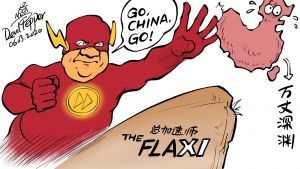
Xi Jinping has earned the nickname “Chief Accelerationist” for his reckless, aggressive style of rule. Everyone says the General Secretary is illiterate, an idiot. But I don't think we should write off a political figure as a simple idiot. Xi isn't a mere politician—he's a true ideologue, which means Xi is really an idiot with conviction, in other words: a reckless hothead.
Even an ideologue is human, but to be one, his foolishness needs its own logic and evidence. The purpose of this article is to explain what, in the Chief Accelerationist's own mind, actually lies behind everything he does.
As I see it, Xi Jinping, as someone who holds decision-making power, must first form a judgment before making any decision, and a single judgment can give rise to many decisions. For example, when a person crosses the street: if he judges that he has enough time and that the oncoming traffic is being driven by ordinary, rational people, he will cross when the light is right. But if that same person wants to kill himself, that identical judgment about timing and traffic will lead him not to cross.
Decision = Judgment + Objective.
This article will systematically analyze the three core judgments underlying everything Xi Jinping does.
First: Foreigners Can Only Be So Ruthless
People are sometimes baffled by Xi Jinping's hardline policies toward Hong Kong, Taiwan, Europe, and America—especially over the past couple of years, during which he hasn't just offended a few countries, he's practically offended entire continents. That's why we like to call him the “Chief Accelerationist.”
In my view, Xi has his own reasoning for acting this way. Take Hong Kong: we can see that despite the escalating resistance from Hong Kongers, Xi kept ratcheting up the crackdown, layer upon layer. The same was true of the trade war—anyone with a shred of common sense knows there's no way to win that kind of contest against the Americans; the sheer gap in overall strength is plain for all to see.
But Xi doesn't see it that way.
Have you noticed? In his series of actions against Hong Kong, Xi anticipated that the West would impose sanctions. But as I've argued in earlier pieces, Xi thinks like a gambler. To him, the Hong Kong issue is like an auction: even though he holds fewer chips than the other side, he can strike an absolutely uncompromising pose and keep raising the stakes, betting that the other side will eventually decide, out of sheer rationality, that it's not worth playing anymore. Take the extradition bill he pushed in Hong Kong, for instance—it drew global attention and put the CCP under real public-opinion pressure.
Then he pushed through the National Security Law, which triggered Western sanctions. Xi believes he has figured out the West's bottom line: even in the worst-case scenario—effectively “one country, one system,” with the PLA deployed to crush resistance—Western militaries still won't land troops in Hong Kong to intervene. So in his mind, he wins. As long as he's ruthless enough, unprincipled enough, and stubborn enough, he can make the West give up.
Xi hopes to defeat reason with sheer madness. This was his basic calculation on the earlier trade dispute, and it will likely be his approach to the future Taiwan issue as well: as long as he's willing to inflict 1,000 casualties on himself to inflict 800 on his enemy and see it through to the end, rational Western countries will end up making concessions instead. So we can more or less predict how Xi will act on Taiwan in the future: he'll strike the outlying islands first, betting that the United States won't move, since he assumes Washington won't risk everything for a small island. Then, step by step, inch by inch, he'll exploit the West's instinct to compromise to gradually expand his own room to maneuver.
In short, his attitude is: I'm going to be a constant thorn in your side—so what are you going to do about it, hit me?
Second: The Communist Party Is Absolutely Capable of Controlling the Domestic Situation
This has two layers of meaning. First, Xi believes that the CCP's extensive experience in “stability maintenance,” combined with high-tech surveillance and control of public opinion, plus what he sees as the Chinese people's cowardly tendency to starve rather than rebel, gives the regime enormous resilience and toughness—so much so that short of an actual American military landing, the CCP government cannot be overthrown. And even if U.S. troops did land, by the logic of his first judgment, the Party could organize a human wall, throwing countless Chinese bodies in the way until the Americans grow too uneasy about the killing to continue—and by that measure alone, the Party would have won.
Or the Party can simply exploit the Chinese people's stupidity and cowardice, along with a media environment it can freely manipulate, to absorb the cost of its own outrageous, reckless conduct.
On top of that, he believes that an absolutely loyal police apparatus, military, and propaganda machine—working together on three fronts—can beat the shit out of any ordinary person who dares to voice a complaint, so he doesn't need to worry about internal chaos leading to his own overthrow.
This is why we see Xi's government using every means available to inject painkillers into the domestic economy, or robbing Peter to pay Paul through fiscal and monetary policy—as long as it can keep ordinary people (often mocked online as “leeks,” forever there to be harvested) from all going hungry at the same time, it can keep their anger divided, and the three-pronged stability-maintenance system of police, military, and propaganda can keep functioning. After all, the essence of “stability maintenance” is division: dividing ordinary people from other ordinary people, dividing the public from civil servants, dividing the military from veterans, dividing civilian officials from the police and security services, dividing the rich from the poor—any division will do.
The essence of stability maintenance is division. As long as the gains and losses of 1.4 billion people never align, they can never spontaneously rise up to overthrow the Communist Party.
Third: China Can Defeat the West in War
The Communist Party's military has always ultimately been built with an eye toward fighting the West. An authoritarian government fears not only its own people but also external enemies; it's not enough to ensure its own tanks can roll into the streets to crush its citizens—it must also ensure that democratic tanks never land on its soil to crush it in turn.
Otherwise, something like an aircraft carrier—which can hardly be driven down Chang'an Avenue—would just be rotting uselessly out at sea.
But anyone with basic military knowledge knows that the Communist Party's forces stand no chance against the United States for at least the next hundred years. Yet the Party isn't all that afraid, and the reason lies in the judgments above: it believes that its own fanaticism, the West's rationality, its own people's docility, the West's tendency toward internal resistance, the uniformity of authoritarian rule, and the endless bickering of democracies can all indirectly offset its military shortfall. The Party has experience with this—the Korean War being a prime example. When it claims to have “won” that war, what it really means is that its own toughness outlasted the West's, and that this toughness can be converted into an ability to keep fighting militarily for longer.
As long as the West fails to completely destroy it each time, the Party can win time again and again, until it eventually flips the script with military superiority and thoroughly wipes out freedom and democracy, grinding Western civilization into the dirt. This is the Communist Party's long-term goal—its ultimate goal.
Underlying all of this is their own worldview, and the distorted understanding of Western civilization that flows from it.
The Communist Party believes that even if war breaks out, there's nothing to fear—as long as it isn't wiped out, and given the conditions described above, it will win in the end.
It's just that Xi Jinping expresses this more nakedly, and believes it more fervently than his predecessors.
The Fragile “Iron Triangle”
Wishful thinking always sounds the loudest. We have to admit that if all the judgments above hold true, and Xi wins his bet, then the Communist Party really will have won. Unfortunately, the Communist Party is still the Communist Party—if the world actually worked the way communists wish it did, the Soviet Union would never have collapsed.
Yes, these three judgments form the iron triangle at the core of Xi's thinking. But the problem is that if even one of them turns out to be wrong, the entire triangle collapses.
Have you noticed? All three judgments share one fatal flaw: each is built on intense arrogance and extreme idealism, and none of them has a backup plan for what happens if public opinion suddenly spirals out of control. This has happened before in Eastern Europe, where crowds poured into the streets and toppled communist governments almost overnight. Or the Party could suffer a catastrophic military defeat, or a foreign power could directly help overthrow the domestic dictatorship.
What's more, there is no freedom of speech under the Communist Party. With Xi holding absolute power and utterly convinced of the judgments above, there is no one left who can correct his mistakes.
For some inexplicable reason, the CCP—or Xi himself—always carries this bizarre, unshakable confidence, never believing that anyone, at home or abroad, would dare move against him.
In my view, the current situation is simultaneously shaking all three corners of this iron triangle. For the West, breaking the deadlock quickly is simply a matter of concentrating force and striking each point in turn: for example, decoupling the yuan from the dollar and turning it into worthless paper, so that it makes no difference whether an ordinary person (a “leek”) behind the Great Firewall holds ten thousand yuan or a hundred thousand; freezing the overseas assets of the elite so they lose their escape route, turning both the younger generation and the ordinary masses into paupers together; this would shift public sentiment toward change. Then, when foreign troops land, a group of local collaborators would emerge, and in the end, the huge number of unemployed ordinary people would be offered a way out: join the American military, fight the Communist Party, and receive generous compensation for it.
That is how the Communist Party's iron triangle could be dismantled.
Looking at the recent string of events, we can already see this trend taking shape. I hope my judgment on this isn't wrong.
In the end, I don't know whether you feel optimistic or pessimistic about the Communist Party's collapse, or whether your politics lean left or right, or even whether you support settling scores with the “little pinks.” All I know is that, for now, overthrowing the Communist Party is the greatest common denominator we share. If you want democracy, accelerate the process—just get on with it. The only way to overcome your hesitation is to act.
Let's encourage one another. Long live accelerationism.