
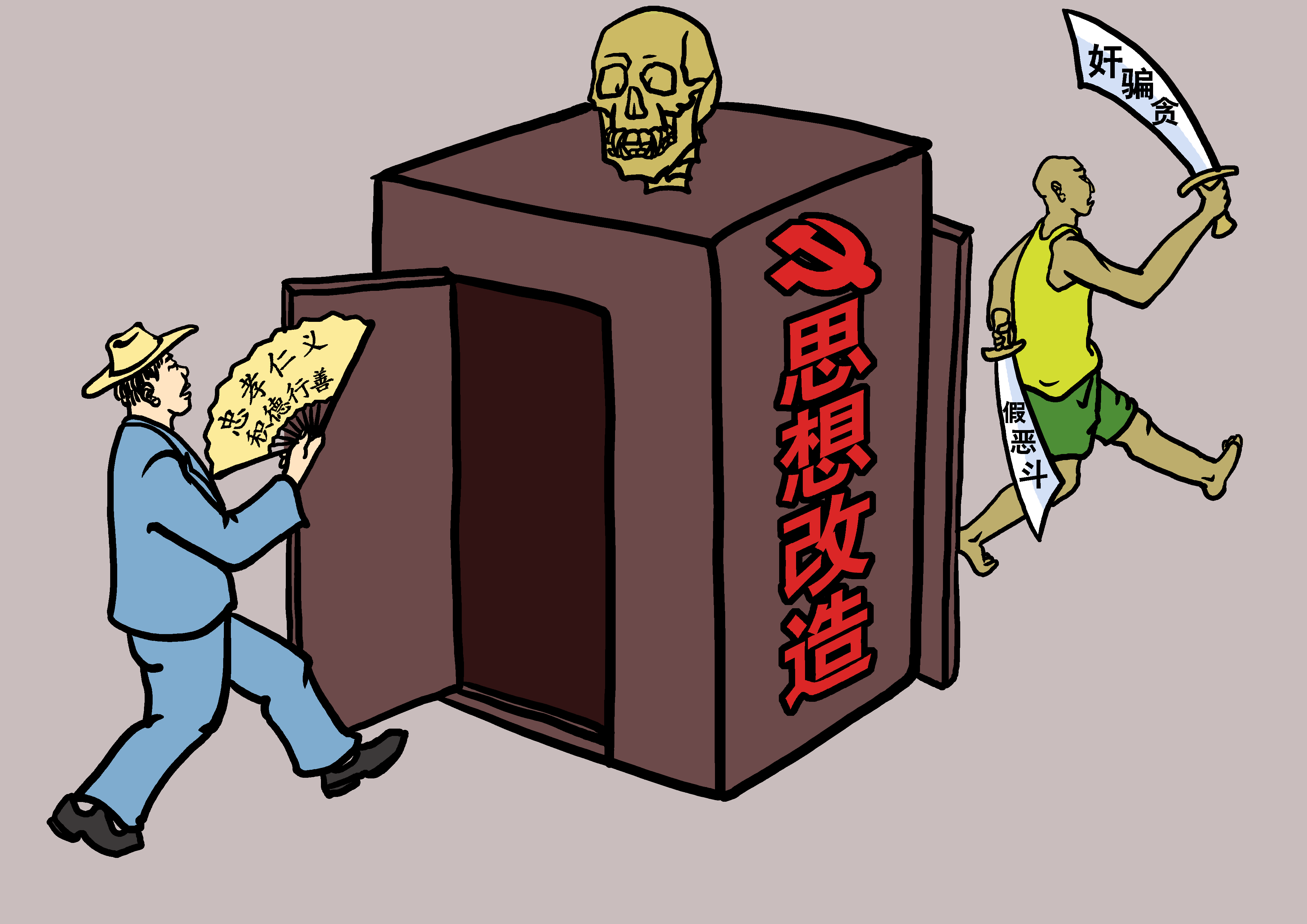
The Communist Party has sought to build a despotism without precedent in history — a dynasty made up of a dictator, his court of grandees, and a circle of followers who share in the spoils. Their aim is to entrench the interests of their own privileged class; what they seek to safeguard is their own hold on power, their economic monopoly, and their monopoly over thought. What they falsely claim is that the interests of society and their own interests are one and the same, that the interests of the Party and the interests of the people are one and the same, that public interest and private interest are one and the same. They have stolen every ideal humanity has ever aspired to — democracy, freedom, equality, fraternity. They have deceived the broad masses and the conscience of humankind; posing as sorcerers, they have monopolized truth itself, using base and shameless means to conceal their filthy, selfish aims.
Over the long ages, humanity has passed through dark times and, step by step, fought its way to a measure of light. The Communists have exploited this human striving toward the light, using their most cunning and shameless deceptions to trap a portion of humanity once again in their clutches. This is a calamity that the forward march of history has run into; it is humanity's sorrow.
And yet the false cannot become the true; deception is eventually exposed for what it is, and an age belonging to human beings will in the end drive out the devil. Had it not been for the Communist Party's extreme despotism, people might never have come to prize as they should the freedom, equality, and democracy that untold millions paid for in blood.
Already, nearly a billion people in the world live under extreme despotic rule; two-thirds of the world's population has never experienced the cruelty of Communist rule. Those who have already suffered under it know its pain intimately — my account cannot convey even one ten-thousandth of their suffering. Those who have never suffered under it may think my account exaggerated. I am sorry that I cannot fully convey the suffering of those in pain; I grieve that I cannot awaken those who merely look on from the sidelines to take the greatest possible care for their own fate. If this red tide continues to spread, it will be a calamity for the whole of humanity. If those who suffer keep resisting, and those who have not yet been tormented plan ahead in time, this red tide could yet be wiped from the face of the earth. Which way shall it go? The choice is ours.
The Communist Party did not devour people all at once — it evolved gradually. Under Marx's pen, communism, however extreme its rhetoric and brutal its methods, still contained an element of idealism. By the time it reached Lenin's hands, there was still revolutionary theory joined to revolutionary practice, though ends and means had already become confused with one another. By the time it reached Stalin's hands, revolution had become a mere pretext, and dictatorship itself had become the goal; to achieve that goal, no means was too low, and the depths of baseness employed exceeded anyone's imagination. The rulers of today's Communist-controlled states are all disciples of Stalin's disciples; their intoxication with dictatorship, their concern only for the privileged interests of the few, and the base methods they employ not only gather together the worst of all the ancient tyrants but carry it to an extreme. The cruelty involved is beyond imagining. In other words, modern communism, from the theory of its founder to the deeds of its executors, has carried an element of evil within it from the start — and that evil has only grown and expanded the further it has developed, its cruelty compounding to a degree that truly extinguishes human nature.
The Communist Party's conduct is immoral, base, and cruel — and yet it also steals the vocabulary of morality, making great show of a so-called ‘Communist morality.’ Engels wrote in Anti-Dühring: ‘Thus far, every theory of morality has, in the final analysis, been the product of the economic conditions of its time.’ He also wrote: ‘If each of the three classes of modern society — the feudal aristocracy, the bourgeoisie, and the proletariat — has its own special morality, we can only conclude that people, consciously or unconsciously, derive their moral views ultimately from the practical relations underlying their class position — that is, from the economic relations in which they produce and exchange.’ This is to say that every ruling class has its own moral standard. As the Communists see it, the morality of the feudal aristocracy and the bourgeoisie is characterized by individualism, the opposition between the individual and society, and self-interest. Lenin said: ‘Bourgeois society is built on the principle that either you plunder others or others plunder you; either you work for others or others work for you; you are either a slave-owner or a slave. Clearly, anyone raised by this kind of society absorbs, from the time he is nursing at the breast, a certain mentality, habit, and outlook — that one must be either a slave-owner or a slave, or else a petty proprietor, a petty clerk, a petty official, an intellectual — in short, a person who cares only for himself and gives no thought to others.’ [1]
The Communists say: ‘Conspiracy and bribery, slander and betrayal, flattery toward the strong men of the age, the merciless destruction of the “weak” in pursuit of one's own personal happiness, mutual distrust and hatred among people scrambling after profit and desire — all these characteristics of the bourgeoisie have destroyed human nature and grafted onto it a bestial quality.’ [2]
A spokesman for the Soviet Union, the ‘homeland of communism,’ said: ‘Communist morality encompasses all the moral qualities, standards, and principles cultivated by the working class and the Communist Party in the course of revolutionary struggle. It reflects the social relations of production formed within Soviet socialist society, and reflects our future — the worldwide victory of communism. Soviet patriotism, Soviet national pride, the spirit of proletarian internationalism and fraternity among nations, a Communist attitude toward labor and public property, socialist humanism, and socialist family relations — these are the basic principles and standards that make up the content of Communist morality.’ [3]
The Chinese Communist Party is a copy of Moscow, following Moscow's guidance in everything. To begin with, it proclaims itself a disciple of Marxism-Leninism, and its writings on morality are copied straight from the Soviet Union, forming the basis on which it trains Party members and educates the people. The constitution adopted in 1954 proclaimed the moral principles and standards of the ‘Five Loves’ — ‘love the motherland, love the people, love science, love labor, love public property.’ The Chinese Communists say: ‘Under capitalism, ugly moral traits such as selfishness, deception, hypocrisy, insatiable greed, and opportunism, and benefiting oneself at others' expense, have only been further developed.’ By contrast, they say: ‘The whole content of Communist morality is imbued with the spirit of collectivism. The cause of communism is a great collective cause.’ What is the principle of collectivism? They say: ‘The principle of collectivism is that collective interest stands above individual interest. Individual interest must be subordinated to collective interest, and when the two come into conflict, individual interest must be sacrificed in favor of collective interest.’ Moreover, ‘the working class's collectivism is expressed first of all in loyalty to one's own class.’ Second, ‘the collectivist spirit of the working class, expressed in relation to the state, is a lofty patriotism; expressed in relation to the individual and to progressive humanity worldwide, it is a sincere and noble internationalism.’
What ‘virtues’ does the Communists' collectivism embody? They say: first, it is expressed in noble qualities such as true courage and heroism. Second, it is expressed in conscious discipline. Third, it is expressed in selflessness and treating others as equals. Finally, it is expressed in harmonious family relations. Liu Shaoqi said: ‘To sacrifice oneself — even to sacrifice one's own life — for the cause of the Party, the class, national liberation, and the liberation of humanity, without the slightest hesitation, indeed with a feeling of joy — this is the highest expression of Communist morality, the highest expression of a Party member's principled character, the purest expression of proletarian consciousness.’ [4]
As for communism's view of labor, they say: any labor beneficial to society is worthy of the highest respect, and Communist labor is collective labor, marked by a high degree of discipline, creativity, and a spirit of thrift and diligence.
On public property, Kalinin said: ‘I believe Communist society is the society in history that most cherishes property. This is only natural, for it is only in Communist society that the power to allocate and to consume the means of production rests in the hands of the producers themselves.’
The Communists also speak of socialist humanism. They say: ‘Socialist humanism is not love for humanity “in general,” but love for the laborer, for those who struggle for the victory of communism — and at the same time it demands hatred for the oppressors, hatred for all enemies of the people.’
They say: ‘Socialist humanism requires that mutual concern, care, loyalty, and sincerity by which people are rescued from undeserved suffering, bullying, and humiliation.’ But ‘socialist humanism first of all requires Bolshevik criticism; without criticism we cannot advance, and without criticism we cannot cultivate the precious talent needed to build communism.’ [5]
Since the Communist Party claims to be the most moral of parties, its members must, as Stalin put it, be ‘people of a special character. We Communists are made of special material.’ To be a Communist Party member, one must first possess a high degree of ideological consciousness and purposefulness, and must be resolute in action, firm in one's convictions and line of action, and boundlessly loyal to the Party and the people. One must be highly vigilant, and must never separate oneself from the masses. One must be modest, never boasting of one's own accomplishments. In criticism and self-criticism, one must maintain the correct attitude, harbor deep feeling, and be loyal and honest. One must possess a spirit of utter fearlessness and a high degree of discipline. Conscious discipline means: ‘unconditionally carrying out the Party's resolutions, strictly observing the Party constitution, carefully guarding the secrets of the Party and the state, faithfully and sincerely fulfilling the tasks entrusted by the Party, serving as a model among all working people in struggle and labor, and making oneself an example of moral conduct worthy of emulation.’ [6]
I set out originally to write about the lies of the Communist Party, and in the course of it I have simply copied out these several passages. If you were to lose yourself in the Communists' own words, you might really believe you had entered a heavenly kingdom, arrived at some paradise of true morality, and met a ‘wondrous immortal.’ In fact it is all empty talk. Strip away the pretense and you find that it only confirms, in the Communists' own words, exactly the lie I originally set out to expose.
That said, we must acknowledge that in the midst of social darkness, thoughtful people will always try to find a way out of that darkness. Though I do not agree with Marx's theories, I would still count him among such people. We must also acknowledge that within a dark society there will naturally be idealists who devote themselves — even give their lives — to their ideals. Like other ‘ism’ movements, the Communist movement, at its outset, always attracted a number of idealists who threw their energy into it, only to be left disillusioned in the end.
Let us also approach the question from a materialist point of view: the Communist movement did not arise out of thin air — it has a material basis. Although communism may be one thing in the minds of idealists and quite another in the hands of the ambitious, it nonetheless reflects the political darkness of a particular class in a particular country. Among the Communists, the idealists were outraged by this darkness, while the ambitious exploited that same darkness to launch their movement. At such moments, it is very difficult to distinguish the idealist from the opportunist.
Wherever communism begins, it always presents itself, at first, as the symbol of an idealistic aspiration. It draws in men and women of conscience, intellectuals, and pure-hearted young people, and it forms alliances with various social parties and organizations for mutual support. The men of conscience and pure-hearted youth who join the Communist Party do so in the struggle for an ideal; in that struggle there is also blood, tears, and genuine feeling. Even the scoundrels and their factions who use communism merely as a banner for their own advancement mingle, during the period of struggle, with those idealists, displaying a certain degree of ‘comradely affection’ and solidarity. But the outcome is always the same: the idealists end in failure and disillusionment, while the scoundrels succeed and grow complacent. The moral doctrines originally conceived out of idealism become tools by which the scoundrels enslave the people and the rank-and-file Party members — an iron hammer for smashing human morality. And these doctrines are further amended and reinterpreted according to the whims of whoever happens to be the ‘strongman of the age.’
The Chinese Communist movement is one link in the chain of international communism, and its success in China has its own background in the times, which I have already described in Chapter One; its true nature I have already exposed in Chapter Three. But the false face of its ruling doctrine — this whole apparatus of morality copied from the Soviet Union — could only be unmasked in this chapter.
Every ruling class has its own doctrine for ruling the people, a doctrine that runs through not only law and decree but the very fabric of social life. In the years since the Communist Party took control of the Chinese mainland, it has worked hard to enforce this doctrine, demanding that it serve the interests of the privileged class. Its mouth is full of words like ‘the people,’ ‘socialism,’ ‘the great motherland,’ ‘the working class’ — but in reality, all these terms stand for nothing but themselves. So-called ‘patriotism’ means loving the privileged class; when war comes, the people are told to fight for them because they represent the motherland. So-called ‘patriotism combined with the spirit of internationalism’ means not only loving the ruling clique but also loving their master, the Soviet Union. So-called ‘equality among nationalities’ means making every ethnic group bow before them. So-called ‘valuing labor’ means endless exploitation and extraction, even deepened through devices like electing ‘labor models’ and organizing labor competitions. So-called ‘cherishing public property’ means the people are forbidden to touch so much as a blade of grass or a twig belonging to the state, which is left instead for the rulers themselves to squander extravagantly. So-called ‘love of science’ means brainwashing — rote memorization of the Marxist-Leninist classics, said to contain all truth. So-called ‘collectivism’ means forcing the individual to make every conceivable sacrifice, unconditionally, for the privileged class. So-called ‘a high degree of discipline’ means treating people as machines that move when a button is pushed and are forbidden to move otherwise. So-called ‘socialist humanism’ means allowing the Communists to kill people as they please, because their ‘humanism’ consists of ‘hatred for all enemies of the people.’ So-called ‘the noble character of a Party member’ means training, within their own ranks, a corps of lackeys of intense loyalty to the Party, sharp and capable, patrolling everywhere, blindly serving their superiors. So-called ‘criticism and self-criticism’ means routinely forcing the people and Party members to confess, so as to have grounds for imprisonment and denunciation. And so on. As for Stalin's claim that ‘we are made of special material’ — in reality, there is no such thing as human beings made of special material. If the Communists insist there is, then I say: whatever kind of person is made of that ‘special material’ must be the dregs of humanity.
The Communist Party's theoretical dogma and moral principles may, at first glance, seem like an impressive body of writing, and have indeed deceived some people — one type being the doctrinaire theorist, the other the blind follower. The former is intoxicated by his own fantasies, deceived by the dogma; the latter is a pure opportunist, cowed by the dogma. Beyond these, there are the ambitious scoundrels who use the banner of communism to spread rumors and swindle. Stalin was the archetypal swindler and executioner, posing as a great teacher while spouting utter nonsense. Mao Zedong, too, was a man of half-baked learning who copied a few of Stalin's phrases and passed himself off as a sage — truly a poisonous plaster that harms whoever it touches.
If we read these texts uncritically, without connecting them to reality, we might well be intimidated by the Communists' professed morality. It would be no surprise at all if a working class that had never yet come to power, never yet held office, held to some such moral outlook and standard of self-discipline. But today, the Communist Party can no longer claim to represent the working class at all — it is merely a small clique lording it over everyone, styling itself sovereign — and for it to list out these moral principles while acting in a manner diametrically opposed to them is bizarre and absurd in the extreme. In truth, when we witness moving, praiseworthy acts — loving one's country and fighting for it; stepping forward courageously to save others at the cost of one's own life; putting the public good above private interest, even sacrificing oneself for a righteous cause — the moral background of such acts is not a product of communism at all, but an inheritance from this society, this nation, this people. Such virtues are simply appropriated and misrepresented as concrete expressions of ‘Communist morality.’ Even if the person who displays such conduct happens to be a Party member, the credit belongs not to communism or the Communist Party, but to the fine national tradition that has not yet been entirely wiped out.
By any moral standard, the Communist Party has never, from the very outset, been able to establish a morality of its own. Whatever stirring episodes occurred in the early days of the revolution were themselves reflections of national morality — not something the Communist Party created, but the fine traditions of the nation shining through, for a fleeting moment, in the revolutionary acts of people fighting for freedom. The Communist Party never built a new morality, and its paper proclamations of morality bear no relation to reality. Strip away the pretense, and the Communist Party stands revealed as a master of destroying national morality — for even the moral doctrine it uses to rule the people and its own members, in service of its privileged class, would already be a considerable calamity for the people if actually practiced. Instead, the Party has abandoned even its own stated moral standards entirely, acting with reckless abandon, doing everything in its power to destroy morality.
In the lie that is Communist collectivism, they say: only Party spirit matters, not human nature — human nature is a product of individualism, whereas Party spirit is the full expression of collectivism. They also say: an individual is of no importance in himself; only through the Party, through society, does he become important. This is a theory stolen from the doctrine of society as an organism, and applying it to human society is already a cruel theory — but in the hands of the Communist Party it becomes the justification for boundless cruelty.
If the individual is unimportant and only society matters; if the individual has no human nature and only Party spirit matters — this is a theory devised to fool ghosts. In the name of Party spirit, an individual's human nature is turned into bestiality. Everything the Communists accuse the bourgeoisie of, quoted above, applies with equal force to themselves. The Communist habit and outlook is precisely ‘either be a slave or be a slave-owner.’ The Communists themselves practice ‘conspiracy, slander, betrayal, flattery toward the strongmen of the age, the merciless destruction of the “weak” in pursuit of personal happiness, mutual distrust and hatred among those scrambling after profit and desire’ — all these characteristics of Communist morality destroy human nature and graft onto it a bestial quality.
The Communist Party's destruction of human dignity has been carried to a degree of cruelty beyond compare. Under its merciless attacks and suppression, people have been turned into shameless animals. In the ten great campaigns described above, the reader will see that it was not only those the Communist Party judged deserving of punishment whose life and death lay entirely at its mercy — even people entirely innocent under the Party's own laws and policies were tormented within an inch of their lives. The Communists have a common expression: forcing someone to ‘take off their pants,’ meaning to make you confess, before the assembled public, every detail of your private life, without reservation or privacy, to curse yourself and your ancestors for three generations back, leaving you not a shred of human dignity — reducing you to a shameless, lower animal. If you refuse to ‘take off your pants,’ the Party and the masses it mobilizes will bring irresistible pressure to bear on you, tormenting a person until body and soul alike are shattered. Living under such conditions, can anyone remain a person of dignity and self-respect? Both the persecutor and the persecuted are turned into beasts. And if someone refuses to bow, choosing death instead to preserve their personal honor and dignity, the Communist Party's law and morality still condemn them as a counterrevolutionary — because in dying, they resisted the revolution through their death.
Beyond using every manner of cruel method to destroy the individual's personhood, the Communist Party has also exploited its monopoly over the economy — its monopoly over every means of livelihood — to exploit people's basest survival instinct. A person cannot live without eating, and one's rice bowl lies entirely in the hands of the Communist Party. If a person does not submit meekly, the Party will deny him employment, deny him any means of livelihood — in effect, deny him food. If he wants to go on living, he must be deferential toward the Party and obey its every command. This is the cruelest method of all for subduing people. A courageous few might refuse to eat the Party's food and die rather than submit; but most people inevitably have no choice but to eat and survive. And of course, this food is not the fruit of the Party's own labor at all — it is seized from the labor of the broad masses and claimed as the Party's own, then used as a powerful weapon for controlling them.
Having destroyed people's personal dignity, and controlling individual life through economic means, the Communist Party leaves a person only one choice: servile submission, or death and resistance. During the times when Communist rule was at its most powerful, there were certainly people who chose death or resistance — those who died passed away like flowing water, while resistance kept rising and being crushed, again and again. But within a given period, throughout society, from inside the Party to outside it, a state of servile, ignoble survival took hold. As a result, those in power grew ever more arrogant, surrounded by flatterers, while the people living under their rule trembled in constant insecurity. Some have said that the way of life for people under Communist rule is one of perpetual insecurity — and this is entirely true. It illustrates both the collapse of morality and the Communist Party's cruel inhumanity.
The Communist Party itself is thoroughly self-interested, even as its leaders demand that Party members be utterly selfless, and demand still more that the people put the public good entirely above private interest. This amounts to a philosophy in which ‘everyone exists for me,’ while ‘I exist for no one’ — how could leadership of this kind fail to sink into an abyss of degeneracy and corruption?
The Communist leaders preach Communist dogma with their mouths — a lofty, high-minded doctrine — yet what they actually practice, close at hand, is naked self-interest. They themselves commit endless acts of injustice, while demanding boundless loyalty from cadres and people alike. The methods they use are the heavy club of Party discipline and state law, and the iron hammer of economic extraction. What people obey is not reason but raw power. And so, at the top, a clique of high-ranking leaders colludes for mutual benefit and does exactly as it pleases; below, a great mass of lower cadres presses down on the people, carrying out orders from above while venting their own pent-up frustrations. Party leaders do not regard their subordinate cadres as comrades but as subordinates to a superior; nor do subordinate cadres feel any comradely affection for their superiors — they merely wait upon them. Though the Party, in its rhetoric, claims to work on the people's behalf and calls itself the people's representative, in reality it treats the people as an enemy to be carefully guarded against, forcefully suppressed, and deceived by every possible means.
The Party recognizes no right or wrong — reward and punishment are decided purely by the likes and dislikes of whoever is the ‘strongman of the age.’ The Party is rigidly stratified: rank above others is not only an honor but a wellspring of every kind of benefit. The Party has no use for people of integrity and true ability; what it wants are lackeys who scurry about doing its bidding. And so, on one side of the Party stands arrogant, extravagant, corrupt indulgence; on the other, naked self-interest, currying favor with the powerful, and flattering one's way to advancement. Moral degeneration has already taken root within the Party, and the sorrow this self-serving privileged class inflicts on the people is the destruction of human dignity.
What the Communist Party wants from the people is not men and women of will and dignity, but machines without will or soul, lackeys without any sense of morality. Such people are easier to rule, easier to exploit at will, with no need to guard against them from any direction. Harboring this vile intent, the Communist Party has used every base method imaginable to destroy the people's personal dignity — the goal, in a word, being the destruction of personhood itself. In their own words: only Party spirit matters, not human nature. In the eight or nine years since the Communist Party took control of the mainland, through its decrees, its brutal rule, and an endless succession of campaigns great and small, the entire population living on the mainland has been transformed beyond recognition. In sum, everyone now wears a mask. The overwhelming majority, having been tormented and abused by the Communist Party, have put on masks for self-protection, pretending to support the Party and to be enthusiastic about the socialist cause; young and old, men and women alike, mouth the same set of stock Communist phrases. They have hidden their true feelings, their true selves, and under this reign of terror and tyranny have learned hypocrisy from the Communist Party itself. A smaller number of people who have drawn closer to the Party — some having simply lost their way and blindly followed along — have learned naked self-interest, currying favor with the powerful, and flattery. They too wear masks, masks worn to please the Communist leadership. Among them, too, are some who have not entirely lost their true feelings and true selves, who carry a hidden sorrow deep within.
Under Communist rule, a person cannot stand tall beneath the open sky as a being of dignity — he can only be a machine without will, feeling, or soul, or else a lackey attached to the ruler. Whatever one truly feels inside, on the surface one is forced to choose one of these two roles, or both together. The Communist Party compels people to behave this way, and people, in order to survive and protect themselves, have no choice but to comply. This is what reveals both the cruelty of the regime and the collapse of morality.
The Communist Party's whole apparatus of deception exists to preserve the power of its privileged class; and the bloody cruelty it has produced has destroyed human dignity and brought about a wholesale collapse of morality. This is the sorrow of humankind!