
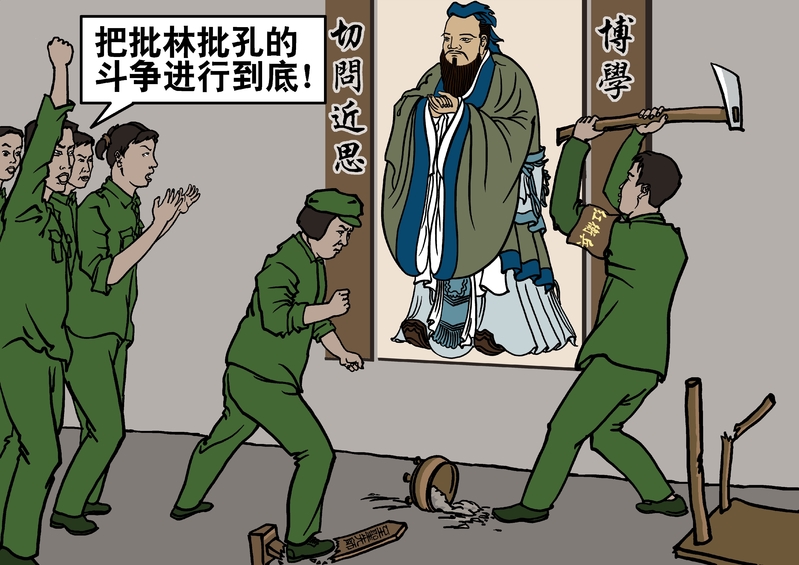
Every nation has its own traditions. But humanity, from primitive times to the present, has continually advanced, and in that process of advancement, traditions that no longer suit the new environment are cast aside and replaced with new content. However much the times move forward, human society remains, in the end, a human society, and human beings remain, in the end, distinct from other animals; and so customs and moral standards that suit human nature and benefit social life have been passed down through the generations. Having been refined and tested over long ages, handed down from one generation to the next, they have consistently been regarded as precious national heritage.
There will, of course, never be a moral standard that remains eternally unchanged — it will grow or diminish according to the times and the social system. But noble qualities such as courage, purity, selflessness, and integrity must take root in the individual person, dissolved into his very body and spirit; only then can a moral standard have any real effect. Let us take ‘loyalty’ as a moral standard and analyze it. In feudal times, loyalty meant loyalty to the king; subjects owed loyalty to the emperor, who at that time represented the state, so that being loyal could also be called serving the country. In modern times, the state belongs to the people, and loyalty means loyalty to the state; when the people are loyal to the state, they are fulfilling the duty the people owe. As for the Communist Party, it claims to represent the working class, and the state is a state under the dictatorship of the working class — so, by its logic, loyalty means loyalty to the working class. But whatever the moral standard, in any age — feudal, modern, or Communist — if the noble qualities are stripped out of a person's essential character, then the moral standard is empty and hollow. Just as a mean, calculating opportunist would never have made a loyal minister or filial son in feudal times, nor a hero who sacrifices himself for his country in a modern capitalist nation, so too, under Communism, such a person would never be a Party member or cadre truly loyal to his own class. This shows how important a person's essential character is. And how is that essential character formed? It depends on education — the education given by parents, by society, by national tradition, and by real-life experience.
The Communist Party places great emphasis on educating the people, and it commands a vast propaganda apparatus — yet this education has failed. The main reason is not that people refuse to believe its doctrine because it is heretical, but that everything it preaches about ‘benevolence, righteousness, and morality’ turns out, in practice, to be betrayal, faithlessness, and merciless cruelty. Outwardly it plays the gentleman; in substance it is a scoundrel. And so those who submit do so only in appearance, never in their hearts. Though the people under its rule may shout ‘Long live Chairman Mao’ with their mouths, in their hearts they hope only that the Communist Party will soon fall and Mao Zedong will soon die.
Why has the Communist Party, for all the emphasis it places on education, failed so badly? It is not for lack of effort in propaganda and education, nor for any shortage of schools, newspapers, or books. The real reason is that the education of real life has awakened the people to the fact that what the Communist Party preaches and what it does are two entirely different things — that it is deceiving them. To give some examples: the Communist Party says ‘the state belongs to the people,’ but in reality the state belongs to the Communist Party itself, and indeed to a small handful of its top leaders; the Communist Party speaks of ‘the people's interest,’ but in reality that interest belongs to the Party and its highest leaders; the Communist Party speaks of ‘democracy and freedom,’ but in reality this means dictatorship oppressing the people; the Communist Party speaks of ‘loyalty,’ but in reality this means deception, luring the honestly loyal into a trap; the Communist Party speaks of ‘distinguishing right from wrong,’ but in reality this means framing and persecuting people; the Communist Party speaks of ‘a harmonious family,’ but in reality this means tearing husbands from wives and children from parents, turning them into enemies of one another; the Communist Party speaks of ‘equality between men and women,’ but in reality this means toying with women or extracting their labor; the Communist Party speaks of ‘promoting democracy,’ but in reality this means ferreting out anyone who has criticism of the Party in order to punish them; the Communist Party speaks of ‘the people's duty,’ but in reality this means teaching individuals to spy on one another and treat one another as enemies; the ‘activists’ the Communist Party makes use of today may become its targets of attack tomorrow — the Communist Party may call you comrade today and arrest and punish you as a Rightist tomorrow; whatever the Communist Party says, in reality the opposite tends to be true. I could go on listing many more examples of this kind. But I say in all fairness that this is not a distortion of the facts, nor something I have fabricated — this is simply how it behaves, in one act after another. Almost anyone who has lived under its rule can rattle off a long list of such contradictions between its words and its deeds. To the outside world this is news; to the Chinese people living under Communist oppression, it is simply everyday life, something everyone knows all too well.
The people have come to understand the Communist Party's words and deeds through the experience of real life. Its writings on paper and its verbal sermons have become worthless; what actually educates the people is what it does. And what does that real education consist of? Running through its rule and its various campaigns are: merciless cruelty; abandoning righteousness for profit; open flattery paired with hidden treachery; benefiting oneself at others' expense; repaying kindness with hatred; betraying friends for personal advancement; acting against Heaven and reason; utter shamelessness; debauchery of every kind; breaking faith and abandoning loyalty; estrangement between father and son; discord between husband and wife; arrogance from above met with sycophancy from below; no distinction between black and white; no clarity between right and wrong; the way of the gentleman receding while the way of the petty man advances; justice suppressed while a corrupt atmosphere runs rampant; no respect shown to teachers; no harmony among neighbors; forming cliques for private gain; colluding in wrongdoing; using public office for private ends; showing no regard for human life; craving grandiose achievement; and hollow insincerity — and so on. In the more than nine years the Communist Party has ruled the Chinese mainland, this is the real content of the education it has given the people, and I list these terms not out of deliberate fabrication but because each one is grounded in fact. And by ‘grounded in fact,’ I do not mean isolated, occasional incidents — I mean that these are general, widespread phenomena. The Communist Party's fig leaf for concealing these crimes is the slogan ‘everything for the revolution,’ ‘everything for the Communist Party.’
Everything I have described above is grounded in concrete fact, and anyone who has lived on the mainland and suffered under this treatment will understand it at a glance. But for the benefit of those outside who have never suffered under Communist torment, a little further explanation is needed. The Communist Party's method of rule is to demand your loyalty to itself alone, never teaching you to be loyal to any other person; every individual is kept isolated, and the Party uses every conceivable method to keep people isolated from and watchful of one another. For instance, to use person A to harm person B, its method is either to offer A some small benefit — turning him into an ‘activist’ — or to instill fear in A, so that by exposing someone else he might spare himself. This kind of enticement and intimidation was used between friends, between father and son, between brothers, between husband and wife, between teacher and student, between superior and subordinate. On the whole, the element of enticement was small, while the element of intimidation was large. Everyone lived in an environment of fear where survival itself was uncertain, and everyone developed the selfish, self-interested impulses of a lower animal — and the Communist Party did everything in its power to help people fulfill that very impulse. For example, during the land reform movement, there were many cases in which sons were made to beat or kill their own fathers. Beating or killing one's father was never a son's own wish — the Communist Party instructed or hinted that if you beat or killed your father, your own guilt would be reduced; otherwise, you would suffer the same fate and die alongside him. And indeed, many sons did beat or kill their fathers, not out of any sense of ‘putting righteousness above family ties,’ but purely in an effort to save themselves. Other cases — ordering a wife to beat her husband, or a husband to kill his wife (as in one land reform case where a husband was ordered to kick to death his wife, who was seven or eight months pregnant), brothers beating brothers, friends framing friends — such cases were everywhere. Their motive, too, was mostly to follow the Communist Party's instructions or hints in order to save themselves; all of this occurred in an environment of extreme terror, where people were forced to bring out the basest instincts of lower animals. Even the ordinary mutual denunciations and criticisms that occurred during campaigns were driven mostly by a desire to claim credit or to escape blame. The Communist Party used these methods to tighten and consolidate its cruel rule.
But these facts and examples point to a serious problem: the collapse of morality, the destruction of the nation's fine moral tradition. The Communist Party is truly the culprit responsible for this destruction.
The nation's fine moral tradition comes down to us from a long history, passed on after having endured trial after trial. Compare it to a physical object: it must be cherished and protected in order to continue being handed down. The Communist Party, as if a being fallen from beyond the heavens, made of some ‘special material’ not of this nation, smashed to pieces, the moment it took power, the precious heritage bequeathed by the ancestors of the Chinese people. And what did the Communists themselves bring? They came empty-handed; the slogans plastered on the walls are nothing but a device to deceive people — even though these moral writings, too, passed through the minds of literate men, they have never been tested in real life, and at most amount to nothing more than words on paper.
China's fine moral tradition was forged over countless generations, tempered by long trial, and remains to this day a genuine spiritual virtue. As for this fine national tradition, the Communist Party calls it a product of the feudal system. In truth, feudalism, capitalism, and communism are none of them capable of containing it within their own bounds. We need not debate what constitutes eternal truth or an unchanging moral standard, but a nation's fine tradition cannot be bounded by any single era or any single ideology, nor severed all at once. As long as human beings continue to exist within this society, that tradition lives and breathes together with them; though the Communist Party has destroyed this fine tradition, the tradition itself has not, for that reason, died and vanished forever — bearing wounds all over its body, it will surely go on struggling and fighting.
Chinese people place great value on ‘integrity’ (qijie), which serves as a standard for what it means to be a person. The loyal ministers, filial sons, virtuous widows, and righteous men of old were praised precisely because they lived by this standard. Viewed through today's eyes, their conduct might seem foolish and inflexible, or rigidly stubborn. But the spirit that made them loyal ministers, filial sons, virtuous widows, and righteous men truly shines like a rainbow spanning ten thousand li, like the light of sun and moon, as unyielding as pine and cypress, as boundless as a compassionate cloud or a sea of love. Their conduct was the expression of unwavering will, the truth of personhood, the beauty of the soul. Though each was, in himself, an insignificant person, the moment he displayed such conduct, his light filled the universe, his spirit moved the hearts of others, and his example was handed down to later generations.
Integrity is honored precisely because it cannot be demanded of every single person; even across China's long history, moving and memorable episodes of this kind, though not few, were never so common as to fill cartloads. Precisely for that reason they are all the more precious, held up as the standard for a complete human being. Take, for example, China's national hero Yue Fei, who served his country with utter loyalty, resolutely resisting foreign invasion, and who struggled at home against the treacherous minister Qin Hui, ultimately murdered by that traitor, his great achievements cut short by his own death. And yet the people honored him; later, when an emperor recognized the injustice done to him, he was posthumously enfeoffed as Prince of E and a temple was built in his honor. Though Yue Fei lived under the Song dynasty, he has been honored by the Chinese of every subsequent generation. Or take Wen Tianxiang of the late Song, who, with the heart of a lone loyal minister, rose up against the Yuan dynasty; once captured, he refused to surrender even unto death, writing his ‘Song of Righteousness’ before going to his execution with unshaken resolve. The Yuan dynasty later built a shrine in his honor. The Chinese people revere him, holding him up as a source of national pride.
Yue Fei, Wen Tianxiang, and the historical heroes, great men, and martyrs like them, were able to display such conduct precisely because the nation's fine moral tradition shaped their character in that way; and, in turn, the genuine conduct of these heroes, martyrs, and great men further polished this fine tradition, or added further weight to it.
Consider, too, how highly China values ‘trustworthiness and righteousness’ (xinyi) and ‘a sense of shame and integrity’ (lianchi) — these, too, are standards for being a person. In dealing with others one must have ‘trustworthiness and righteousness’ — trustworthiness meaning keeping one's word, righteousness meaning acting appropriately. In conducting oneself, one must have ‘a sense of shame and integrity’ — integrity (lian) meaning keeping oneself pure and free of greed, shame (chi) meaning a sense of disgrace that spurs one not to do anything one's conscience would condemn.
The Chinese people's regard for ‘trustworthiness and righteousness’ and for ‘shame and integrity’ has repeatedly been borne out across the generations: those who conduct their affairs and their lives by these principles prosper, while those who go against them perish. As the old saying goes: ‘Without trust, the people cannot stand.’ And again: ‘He who repeatedly acts unrighteously will surely bring about his own downfall.’ And again: ‘None who are without shame or integrity have ever escaped ruin.’
China's fine moral tradition matters all the more among the educated class, where there is a maxim: ‘A scholar may be killed, but he may not be humiliated.’ The educated class holds a position of leadership in society, serving as the standard-bearer of social custom. When the morale of scholars collapses and culture declines, it signals the decline and fall of a dynasty; and along with that fall inevitably comes a new dynasty, a new cast of figures, a new atmosphere.
Since coming to power, the Communist Party, in the name of overthrowing feudal consciousness and feudal institutions, has swept away China's fine moral tradition. You speak of integrity — the Communist Party sets out precisely to destroy your character, using enticement, intimidation, humiliation, and every manner of torment to strip you of moral courage and principle, reducing you to a low, soulless animal. You speak of trustworthiness and righteousness — the Communist Party makes you faithless and unrighteous, turns you into a petty man who breaks faith and abandons loyalty. You speak of shame and integrity — the Communist Party makes you filthy beyond description, forcing you to ‘take off your pants’ until you feel no shame at all. You say a scholar may be killed but not humiliated — the Communist Party spits in your face, humiliating you in every conceivable way. In short, it is determined to utterly destroy this fine national tradition, determined to grind an individual's character to pieces.
The Communist Party has done all this, and no small number of people have given up their lives for the sake of justice, integrity, honor, and shame. In ancient times, a person who died protesting tyranny left behind a name that endured through the ages; today, a person who dies protesting tyranny is met with curses and branded a counterrevolutionary. As for the rest, those who did not die — as long as you still wish to go on living, you are bound to suffer torment and humiliation at the Communist Party's hands, and the Party's methods — mass struggle sessions, self-examination, self-reflection, arrest, punishment, exhausting rounds of pressure, cutting off one's livelihood, and so on — are certain to reduce a person to a state where living becomes unbearable and dying is likewise impossible, until his will collapses, his morality degenerates, and he is reduced to a low animal clinging to a wretched existence. The destruction of a person's will, or the destruction of his morality, is the Communist Party's most brutal act of all.
A moral tradition that can withstand the battering of the storm is one that has already weathered storms before, and has been handed down precisely because of that; battered once again, it will still be handed down further. But every storm inevitably leaves it damaged — even as, at the same time, it strengthens its power of resistance. Today, on the Chinese mainland, everyone lives in isolation, everyone is on guard, everyone speaks falsely, no one dares to speak of trust and righteousness, and everyone parrots Communist jargon instead. A father dares not speak from the heart with his son; a husband dares not share private words with his wife; children repeat at school whatever the Communist Party has taught them, only to switch to a different way of speaking once home. In an environment where everyone lives in danger and everyone is on guard, every individual develops a split personality — one on the inside, another on the surface. On the surface lies the bestial conduct the Communist Party has taught; underneath, in the hearts of most people, lies suffering — the fine national moral tradition still fighting its battle there. Under these circumstances, we cannot help but painfully admit that because this corrosive atmosphere has spread so widely and so deeply, it has eaten away at the strength of this fine moral tradition. The China ruled by the Communist Party has become a land of universal falsehood.
But what gives us cause for some optimism is that a fine moral tradition cannot be utterly destroyed — however wounded, it can still fight on. And what gives us confidence, too, is that the Communist Party's own cruelty and inhumanity, its wilful, unrestrained conduct, has already proven itself to be rejected by the people. So we may conclude: though the Communist Party has destroyed personal dignity and trampled on the nation's moral tradition, forcing the conduct of mainland Chinese into moral degradation, the very fact that they speak falsely and wear two faces shows that they have been driven to it by force, adapting to survive, skilled at self-protection. As long as their hearts have not died, and as long as they truly confront what the Communist Party has done, no one's conscience can ever truly die — and hidden in the hearts of the people is a single spark that can, in the end, set the whole prairie ablaze.